Genius Sports (GENI): The Operating System of Modern Sport
Published 25 June 2026 — the full thesis, unchanged.
Why This Takes A Full Read
Most analyses of Genius Sports start and end with the NFL data deal and a comparison to Sportradar. That framing misses at least four distinct businesses operating under one roof, each with different economics and different growth vectors, and misses entirely the strategic thesis that makes this stock interesting.
This piece goes through each revenue line, the cost structure that the market misreads, the college sports deal that I think is underappreciated even by bulls, the advertising platform that is landing Samsung and Publicis and DoorDash as clients, the prediction markets opportunity that's not in guidance, and the financial path to what management expects will be positive GAAP net income in 2027.
This is a speculative position. The debt is real. The integration is early. But the platform they've assembled is more defensible than anything I can find at a comparable growth rate at this valuation.
The Company: 26 Years of Stacking the Deck
Genius Sports didn't arrive fully formed. The current platform is the product of two and a half decades of deliberate capital allocation, each move timed to catch a market transition.
Mark Locke and Steven Holmes founded the company as Betgenius in London in March 2000. The timing was deliberate. Online sports betting was surging in Europe, and sportsbooks needed low-latency, verified match data to power in-play wagering. Betgenius built the pipes: normalized real-time feeds for football and tennis, sold as B2B subscriptions. Not glamorous. Deeply sticky.
For sixteen years, they refined that core business. Then in 2016, Betgenius merged with SportingPulse International, an Australian sports data and software company. SportingPulse brought grassroots sports technology (league management systems, competition platforms) and a presence in markets Betgenius hadn't reached. The merged entity became Genius Sports.
In April 2021, Genius went public on the NYSE via a SPAC merger with dMY Technology Group, raising capital to execute the acquisition strategy that defines the current business.
Three acquisitions in the months after going public tell you everything about what Locke was building:
Second Spectrum ($200M, May 2021) — the official tracking provider of the English Premier League, NBA, and MLS. Second Spectrum, founded in 2013, had pioneered AI-powered computer vision for sports, capturing ball and player position data using in-venue camera arrays. With Second Spectrum, a data distribution company bought the technology layer that generates the data. Second Spectrum became the foundation of GeniusIQ.
FanHub Media (mid-2021) — a fan engagement platform that became the backbone of the FANHub:ID consumer graph, now 250 million profiles.
Spirable (mid-2021) — a personalized video and content platform that fed into the advertising technology stack, eventually becoming part of the Moment Engine.
Then in April 2025, Genius signed the NCAA through 2032. Exclusive official data distribution for March Madness and all championship events, plus free LiveStats technology for 70,000+ games per year across member schools.
In August 2025, a landmark deal with the European Leagues Association: exclusive betting data and GeniusIQ deployment across 18 member leagues and 46 professional competitions — over 8,000 matches annually. Belgian Pro League, Liga Portugal, Eredivisie, Greek Super League, German 3. Liga, and others.
And in May 2026, the Legend acquisition closed at $1.2 billion, the largest gaming affiliate deal ever, bringing Covers.com, Casino.org, Casino Guru, and a 118-million-user intent data platform into the fold.
Every acquisition follows the same logic: buy an asset that makes the existing platform more valuable, not just larger. Second Spectrum made the data proprietary. FanHub made the data addressable. Spirable made it monetizable through advertising. The NCAA and European Leagues expanded the data surface. Legend closed the loop between data generation and customer acquisition. None of it is sprawl; each piece compounds the value of every other piece.
The Management Team
Mark Locke has been CEO since founding the company in 2000. Twenty-six years at the helm of a business he built from a two-person shop to a $1B revenue platform. That kind of founder continuity is rare. The strategic vision is consistent, not inherited.
The leadership team Locke has assembled reflects the platform's ambitions:
Nick Maywald (Chief Commercial Officer) — founder of SportingPulse, who came in with the 2016 merger. He runs the commercial relationships across 500+ sportsbook customers and 400+ league and team partners.
Tony Marlow (CMO, appointed April 2026) — former CMO of LG Ad Solutions and Integral Ad Science, with eight years leading B2B marketing at Yahoo. This is a hiring signal. You bring in a senior advertising industry executive when you're scaling an advertising product, not just a sports data business. Marlow's job is to position the Moment Engine as a serious ad-tech product in the eyes of agencies and brands.
Steven Burton (COO), Tom Russell (Chief Legal Officer), Jack Davison (Chief Commercial Officer) round out the C-suite with institutional knowledge of the regulatory environments Genius operates in — not trivial when your business touches gambling regulation in dozens of jurisdictions.
The pattern I see in the leadership is a team built for the current transition: from a sports data company to a sports data, media, and advertising platform. The Marlow hire in particular is forward-looking. You don't recruit from LG Ad Solutions and IAS if you're content staying in the data feed business.
The Business: Four Revenue Lines, One Platform
Genius reports two segments — Betting and Media — but the underlying revenue streams are more granular. Here's how I think about the actual businesses:
1. Official Data Distribution (Betting Segment — Core)
This is the original business and still the largest revenue driver. Genius holds exclusive official data distribution rights from a portfolio of major leagues and distributes real-time, official game data to licensed sportsbooks globally. The data is what enables live in-game betting. Without it, books are guessing or working from slower unofficial feeds.
The customer base reads like a directory of the US sports betting industry. DraftKings, FanDuel, Caesars, BetMGM, Entain, Hard Rock Digital, WynnBET, PointsBet, Penn Interactive (Barstool Sportsbook), 888 (SI Sportsbook), Golden Nugget Online Gaming — all are confirmed Genius customers for NFL data products alone. Expand beyond the NFL into global sportsbooks and the total is approximately 500 licensed operators across regulated markets worldwide.
The key metrics: ~500 licensed sportsbook customers across regulated markets globally. Net revenue retention of 120-130% year after year. More than 50% of revenue generated outside the United States. Q1 2026 Betting segment revenue: +33% YoY.
That NRR number is exceptional. 120-130% means that even without winning a single new customer, the existing base is expanding its spend by 20-30% annually. This happens through selling additional content at each renewal, winning new geographies within existing relationships, and sharing in handle growth as sports betting matures in each market. To put that in perspective: FanDuel holds 44% of US gross gaming revenue, DraftKings holds 34%, BetMGM holds 14%. Genius supplies data infrastructure to all of them. When the US sports betting market grows, and it's still expanding into new states, Genius's revenue grows with it mechanically through these contracts.
The business is deliberately built for predictability. Contracts are structured to insulate Genius from hold volatility: swings in how much sportsbooks keep don't translate into revenue swings for Genius. In the Q1 2026 call, Locke put it plainly: "We have proven this through periods of industry-wide pressure."
The geographic mix is a structural advantage. When US betting slows, Europe and Latin America carry the growth. One market in regulatory transition gets absorbed by diversification. More than half of revenue comes from outside the US. This is a global infrastructure business, not an American sports betting play.
| Period | Revenue | YoY Growth |
|---|---|---|
| FY2024 | $354.9M | +29% |
| FY2025 est. | ~$455M | ~+28% |
| Q1 2026 | ~$125M (est.) | +33% |
2. Official Data at the League Level: The NCAA and European Moats
The betting data business gets the headlines, but the most underappreciated assets in the portfolio are the league-level exclusives.
NCAA (through 2032): In April 2025, the NCAA expanded its partnership with Genius to include exclusive official data distribution for March Madness and all championship events. For the first time, the NCAA authorized sportsbooks to receive official data from its championship tournaments. Genius also provides NCAA LiveStats free to all member schools: real-time data for over 70,000 games per year.
Why give away technology? Because every game processed through GeniusIQ improves the model. 70,000 games per year is a proprietary training set of enormous scale. The more diverse the game contexts, the more accurate the predictions, the stickier the product to sportsbooks. And when those colleges want GeniusIQ for coaching analytics, officiating support, or fan engagement, Genius is already installed. The relationship was built for free. The upsell is available for a fee.
European Leagues (August 2025): Exclusive betting data and GeniusIQ deployment across 18 member leagues of the European Leagues Association: 46 professional competitions, 8,000+ matches annually. The Belgian Pro League, Liga Portugal, Eredivisie, and others now run on GeniusIQ infrastructure. This deal didn't just add data rights. It planted GeniusIQ cameras in stadiums across a continent.
NFL (through 2030): The original $120M deal from 2021 has been extended twice, now running through the 2030 season. Genius is the exclusive distributor of Next Gen Stats data and the official NFL sports betting feed. Thirty cameras per stadium capturing 10,000+ surface data points per player multiple times per second.
Premier League: Genius supplies the Semi-Automated Offside Technology (SAOT) for the EPL, the technology that makes the offside calls you see on broadcasts. This came through the Second Spectrum acquisition.
Liga MX (2026): A single GeniusIQ relationship that now covers officiating support, performance analytics for clubs, betting data distribution, and fan engagement. Four distinct revenue streams from one league deal. That's the GeniusIQ model in miniature: the old model had one revenue stream per league, the new model has multiple.
Brazilian Football (2026): GeniusIQ's SAOT technology deployed across top-flight Brazilian stadiums for the 2026 Clausura season.
These aren't short-term contracts. Combined, they represent a league portfolio that is difficult to displace.
3. GeniusIQ: The Operating System Layer
GeniusIQ is where the platform thesis lives. Every other business line runs on it.
At the physical layer: camera arrays in venues worldwide, capturing mesh tracking data: thousands of surface data points per player, multiple times per second. This is Second Spectrum's technology, now fully integrated. The camera arrays generate a continuous, proprietary data stream that cannot be replicated without physical access to the venues. Competitors working from broadcast feeds are operating on data that is seconds delayed and resolution-degraded compared to what Genius captures at source.
At the intelligence layer: machine learning applied across billions of data points from multiple sports and leagues to produce probabilities, pattern recognition, and real-time predictions. The system has a complete, semantic understanding of what's happening on the pitch. It can automatically detect what counts as a shot on goal, a momentum shift, a tactical pattern change, and serve that information in real time.
The AI surface area here is large and growing. BetVision (the live betting overlay product deployed across DraftKings, FanDuel, and Caesars since the 2023 NFL season) uses GeniusIQ to augment live broadcasts with data-driven overlays: player identification, live minimaps, and a "Touch-to-Bet" feature where users tap directly on a player in the video stream to access their betting markets instantly. The results: 2x increase in in-play event turnover for partner sportsbooks, 76% of bets placed while the stream was active, and viewership and engagement metrics climbing through each successive NFL season. BetVision reached an all-time high in the 2025 season, touching millions of devices worldwide. In 2026 it expanded into soccer and tennis. BetVision is on its way to being the standard interface for live betting.
The broadcast augmentation capabilities (player trails, shot paths, speed bursts, tactical animations overlaid on live broadcasts) are another output of the same computer vision pipeline. This is visual AI applied at scale, in real time, across global sporting events.
The margin lever is automation. Legacy data capture involves humans watching TV feeds and manually keying in events. GeniusIQ automates this at every venue where it's deployed. By end of 2025, management targeted full automation across the entire data rights portfolio. Each automated data point is a human operator no longer needed. At scale, the marginal cost of each additional rights deal compresses toward the rights fee itself.
Internally, agentic AI tooling cut feature development time by more than 50% in Q1. That shows up in product velocity: the Moment Engine launched and reached 90% programmatic integration in a single quarter.
4. Media and Advertising: The Moment Engine
This is the fastest-growing segment and the least understood.
In 2024, Media represented about 20% of revenue ($105.3M). In Q3 2025, Media grew 89% year-over-year. By Q1 2026, still growing at 22% on a much larger base.
The product driving this is the Moment Engine, a proprietary advertising platform that predicts fan engagement peaks in real time and matches advertising inventory to those moments. Sports fans are not uniformly attentive. A third quarter of a blowout is worth much less to an advertiser than the final two minutes of a one-possession game. The Moment Engine identifies these inflection points before they fully materialize, using GeniusIQ's live game data, and activates advertising delivery at the moment of peak attention.
The signal is not just game state. It's who is watching and how they're likely to respond. The FANHub:ID graph (250 million consumer profiles) combined with Legend's behavioral data (intent signals from 118 million users actively engaging with sports betting content) creates an ad-targeting capability that pure sports data companies or pure affiliate companies cannot replicate separately.
In March 2026, the Moment Engine reached 90% integration across the programmatic advertising ecosystem: SSPs and DSPs including FreeWheel, Magnite, OpenX, PubMatic, Index Exchange, DIRECTV Advertising, and Equativ. It plugs into existing advertiser workflows. That's how you scale an ad product without an enormous direct sales force.
So who's buying Genius products?
Samsung tested Genius's self-serve CTV advertising product, graded them Tier 1 within Samsung's internal evaluation framework, and increased spend 220% from test to most recent booking. Samsung is not a sportsbook; it's one of the largest consumer electronics companies on the planet. They're spending with Genius because the Moment Engine delivers targeted advertising at moments of peak fan attention in ways the rest of the programmatic ecosystem cannot replicate. That's a general advertising use case with a proprietary data advantage, not a sports betting one.
Publicis — the world's third-largest advertising holding company — is the founding agency partner for the Moment Engine. Through their strategic partnership, Publicis clients get early access to the Moment Engine's fan identity layer via Epsilon, Publicis's data platform. Publicis Sports is the first agency to fully integrate and activate the combined consumer and fan identity layer. They also joined the Genius Sports Innovation Council, an advisory forum for advancing sports advertising. This is a holding company embedding Genius's data infrastructure into its global client service model, not running a trial.
NBC Sports launched an exclusive partnership in February 2026 to commercialize AI-powered augmented advertising across live NBA broadcasts. GeniusIQ dynamically triggers branded integrations during peak emotional moments — player IDs, shot probability overlays, defender distance, heat maps — across 15 NBA teams and 600+ live games on NBC's regional networks. Genius exclusively commercializes this premium inventory across linear, digital, and streaming. This moves advertising beyond the commercial break into the broadcast itself. NBC chose Genius for this, not any of the dozens of ad-tech companies that could theoretically do in-stream overlays, because none of them have the live game data at the resolution GeniusIQ provides.
DoorDash, Venmo, WPP are also existing partners. Around 70 new advertisers signed at NewFront in Q1 2026.
The pattern here matters more than the individual names. Samsung, Publicis, NBC, DoorDash are Fortune 500 companies and global media conglomerates. The Moment Engine is an ad-tech product that happens to run on sports data, not a sports product that happens to have ads.
| Period | Revenue | YoY Growth |
|---|---|---|
| FY2024 | $105.3M | +15% |
| FY2025 est. | ~$198M | ~+89% |
| Q1 2026 | ~$63M (est.) | +22% |
The AI Thesis: Why This Is an AI Company Trading at a Data Company Multiple
I want to spell this out because I think the market is pricing GENI as if it sells data feeds. It doesn't. It runs AI inference at scale, in real time, across the most data-rich environments in the world.
Consider what GeniusIQ does in a single NFL game: 30 cameras generate mesh tracking data (thousands of data points per player, multiple times per second) and machine learning models process this into real-time probabilities, pattern recognition, player identification, and predictive analytics. All of this happens live, during the game, and feeds simultaneously into multiple products: the official data feed to sportsbooks, the BetVision overlay for fans, the SAOT offside system for officials, the Moment Engine triggers for advertisers, and the coaching analytics platform for teams.
That's five distinct inference pipelines running on the same data stream. Each new pipeline adds revenue without proportionally adding compute or data cost: the cameras are already installed, the data is already captured, the models are already trained. This is operating leverage in an AI business.
The visual AI component is differentiated. Competitors working from broadcast feeds get delayed, resolution-degraded data. Genius gets raw tracking data from cameras it controls, in venues it has exclusive access to. The data moat is physical: you cannot replicate this from outside the stadium.
As computer vision models improve, every improvement makes the same camera hardware more valuable. Better player tracking leads to better predictions, better betting odds, better advertising triggers, better officiating decisions. The improvement compounds across every product line simultaneously.
The 70,000+ NCAA games per year are, in machine learning terms, a training pipeline that competitors don't have access to. Add Premier League, Liga MX, Brazilian football, 18 European leagues, and the NFL, and the dataset is staggering in both volume and diversity. It's proprietary, high-resolution, in-venue capture across multiple sports and dozens of leagues worldwide, not synthetic data or scraped footage.
Think about what Genius has actually built in terms of the broader AI infrastructure landscape. They have proprietary hardware deployed in exclusive physical locations generating high-resolution real-time data. They have models trained on that data processing billions of inputs. They have multiple product lines running inference on the same data stream, each generating revenue from a different customer segment. They have a 250-million-profile identity graph linking that data to addressable audiences. They have distribution embedded into 90% of the programmatic advertising ecosystem and the top sportsbook platforms.
No sports data company looks like that. It's AI infrastructure with a moat built from physical access, exclusive data rights, and network effects, deployed in an industry where the data is real-time, the decisions are high-value, and the customers (Samsung, Publicis, NBC, DraftKings) are the largest companies in their respective sectors.
The market is pricing GENI at 1.6x forward revenue. Palantir trades at 40x+. I'm not arguing GENI deserves a Palantir multiple. But the gap between "sports data company" and "AI infrastructure with embedded distribution" is a multiple expansion from 1.6x to 4-6x revenue, and I think that recognition is 12-18 months away.
The Legend Acquisition: Cash Flow Engine and Data Moat Expansion
Legend (acquired May 1, 2026, $1.2B total: $800M cash, $100M stock, up to $300M earnout over two years) is an affiliate marketing platform with three distinct assets: owned properties (Covers.com, Casino.org, Casino Guru), syndicated content reaching SI and Yahoo Sports, and a marketing technology stack connecting sports fans with sportsbooks.
The raw numbers: 320 million annual visits from 118 million unique visitors, more than two-thirds returning regularly. Revenue estimated at $250-300M with capital-light economics.
What Legend actually does for the thesis:
First, immediate cash flow. Management guided that the combined H2 2026 business will generate ~$100M in total cash flow, roughly 50-55% conversion of ~$200M adj. EBITDA. Legend's cash generation is what makes that possible in year one. The $825M in debt is a different conversation when the acquired business generates $150M+ in annual EBITDA.
Second, it closes the value loop. Before Legend, Genius provided data to sportsbooks and received a fee. The sportsbooks then acquired customers through channels Genius didn't own. Those customers had lifetime values Genius never captured. Legend directly monetizes the customer acquisition stage. When a Covers.com user clicks through to DraftKings, Genius captures a share of that customer's lifetime value — not just a data fee.
Third, behavioral intent data that supercharges the Moment Engine. Legend's 118 million users are not casual visitors; they're actively engaged sports bettors. The interaction between their intent signals and the Moment Engine's live game data creates a targeting signal that neither a pure data company nor a pure affiliate company can replicate alone.
On the LLM question: one analyst on the Q1 call raised the concern that LLMs scraping Covers.com content might cannibalize traffic. Locke's response was the opposite of what I expected: they're seeing record traffic through LLMs to Legend properties. AI aggregates information and sends users to destination sites where they go to act. Covers.com is where you go to place a bet, compare odds, find a sportsbook. That content doesn't get summarized away; it's a transaction destination.
Four synergies explicitly excluded from 2026 guidance:
1. Cross-sell — embedding Genius official data into the Legend acquisition funnel. A new value proposition to sportsbooks that neither company could offer separately.
2. Audience monetization — deploying the Moment Engine against Legend's 320M annual visits of owned inventory. Yield on owned inventory is substantially higher than third-party placements.
3. Legend tech at league level — taking Legend's marketing technology and deploying it across Genius's 400+ league and team partners for digital audience monetization.
4. Genius products through Legend channels — BetVision and GeniusIQ-powered products integrated directly into Covers.com, turning it from a research destination into a live betting experience.
None need to contribute materially in 2026 for the base thesis to work. If even one is demonstrably in motion by Q2 earnings, the multiple re-rates.
The Prediction Markets Opportunity (Not In Guidance, Not In Valuation)
Prediction markets are growing at a rate that's hard to overstate. Combined monthly trading volume on Kalshi and Polymarket quadrupled in eight months, from under $5 billion in September 2025 to $24 billion in April 2026. Total Q1 2026 volume hit $36.6 billion. Nearly 90% of Kalshi's volume is on sports.
These platforms require exactly what Genius provides: low-latency, official, real-time sports data to power the contracts. The CFTC published a proposed rule in June 2026 that moves toward formalizing prediction markets, and the framework signals regulatory movement toward requiring official data for integrity purposes.
As prediction markets mature from unregulated to regulated, they will need the same infrastructure regulated sports betting uses. Locke's framing from the Q1 call: each major prediction market player is similar in scale to a top US sportsbook. Each Kalshi or Polymarket that comes under an official data framework is, for Genius, roughly equivalent to adding a major new sportsbook customer.
Both the data side (official feeds to market makers) and the media side (Legend capturing prediction market customer acquisition spend) benefit. The funding flowing into prediction market operators — multiple large rounds in 2026 — is flowing into customer acquisition spend, and Locke confirmed they're already seeing that spend come through Legend properties.
Neither data revenue from prediction markets nor media revenue from their customer acquisition is currently in guidance. This is pure optionality at zero cost.
The Cost Structure: Data Rights Are Investment, Not Drag
The bearish read focuses on data rights payments as a margin suppressor. This is partially correct and importantly incomplete.
Cost of revenue ran at approximately 68% in 2024, with gross margins around 32%. Sportradar runs similar.
What this misses is what the rights payment buys. Each deal is a long-term commitment to multi-year exclusive revenue. The NFL runs through 2030. The NCAA through 2032. The upfront payment is front-loaded; revenue distributes over the contract life. This is why Genius has H1 cash burn and H2 cash inflows every year.
The marginal cost of each additional deal is falling because GeniusIQ automates data collection. Once the camera infrastructure is in place, adding a new league costs primarily the rights fee, not incremental headcount. As computer vision models improve, the operational cost per data point continues to compress.
The platform makes individual rights more valuable. A Liga MX deal that once generated one revenue stream now generates four through GeniusIQ. Revenue per rights relationship is increasing while cost grows more slowly. This is operating leverage.
| Period | Adj. EBITDA Margin |
|---|---|
| FY2024 | ~15% |
| FY2025 | ~20% |
| FY2026 guidance (standalone) | 23% |
| FY2026 guidance (with Legend) | 28% |
| Long-term target (2028+) | ~35%+ |
Each point of margin expansion comes from one of three places: GeniusIQ automation reducing cost per data point, Moment Engine revenue growing at inherently high margins, or Legend contributing capital-light affiliate revenue. All three compound simultaneously.
NPV Estimate
I built a DCF model using company guidance as the starting point, tapering growth rates conservatively from the current 25-31% down to 10% by 2033. EBITDA margins expand from the guided 28% in 2026 to the long-term target of 35-36%. FCF conversion improves from 50% to 65% as the business scales and debt amortizes.
Base case assumptions: WACC of 12% (reflecting the leverage and growth-stage risk profile), terminal growth rate of 3%.
| Year | Revenue | Growth | EBITDA | Margin | FCF | Disc. FCF |
|---|---|---|---|---|---|---|
| 2026 | $1,000M | base | $280M | 28% | $140M | $132M |
| 2027 | $1,250M | 25% | $375M | 30% | $206M | $174M |
| 2028 | $1,525M | 22% | $488M | 32% | $293M | $221M |
| 2029 | $1,830M | 20% | $622M | 34% | $386M | $259M |
| 2030 | $2,159M | 18% | $756M | 35% | $476M | $286M |
| 2031 | $2,483M | 15% | $894M | 36% | $572M | $307M |
| 2032 | $2,781M | 12% | $1,001M | 36% | $651M | $312M |
Enterprise value: ~$5.3B. Less $825M debt, plus estimated cash: equity value of approximately $4.6B, or ~$14.80 per share across 311M fully diluted shares (warrants, RSUs, and the Legend stock consideration included).
For context, the 24-analyst consensus sits near $11.70, with targets ranging to $14.
Sensitivity: At a more aggressive 10% WACC, fair value reaches ~$19. At a more conservative 14% WACC, it's still ~$10.50 — well above the current price.
Multiple sanity check: At 3x 2027 estimated revenue ($1.25B), the stock would trade around $9.70. At 15x 2027 EBITDA ($375M), around $15.70. The median SaaS/data infrastructure company growing at 25%+ trades at 4-6x revenue. Even at 4x, the implied price is ~$13.70. All per-share figures on the full 311M count.
GENI vs. SRAD: The Head-to-Head
The market treats Genius Sports and Sportradar as comparable businesses. They share a common origin: both distribute official sports data to sportsbooks. But the companies have diverged strategically in ways that make a straight comparison misleading. This section goes through the league rights, the financials, the product portfolios, and the growth trajectories side by side.
Who Owns What: The League Rights Map
| League / Property | GENI | SRAD |
|---|---|---|
| NFL | Exclusive (through 2030) | Lost to GENI |
| NBA / WNBA | Official partner | Official partner |
| MLB | — | Official partner (through 2032) |
| NHL | — | Exclusive (10-year deal) |
| NCAA | Exclusive (through 2032) | — |
| English Premier League | SAOT + tracking | — |
| 18 European Leagues | Exclusive (Aug 2025 deal) | — |
| Liga MX | Exclusive (full GeniusIQ) | — |
| Brazilian Football | SAOT deployment | — |
| Wimbledon | — | Via IMG Arena acquisition |
| PGA Tour | — | Official partner |
| UFC | — | Official partner |
| UEFA / FIFA | — | Official partner |
| Bundesliga | — | Official partner |
| ATP / Grand Slams | — | Official partner (via IMG) |
| MLS | Tracking (via Second Spectrum) | Streaming rights (via IMG) |
| NASCAR | — | Official partner |
SRAD has breadth: more leagues, more sports, more geographies covered. They acquired IMG Arena from Endeavor in November 2025 for $225M (paid favorably; Endeavor effectively contributed $122M in prepaid rights), adding Wimbledon, PGA Tour, EuroLeague basketball, and ~39,000 events across 70 rightsholders. That's a smart deal that filled gaps in their portfolio without significant debt.
GENI has depth: fewer leagues but deeper integration. The NFL is exclusive. The NCAA is exclusive. The 18 European Leagues deal is exclusive. And critically, GENI's relationships increasingly involve multiple revenue streams per league through GeniusIQ (officiating, analytics, betting data, fan engagement, advertising), while SRAD's relationships are primarily data distribution.
The Liga MX example is the best illustration of the difference. SRAD would sell Liga MX data to sportsbooks. GENI runs the offside technology, provides club performance analytics, distributes betting data, and powers fan engagement — four revenue streams from one relationship, all running on the same GeniusIQ infrastructure.
The Financial Comparison
| Metric | GENI | SRAD |
|---|---|---|
| Market Cap | ~$1.6B | ~$4.5B |
| 2026 Revenue Guidance | $990M-$1.01B | €1.56-1.58B (~$1.7B) |
| Q1 2026 Revenue Growth | +31% | +11% |
| 2026 EBITDA Guidance | $270-280M (28% margin) | €390-400M (~25% margin) |
| Net Debt | ~$745M ($825M loan - cash) | Net cash positive |
| FCF (trailing) | Cash burn H1 / ~$100M H2 2026 | $44M Q1 FCF (+38% YoY) |
| Shares Outstanding | ~311M fully diluted | ~296M |
| EV/2026 Revenue | ~2.4x | ~2.6x |
| Buybacks | None (deleveraging priority) | $250M accelerated buyback + $1B program |
| GAAP Profitability | Expected 2027 | Achieved (but Q1 2026 net loss due to FX) |
Two things jump out.
First, GENI is growing at nearly 3x the rate of SRAD. Q1 2026: 31% vs 11%. Full-year 2026 guidance: ~25% organic growth for GENI standalone vs SRAD's 23-25% constant currency (but only 11% reported after FX headwinds). At some point, growth rate differentials overwhelm current-year profit comparisons. A company compounding revenue at 30% should not trade at a lower multiple than one compounding at 11%.
Second, SRAD is returning capital to shareholders through a massive buyback program ($250M accelerated + up to $1B total). GENI is investing aggressively (Legend, GeniusIQ expansion, Moment Engine) and carrying debt to do it. This is a strategic divergence, not just a financial one. SRAD is optimizing for the business it has. GENI is building the business it wants to become.
The Product Gap
This is where the comparison gets uneven in GENI's favor, and I think it's the most important dimension.
SRAD sells sports data. It does it well, at scale, profitably. After the IMG Arena acquisition, it has a deep and diversified portfolio of rights and a strong global distribution network.
GENI sells sports data, and also: an AI-powered computer vision platform (GeniusIQ), a live betting overlay integrated into DraftKings/FanDuel/Caesars (BetVision — driving 2x in-play turnover), a real-time advertising engine embedded in 90% of the programmatic ecosystem (Moment Engine), an audience identity graph of 250 million consumer profiles (FANHub:ID), the largest gaming affiliate platform in the world (Legend/Covers.com), and an NBC Sports partnership to exclusively commercialize augmented advertising across 600+ live NBA broadcasts.
SRAD has nothing comparable to any of these five products. It has no consumer-facing media properties. No ad-tech platform. No identity graph. No broadcast advertising integration. No affiliate customer acquisition funnel.
The SRAD bull case is: they're profitable, debt-free, and returning capital. The GENI bull case is: they're building a platform that, if execution holds, makes SRAD's pure-data model look like a component supplier while GENI owns the full stack from camera to customer to advertiser. The businesses are converging on the same revenue base (~$1.5-1.7B) but GENI's product surface area is dramatically wider.
What SRAD Would Need to Catch Up
To replicate GENI's current platform, SRAD would need to: build or acquire a computer vision system comparable to GeniusIQ and get it installed in exclusive venues, build or acquire an ad-tech platform and integrate it across 90% of SSPs/DSPs, build or acquire a consumer identity graph of 250M+ profiles, build or acquire a media affiliate business with 300M+ annual visits, negotiate broadcast advertising integration deals with a major network, and build or acquire a live betting overlay product deployed across the top sportsbooks.
That's four to six acquisitions, multiple years of integration, and billions of dollars. SRAD has the balance sheet for it. But balance sheet and execution are different things. GENI has been building this stack for five years and is just now reaching the point where the pieces compound. The head start matters.
The Risks
Debt. $825M term loan at SOFR+350bps is approximately $60-65M in annual interest. Coverage against $270-280M adj. EBITDA is adequate but not comfortable. The loan matures in 2031 and begins amortizing at 1.25% quarterly in Q4 2026. Margins have step-downs built in at leverage ratio milestones. The risk is if Legend's revenue disappoints, reducing combined EBITDA below guidance. They sized the loan $25M below the original structure to preserve cash. That's a credible signal. But leverage is leverage.
Integration risk. Genius and Legend are two companies with different cultures, products, and customer bases. The 60-person commercial off-site is encouraging. Early BetVision integration into Legend properties is encouraging. But large acquisitions fail at execution more often than at the thesis stage. The first two to three quarters are the tell.
Dilution. Fully diluted shares are ~311M once warrants, RSUs, and the Legend stock consideration are counted — meaningfully above the ~269M often quoted. That's a 16% haircut to every per-share figure before the business does anything, and ongoing compensation issuance keeps it drifting higher. If the company needs additional capital, dilution at these prices would be painful.
Prediction markets regulation. The entire prediction markets opportunity is contingent on regulatory evolution. The CFTC proposed rule from June 2026 is encouraging but not final. If prediction markets evolve without requiring official data, Genius doesn't capture that TAM expansion.
Media seasonality. The Moment Engine's best quarters are NFL season (Q3/Q4) and major tournaments. Q1 and Q2 will always look weaker. Investors who benchmark quarterly will misread the seasonality.
Customer concentration. The NFL is a large share of betting segment revenue. Loss or non-renewal (currently through 2030) would be material. I consider this low-probability given the depth of integration and two prior extensions, but it's a tail risk.
The Path From Here
The investment case comes down to whether the platform — which has no direct competitor combining all of these capabilities — can convert into sustained margins and free cash flow on the trajectory management has outlined.
I keep coming back to the customer list. DraftKings, FanDuel, Caesars, BetMGM, Hard Rock Digital pay for the data. Samsung, Publicis, NBC, DoorDash pay for the advertising. The NFL, NCAA, Premier League, Liga MX, 18 European leagues pay for the technology. These are not early adopters or niche clients. These are the dominant companies in their industries. When Samsung grades you Tier 1 and triples its spend, when NBC gives you exclusive commercialization rights across 600 live NBA broadcasts, when Publicis embeds your identity graph into their global data platform through Epsilon — that is market validation from companies whose due diligence teams are larger than most startups.
NRR of 120-130% held for multiple years. Moment Engine at 90% programmatic integration in one quarter. BetVision driving 2x in-play turnover across the top three US sportsbooks with 76% of bets placed during active streams. GeniusIQ deployed in venues across four continents powering offside calls, coaching analytics, and fan engagement. Legend generating $150M+ in annual EBITDA from 118 million recurring users. Management expects positive GAAP net income in 2027 with analyst consensus of $0.34 EPS. Four identified revenue synergies not in guidance. Prediction markets opportunity not in guidance.
The stock is at $5.83. My DCF puts fair value at approximately $15 on the full 311M share count. The 16-analyst consensus targets $12-14. SRAD trades at 3x trailing revenue for 11% growth. GENI trades at 1.6x forward revenue for 31% growth. The market is pricing in execution failure and leverage risk. Those risks are real.
But this is not a betting company. It is an AI infrastructure company with proprietary hardware in exclusive venues, real-time inference across five simultaneous product lines, a 250-million-profile identity graph, the largest gaming affiliate platform ever assembled, and distribution embedded into the workflows of the biggest advertisers, sportsbooks, leagues, and broadcasters in the world.
The gap between how the market categorizes this business and what the platform actually does is where the return lives. Q2 earnings is the first clean look at the combined business. If the margin holds, the Legend integration is tracking, and even one of the four synergies is in motion, this stock at $5.83 is mispriced by a factor of two to three.
Priced as a betting-data vendor. Repricing — slowly — as regulated infrastructure.
The market sold GENI on a scary affiliate acquisition and widening GAAP losses. It hasn't priced the Legend accretion landing, and it's only beginning to price official data as a mandatory input for regulated prediction markets. The gap closes on execution — Q2 is the first read.
Overhang ledger
Drivers the metrics don't show yet, scored materiality × unpriced × low-attention × linkage. Net lean positive; the regulatory risk is the live counterweight.
Numbers
Q1 2026 — pre-Legend
Guidance — post-Legend
Scenario targets — EV/sales on 2028E revenue
| Scenario | Multiple | Implied | Path |
|---|---|---|---|
| Bear | ~1.5× | ~$5.50 | Legend underdelivers, TAM stalls, multiple stuck |
| Base | ~2.3× | ~$9.50 | accretion confirms, modest PM recognition (= consensus) |
| Bull | ~3.0× | ~$13+ | SRAD-parity + PM recognized as official-data infra |
Bear case
The steelman, given equal room.
The short thesis
GENI is a levered, GAAP-lossmaking small-cap that paid $1.2B for an affiliate business at the exact moment affiliate economics face their biggest secular threat — AI search eating the SEO-driven traffic that Covers/Casino.org depend on. The $825M debt service eats the free cash flow that's supposed to prove the thesis, and dilution keeps the share count climbing.
Why the re-rate may never fire
The "AI infrastructure for prediction markets" reframe is a bet on other investors' psychology, not fundamentals — the market has spent years refusing to give betting-data and affiliate names premium multiples. The Trade Desk is the cautionary peer: best-in-class and still de-rated ~78% when sentiment turned. And in a risk-off tape, the market pays up for Sportradar's profitable, net-cash profile and discounts GENI's leverage — your thesis needs risk appetite to return.
Pre-committed invalidations
| Q2 shows Legend EBITDA below the ~$150M run-rate the guidance implies |
| Affiliate revenue visibly softens (AI-search drag shows in the numbers) |
| Adverse CFTC action kills the prediction-market channel |
| Growth decelerates below ~15% under the debt load |
Godel Terminal
A browser-based research terminal with a Bloomberg-style command interface: DES, FOCUS, TAS, HDS. Real-time quotes, filings, financials, ownership and news, at $996 a year against Bloomberg's roughly $27,000.
The filing and ownership work behind this piece ran through it. Research and analysis only; order execution and dealer chat are not in it, so it sits alongside a broker rather than replacing one. Fourteen-day trial.
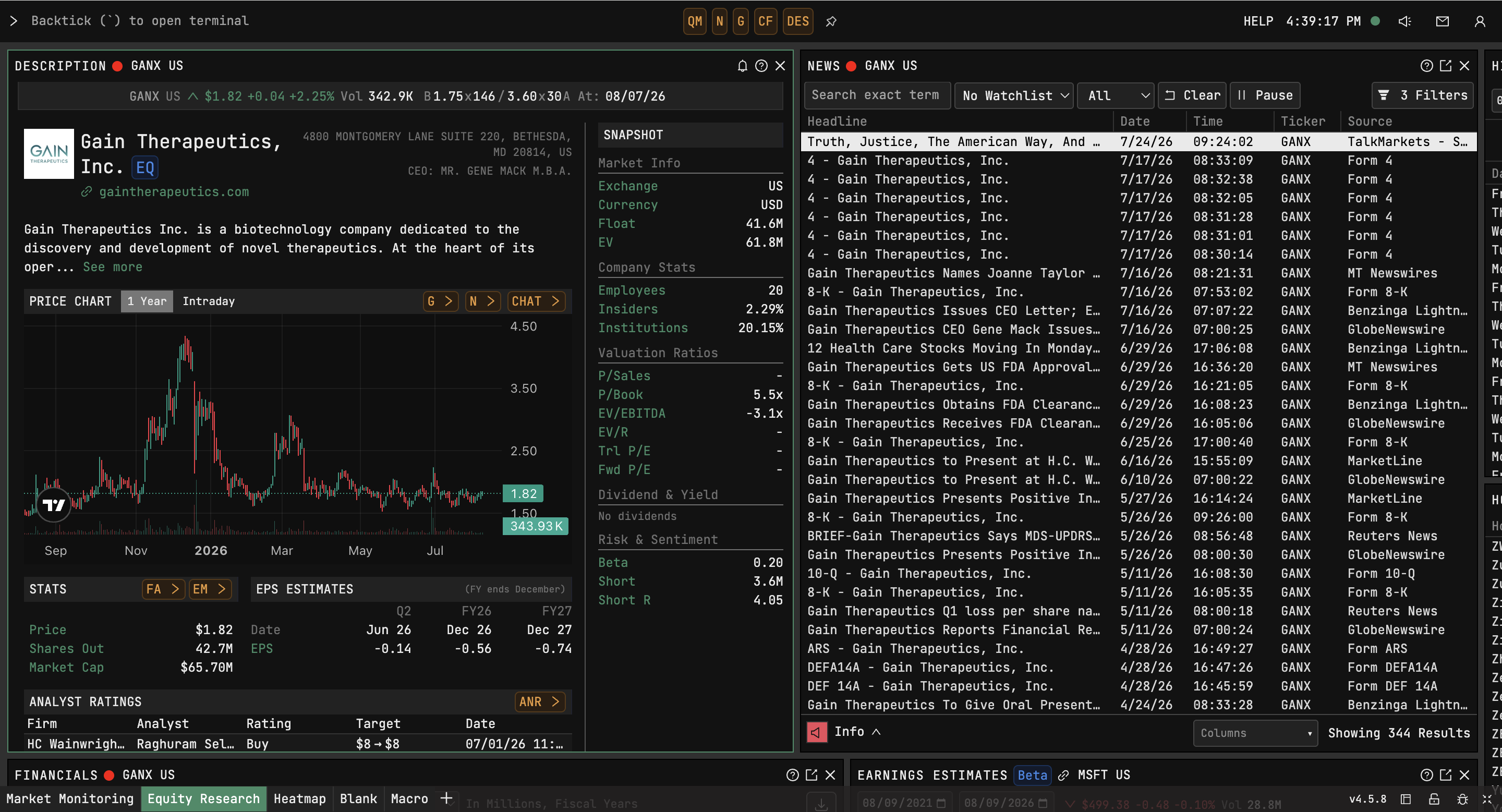
Disclosure: this is a referral link and mungbeans.io earns a commission if you subscribe, at no extra cost to you. The discount code is why it is here; the recommendation is because I pay for it myself. This is the only paid link on the site, and the site carries no advertising.