Deep Dives
Full forensic theses on single names — the business, the valuation, the overhangs, the bear case, and a live performance tag from publish day.
GENI Q2 Review: What the Screener Found, and What the Business Proved
Eight of nine calls from the June thesis landed inside six weeks. Q2 beat on revenue and margin, Legend backs out to ~$274M annualized, and both Polymarket and Kalshi signed before the print. The 200-week line found the question; the business answered it. Revised target $15.41 on 311M fully diluted shares, with GAAP positivity as the gate.
Genius Sports (GENI): The Operating System of Modern Sport
GENI has assembled the only platform that owns sports data at the camera, owns the fan at the destination, and sits between both and the advertiser. Revenue is compounding at 30%+. Margins are expanding 500bps in a single transaction. The market has it down 45% in 2026. I go line by line through the business to understand why.
The Golden Screen: 5 Stocks Where Every Signal Says Buy
I ran every variable in the mungbeans screener at once — below the 200WMA, positive Bean Score, growing FCF, cannibal buybacks, profitability, insider buying — and found 5 stocks where nothing is flashing red. This is a live test of whether the screener works as a combined signal.
Godel Terminal
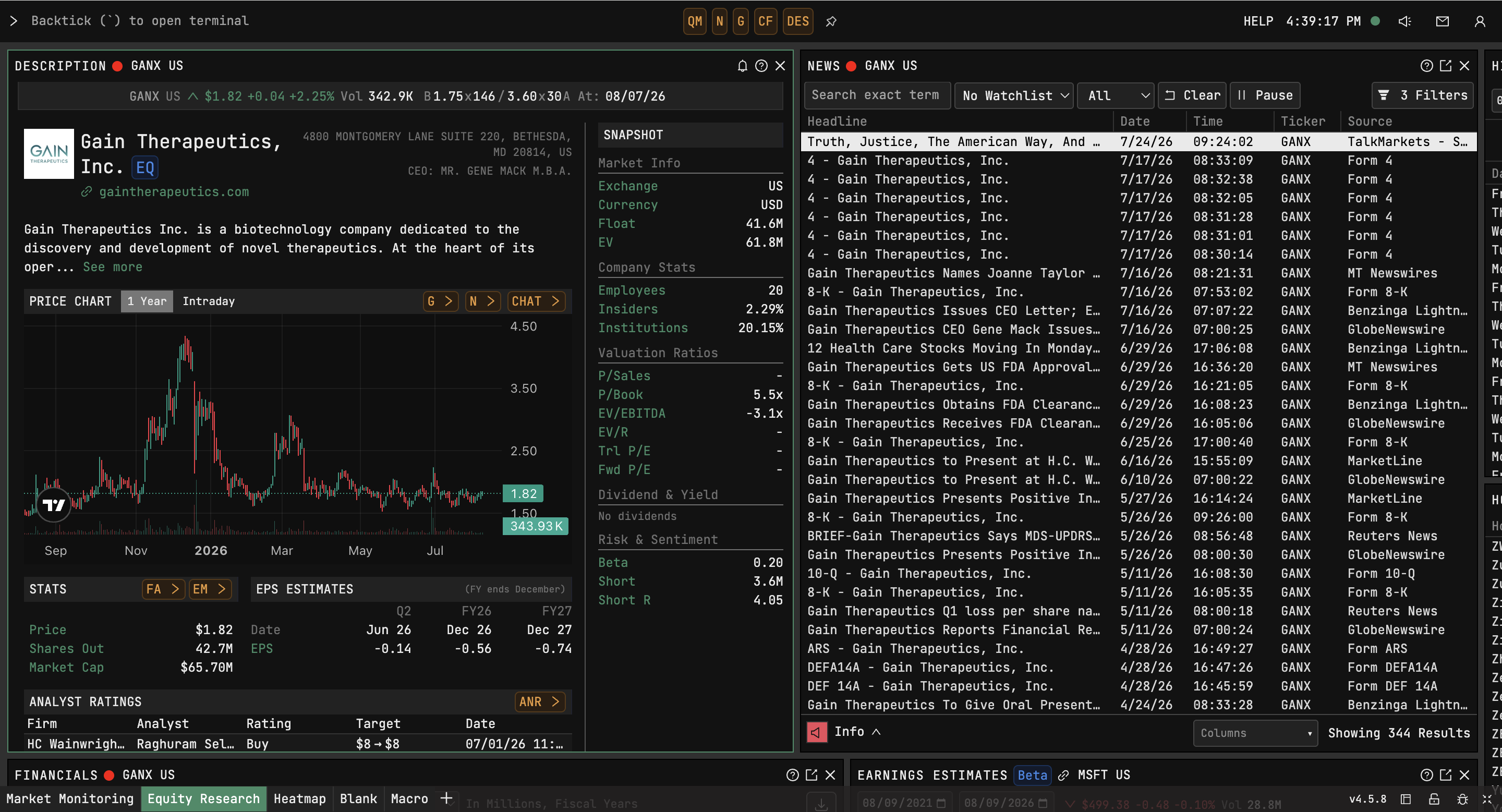
A browser-based research terminal with a Bloomberg-style command interface: DES, FOCUS, TAS, HDS. Real-time quotes, filings, financials, ownership and news, at $996 a year against Bloomberg's roughly $27,000.
I use it for the filing and ownership work behind the deep dives, the part that used to mean six browser tabs and a spreadsheet. It handles research and analysis; order execution and dealer chat are not in it, so it sits alongside a broker rather than replacing one. There is a 14-day trial, so the cheapest way to judge it is to run it against whatever you use now.
Disclosure: this is a referral link and mungbeans.io earns a commission if you subscribe, at no extra cost to you. The discount code is why it is here; the recommendation is because I pay for it myself. The site carries no advertising, and every paid link is listed on one page.
📬 Get Notified
Weekly signal reports when stocks cross below the 200-week line, plus every deep dive as it publishes.
No spam. Unsubscribe anytime.
📉 Below The Line
Stocks trading 5–50% below their 200-week moving average — the actionable zone.
🔻 Deep Value (High Risk)
Stocks 50-70% below their 200WMA. Higher risk — verify fundamentals carefully.
⏳ The Waiting Room
Stocks within 15% of their 200-week line, sorted by proximity.
View all 20 approaching stocks →📊 Oversold + Below Line
Below-line stocks also showing RSI < 30. Double signal.
View all 160 oversold stocks →🔍 Insider Buying + Below Line
Insiders are buying their own stock with conviction ($500K+ purchases) while the stock trades below its 200-week MA. The market says it's broken — they disagree.
📈 Growing Cash Flow + Below Line
Free cash flow is growing while the stock trades below its 200-week MA. The business is getting healthier — the market hasn't noticed yet.
View all 209 growing FCF + below-line stocks →⚠️ Distressed (60 stocks >70% below)
These stocks are more than 70% below their 200WMA. Many may be facing serious fundamental issues.
View all 60 distressed stocks →The Methodology
The 200-week moving average represents roughly 4 years of price history. When a quality stock drops to this level, it often represents a significant buying opportunity—the kind that comes along only a handful of times per decade for any given company.
This tool tracks two simple things:
- Is the stock below its 200-week moving average? Yes or no.
- Is it approaching or retreating? Week-over-week direction.
We also show 14-week RSI as a short-term oversold indicator, and historical data on what happened after previous touches.
This is not financial advice. A stock being below its 200-week average could mean opportunity—or it could mean the business is deteriorating. Always do your own research.
Frequently Asked Questions
What is the 200-week moving average?
The 200-week moving average (200WMA) is the average closing price of a stock over the last 200 weeks — roughly 4 years. It smooths out short-term volatility and acts as a long-term support level. When a quality stock drops below this line, it often signals a significant buying opportunity that may only occur a handful of times per decade for any given company.
How does the below-the-line stock screener work?
The screener tracks over 1,700 stocks and checks two things each week: is the stock currently trading below its 200-week moving average, and is it moving toward or away from that line. Stocks are categorized as actionable (5–50% below), deep value (50–70% below), or distressed (70%+ below). Additional signals like RSI, insider buying, and free cash flow trends help identify the strongest opportunities.
Is buying stocks below the 200-week moving average a good strategy?
Historically, buying quality stocks near their 200-week moving average has produced strong long-term returns. Our data shows that while 12-month returns from a touch can be modest, 24-month returns are often significantly higher. However, not every stock that drops below the line is a good buy — some are declining for fundamental reasons. This tool is a starting point for research, not a buy signal on its own.
What does it mean when insiders buy stock below the 200-week moving average?
When corporate insiders — executives, directors, or large shareholders — make significant open-market purchases (over $500K) while the stock is below its 200-week moving average, it can be a strong conviction signal. These insiders have the most detailed knowledge of the company's prospects and are putting their own money at risk, suggesting they believe the stock is undervalued.
How often is the stock data updated?
Stock data is updated weekly after the Friday market close. The screener recalculates 200-week moving averages, RSI readings, insider buying activity, and free cash flow trends for all tracked stocks. This weekly cadence matches the long-term nature of the strategy — daily fluctuations are noise at this time horizon.
What is free cash flow and why does it matter for value investing?
Free cash flow (FCF) is the cash a company generates after paying for operations and capital expenditures. It matters because a stock can trade below its 200-week moving average for two very different reasons: temporary market pessimism or genuine business deterioration. Growing free cash flow while below the line suggests the business is actually getting healthier even as the stock price declines — meaning the market may be wrong.