UiPath (PATH): Deep Value or Value Trap?
The Setup
UiPath closed the first week of May at approximately $11 — down 87% from its May 2021 all-time high of $85.12, down 36% year-to-date, and sitting roughly 30% below its 200-week moving average.
This is a company that went public in April 2021 at $56 per share in what was one of the largest software IPOs in history, raising $1.3 billion. The stock popped 23% on day one. Within a month, it touched $85. Then the unraveling began: a slow, grinding four-year decline from pandemic-era darling to the kind of stock nobody wants to talk about at a dinner party.
But while the stock cratered, the business quietly improved. Fiscal year 2026 (ended January 31, 2026) was the first year UiPath posted GAAP operating income — $57 million, up from a GAAP loss of $233 million just two years prior. Revenue reached $1.61 billion, up 13%. ARR hit $1.85 billion. Free cash flow was $372 million. And the company did it with zero debt and $1.69 billion in cash on the balance sheet.
The knock on UiPath has always been that traditional robotic process automation is a feature, not a platform — that Microsoft, ServiceNow, and a wave of AI-native tools would commoditize the bots. The stock price says the market believes that thesis. The financials say the obituary may be premature.
At $11, UiPath trades at roughly 14x forward earnings with a PEG ratio of 0.50. For a company with 85% gross margins, no debt, and a net cash position equal to 34% of its market cap, the question is whether the market has correctly priced existential risk or whether it’s paying far too much attention to the narrative and far too little to the numbers.
Layer 1: Earnings Quality — Is the Company What It Claims to Be?
The Accruals Check
UiPath’s operating cash flow for fiscal 2026 was $371 million against GAAP operating income of $57 million. That’s a massive cash conversion ratio — the company generates far more cash than GAAP earnings suggest because stock-based compensation, the largest non-cash expense, flows through the income statement but not through the cash register.
Free cash flow of $372 million against net income gives an FCF-to-net-income ratio well above 1.0x. This is a company where the cash earnings are substantially higher than the reported earnings. No manipulation signals here — the accruals are running in the right direction.
Stock-Based Compensation
This is where the story gets more nuanced. UiPath’s SBC has historically been the single biggest bear argument on earnings quality. At its peak, annual SBC ran above $400 million — more than the company generated in free cash flow. That’s a problem.
But the trend is moving in the right direction. SBC has been declining as a percentage of revenue, and more importantly, UiPath is now actively buying back shares. Diluted shares outstanding declined 2.7% year-over-year to 545 million, and the company’s buyback yield of 3.8% now meaningfully exceeds dilution from compensation grants. This is a recent and significant development — for the first time, net share count is shrinking.
Revenue Quality: Recurring and Sticky
97% of UiPath’s revenue is subscription-based. Dollar-based net retention was 107% in Q4 FY2026, meaning existing customers are spending 7% more year-over-year. ARR of $1.85 billion grew 11% year-over-year. Remaining performance obligations reached new highs.
This is enterprise software with high switching costs. Once a company has hundreds or thousands of bots running mission-critical processes, ripping them out is expensive and risky. The net retention rate isn’t spectacular — it’s not a Snowflake or Datadog at 130%+ — but 107% on a $1.85 billion base is stable and accretive.
Layer 1 Verdict: PASS. Cash conversion is strong, SBC is declining and now offset by buybacks, and nearly all revenue is recurring with reasonable retention. Earnings quality has improved materially over the past two years.
Layer 2: Financial Distress — Can It Survive Long Enough for the Thesis to Play Out?
The Balance Sheet
This is UiPath’s clearest strength. As of January 31, 2026:
- Cash, cash equivalents, and marketable securities: $1.69 billion
- Total debt: $0
- Net cash position: $1.69 billion
- Net cash as a percentage of market cap: ~34%
Read that again. More than a third of UiPath’s entire market capitalization is cash on the balance sheet. If you bought every share outstanding and took the cash, you’d be acquiring a $1.6 billion revenue, $372 million FCF software business for an effective enterprise value of roughly $3.2 billion. That’s 2x revenue and 8.6x free cash flow for the operating business.
Cash Burn / Cash Generation
UiPath is no longer burning cash. The company generated $371 million in operating cash flow and $372 million in adjusted free cash flow in FY2026. At the current rate, the cash pile is growing, not shrinking. Even in a severe downturn scenario where FCF drops 50%, UiPath has over eight years of runway before touching the cash reserve.
The Altman Z-Score
UiPath’s zero-debt balance sheet, $1.69 billion cash position, and positive operating income produce a Z-Score comfortably above the distress threshold. This is not a company facing financial distress by any traditional metric.
Layer 2 Verdict: PASS with distinction. Zero debt, $1.69 billion in cash, positive and growing free cash flow. Financial distress risk is negligible. The balance sheet is a fortress.
Layer 3: Value Creation — Is Management Creating or Destroying Shareholder Value?
Return on Invested Capital
UiPath’s ROIC has been improving as the company shifts from growth-at-all-costs to profitable growth. With $57 million in GAAP operating income on an invested capital base that includes $1.69 billion in cash, the returns look modest. But strip out the excess cash — which earns a market return on its own — and the operating ROIC on the actual business assets is substantially higher.
More importantly, the trajectory is right. UiPath went from deeply GAAP-negative to GAAP-positive in three years. That’s a meaningful inflection.
Capital Allocation
Management’s capital allocation is defensible:
- Share repurchases: Buybacks now exceed dilution, with shares declining 2.7% year-over-year. The $500 million authorization is being used at prices well below the IPO.
- WorkFusion acquisition (February 2026): A targeted acquisition to strengthen agentic AI capabilities in financial services. This is a tuck-in that adds domain-specific packaged workflows rather than a bet-the-company deal.
- No debt: Management has resisted the temptation to lever up the balance sheet for acquisitions, which is unusual and commendable.
- No dividend: Appropriate for a company still in the growth-to-profitability transition.
The CEO Question
Daniel Dines, co-founder, returned as CEO in June 2024 after briefly stepping aside. He holds approximately 20% of outstanding shares through Class A and Class B stock. The dual-class structure gives him outsized voting control — Class B shares carry 35 votes per share versus one vote for Class A. This is the standard Silicon Valley founder-control setup.
The concern: Dines has been selling shares. He sold 122,734 shares in October 2025, followed by additional sales through January 2026 while the stock declined 36% year-to-date. Insider selling during a stock decline is never a great look, though these were pre-arranged 10b5-1 plan sales and represent a tiny fraction of his total position.
Layer 3 Verdict: CAUTIOUS PASS. ROIC is improving, capital allocation is disciplined, and the balance sheet is pristine. The insider selling and dual-class structure are minor flags, not disqualifying ones. Management is making the right operational decisions even if the market isn’t rewarding them yet.
Layer 4: Structural Fragility — What Could Break the Thesis?
The AI Displacement Narrative
This is the central bear case and it deserves serious engagement. The argument runs like this: traditional RPA automates repetitive, rule-based tasks by mimicking human clicks and keystrokes. Large language models and AI agents can now handle those same tasks natively, without the brittle screen-scraping approach. Therefore, RPA is obsolete.
There’s some truth here. Simple, single-step automations — the kind you can set up in Microsoft Power Automate or Zapier — are being commoditized. UiPath’s original value proposition of “record a macro and deploy a bot” is no longer differentiated.
But UiPath’s counter-move is significant. The company is repositioning as the orchestration layer for enterprise automation — the platform that connects AI agents, software bots, APIs, and human approvals into complex end-to-end workflows. The May 2026 launch of on-premises agentic AI capabilities for government and regulated industries is exactly the kind of moat-deepening move that matters. Enterprises don’t need another AI model. They need a way to connect the AI to their existing systems, with audit trails, compliance controls, and governance. That’s where UiPath is planting its flag.
Customer Concentration
UiPath’s customer base is diversified across 10,800+ enterprise customers, with strong presence in financial services, healthcare, government, and manufacturing. No single customer represents a material percentage of revenue.
Platform Risk
Microsoft is the most dangerous competitor. Power Automate is bundled into Microsoft 365 and is good enough for simple workflows. ServiceNow is expanding into process automation. Salesforce has its own workflow tools. The risk is real, but UiPath’s advantage is that it works across platforms — it can automate processes that span SAP, Oracle, Salesforce, and legacy mainframe systems in a single workflow. Microsoft’s tool primarily automates within the Microsoft ecosystem.
Macro Sensitivity
Enterprise software spending is cyclical, and automation budgets are not immune to cuts. However, automation has a clear ROI argument — it reduces headcount costs — which tends to make it more resilient during downturns than discretionary software. The FY2027 guidance of $1.75-1.76 billion in revenue (9-10% growth) suggests management sees continued expansion.
Layer 4 Verdict: MODERATE RISK. The AI displacement narrative is the real structural risk, but UiPath’s pivot to orchestration is the correct strategic response. Platform risk from Microsoft is meaningful but addressable. No customer concentration issues.
Layer 5: Informed Sentiment — What Are the Smart Money and Insiders Saying?
Institutional Ownership
Institutional ownership stands at approximately 81%, indicating that major asset managers haven’t abandoned the position despite the stock’s decline. This is a stock held by index funds, growth funds, and increasingly, value funds rotating in at depressed levels.
Short Interest
Short interest is elevated at roughly 16% of float, with some sources reporting as high as 23% of public float. This is a meaningful short position and indicates active betting against the stock. However, high short interest at a potential inflection point can become fuel for a rally if earnings continue to improve — the classic short-squeeze setup.
Analyst Sentiment
Analyst consensus is cautiously optimistic. The average one-year price target is $14.07, representing 28% upside from current levels. Needham upgraded PATH from Hold to Buy in March 2026. The stock is trading 25% below the average analyst target.
Insider Activity
As noted in Layer 3, CEO Daniel Dines has been selling shares through pre-arranged plans. No notable insider buying has been reported recently. This is a negative signal, though the selling amounts are small relative to his overall position.
Layer 5 Verdict: MIXED. Institutional ownership is solid, but the high short interest and insider selling are headwinds. The analyst community sees significant upside, and the short interest could amplify any positive catalyst.
Traditional Valuation Metrics
| Metric | PATH | Software Median | Notes |
|---|---|---|---|
| Forward P/E | ~14x | ~25x | Deep discount to sector |
| PEG Ratio | 0.50 | 1.5-2.0 | Growth meaningfully underpriced |
| EV/Revenue | ~2.0x | ~6x | Cheapest in its peer group |
| EV/FCF | ~8.6x | ~20x | Free cash flow heavily discounted |
| FCF Yield | 4.8% | ~2% | Cash generation pricing in decline |
| Gross Margin | 85% | 75% | Premium unit economics |
| Net Cash/Mkt Cap | 34% | <5% | Massive cash cushion |
UiPath is trading at valuations you don’t typically see for a profitable, growing software company with 85% gross margins and zero debt. The EV/FCF of 8.6x is closer to a distressed industrial company than a software platform. Either the market is correctly pricing terminal decline, or this is a significant mispricing.
Crossing History: What the Line Tells Us
UiPath is not in our S&P 500 crossing episode dataset — it’s a mid-cap stock that has never been included in the index. We cannot apply the crossing frequency or historical episode analysis directly.
However, the broader framework data provides useful context. PATH is approximately 30% below its 200-week moving average. Our dataset shows that stocks crossing 20%+ below their 200WMA deliver a median episode return of +34%, with a 64% probability of beating SPY during the recovery. The deeper the crossing, the stronger the signal — and 30% is a deep crossing.
The critical caveat is duration. At the time of this analysis, PATH has been below its 200WMA for an extended period — well past the 13-week checkpoint where our data shows odds begin to shift. In our dataset, stocks that remain below the line for 26+ weeks underperform SPY 76% of the time. PATH has been trending below its long-term average for the better part of two years as the stock drifted from $25 to $11.
This creates a tension in the signal. The depth says buy. The duration says be cautious. The resolution depends on whether the GAAP profitability inflection and agentic AI pivot represent a genuine fundamental reset — the kind of catalyst that breaks a stock out of a prolonged below-the-line period — or whether the decline is secular and permanent.
Bear Case
AI makes traditional RPA obsolete. Large language models and AI agents handle tasks that previously required screen-scraping bots. Microsoft bundles competitive automation tools for free. UiPath’s core product becomes a legacy technology within 3-5 years.
The agentic pivot doesn’t stick. UiPath’s repositioning as an orchestration platform sounds good in presentations, but enterprises already have workflow tools from ServiceNow, Microsoft, and Salesforce. UiPath is fighting for a market that bigger players are also claiming.
Revenue growth continues to decelerate. FY2026 grew 13%, but Q1 FY2026 was only 6%. If net new ARR starts declining, the market will reprice the stock further. Dollar-based net retention at 107% isn’t expanding fast enough to signal land-and-expand momentum.
Insider selling signals lack of conviction. CEO Daniel Dines continues to sell shares during the decline. When the founder is reducing exposure, outside investors should ask why.
The short interest is informed, not contrarian. 16%+ short interest exists for a reason. The shorts see a legacy RPA company with a shrinking TAM, and the burden of proof is on the bulls to prove otherwise.
Bull Case
The balance sheet alone provides downside protection. $1.69 billion in net cash — 34% of market cap — means you’re buying the operating business for roughly $3.2 billion. A $1.6 billion revenue, $372 million FCF software company at 8.6x free cash flow is private equity pricing for a publicly traded asset.
GAAP profitability is a genuine inflection point. UiPath went from -$233 million GAAP operating loss to +$57 million GAAP operating income in three years. The margin expansion story has been consistent: non-GAAP operating margins went from single digits to 23% in FY2026. FY2027 guidance implies continued expansion.
Agentic AI is an expansion of TAM, not a replacement. The shift from simple bot automation to complex multi-agent orchestration actually increases the value of a platform that can coordinate across enterprise systems. UiPath’s installed base of 10,800+ enterprise customers gives it a distribution advantage that AI-native startups don’t have.
The short interest is a coiled spring. At 16%+ of float, any sustained positive catalyst — a strong Q1 FY2027 report, a major customer win, an agentic AI deployment milestone — could trigger aggressive short covering. The stock moved 2.7% in a single session on the May 2026 on-premises agentic AI announcement.
FY2027 guidance is accelerating. Revenue guidance of $1.75-1.76 billion represents 9-10% growth, but the company has a history of guiding conservatively and beating. Q4 FY2026 revenue of $481 million (14% growth) was the strongest quarter of the year, suggesting momentum is building, not fading.
Our Determination
Deep Value.
UiPath at $11 is a deeply mispriced asset hiding behind a stale narrative. The “RPA is dead” thesis made sense when the company was unprofitable, burning cash, and diluting shareholders at a premium valuation. None of those conditions hold anymore.
The company is GAAP-profitable. Free cash flow is $372 million. The balance sheet has $1.69 billion in cash and zero debt. Shares outstanding are declining for the first time. Revenue is growing. Margins are expanding. And the stock is trading at 8.6x enterprise-value-to-FCF — a multiple that prices in not just deceleration but permanent decline.
The market is essentially saying UiPath’s free cash flow will go to zero. The business fundamentals say otherwise. The FY2027 revenue guide of $1.75 billion represents acceleration from the first half of FY2026, and the agentic AI pivot positions UiPath for a larger addressable market, not a smaller one.
The risks are real. Microsoft is a formidable competitor. AI will continue to reshape the automation landscape. The duration below the 200WMA is extended. But the margin of safety at this price — the cash cushion, the FCF yield, the valuation discount to every comparable software company — is substantial enough to absorb significant downside scenarios.
What We’re Watching
Q1 FY2027 results (expected late May/early June 2026): Revenue of $395-400 million would confirm the growth reacceleration. Net new ARR trends will reveal whether the agentic pivot is driving incremental customer spending.
Dollar-based net retention: Needs to stabilize above 107% or start climbing. A move toward 110%+ would signal that existing customers are expanding usage of the new platform capabilities.
Short interest trajectory: A sustained decline from 16%+ toward 10% would indicate that active short-sellers are capitulating, removing a major overhang.
Insider buying: Any open-market purchases by executives — particularly CEO Dines — would be a powerful signal that management sees the current price as materially below intrinsic value.
WorkFusion integration: Early results from the financial services agentic AI product will indicate whether UiPath can command premium pricing for industry-specific automation solutions.
Downside Risk & Upside Potential
Valuation-Based Scenarios
| Scenario | Assumptions | Price Target | Return |
|---|---|---|---|
| Bear | Revenue flat, FCF declines 30% to ~$260M, 10x EV/FCF | ~$8 | -27% |
| Base | Revenue grows 9%, FCF grows to ~$410M, 14x EV/FCF | ~$14 | +27% |
| Bull | Revenue grows 15%, agentic AI drives expansion, FCF ~$480M, 18x EV/FCF | ~$19 | +73% |
The Range
| Reference Point | Price | vs. Current |
|---|---|---|
| Bear case | $8.00 | -27% |
| Current price | $10.99 | — |
| 200-week moving average (est.) | ~$15.50 | +41% |
| Base case | $14.00 | +27% |
| Analyst consensus target | $14.07 | +28% |
| Bull case | $19.00 | +73% |
The risk/reward is asymmetric in the bull’s favor. The bear case — revenue stagnation and FCF compression — produces a 27% drawdown from already depressed levels. The base case delivers a 27% return just by mean-reverting toward the 200WMA. The bull case, which requires the agentic AI pivot to show measurable traction, delivers 73% upside.
The net cash position of $1.69 billion ($3.10 per share) provides a meaningful floor. Even in the bear scenario, you’re buying a profitable, cash-generating software business for an effective enterprise value of less than $3 billion.
Disclaimer: This analysis is for informational purposes only and does not constitute investment advice. The author may hold positions in the securities discussed. Always conduct your own research before making investment decisions.
Godel Terminal
A browser-based research terminal with a Bloomberg-style command interface: DES, FOCUS, TAS, HDS. Real-time quotes, filings, financials, ownership and news, at $996 a year against Bloomberg's roughly $27,000.
I use it for the filing and ownership work behind the deep dives, the part that used to mean six browser tabs and a spreadsheet. It handles research and analysis; order execution and dealer chat are not in it, so it sits alongside a broker rather than replacing one. There is a 14-day trial, so the cheapest way to judge it is to run it against whatever you use now.
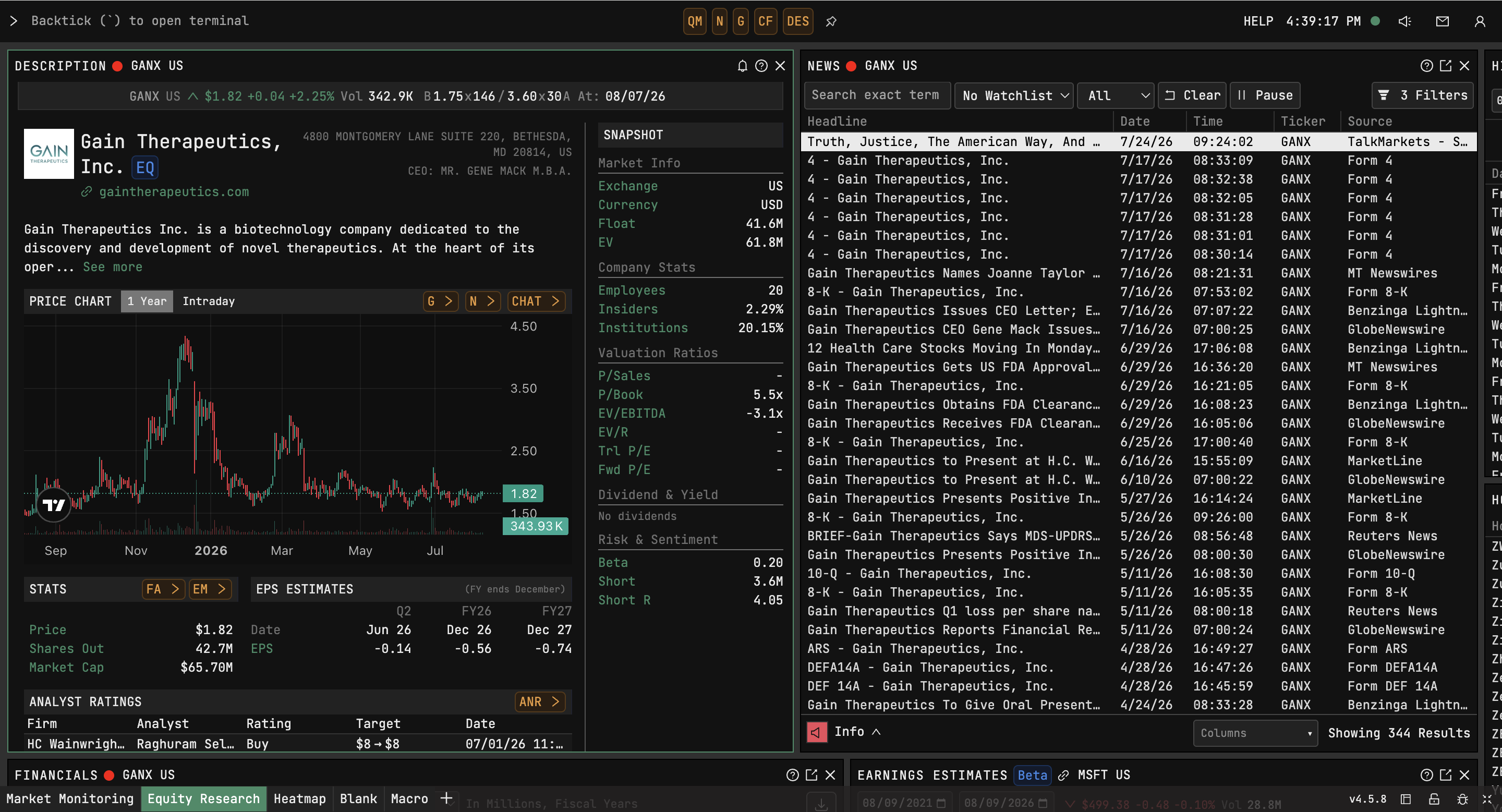
Disclosure: this is a referral link and mungbeans.io earns a commission if you subscribe, at no extra cost to you. The discount code is why it is here; the recommendation is because I pay for it myself. The site carries no advertising, and every paid link is listed on one page.
Get the work as it publishes
One list: weekly signal reports when stocks cross the line, and every deep dive as it goes up.
No spam. Unsubscribe anytime.
Not financial advice. This is an educational tool. Past performance does not guarantee future results. Do your own research before making investment decisions.