Everspin (MRAM) vs NVE Corp (NVEC): The Spintronics Thesis
Why These Two Together
Magnetoresistive Random Access Memory (MRAM) is a non-volatile memory technology based on spintronics — using electron spin rather than electrical charge to store data. Unlike DRAM, it retains data without power. Unlike Flash, it writes at near-DRAM speeds with virtually unlimited endurance. Unlike SRAM, it’s dense enough to scale. The physics gives it a unique performance envelope: persistent, fast, durable, and radiation-hard.
Two public companies own this space. Everspin Technologies (MRAM) is the only company shipping standalone MRAM products at volume — Toggle MRAM and STT-MRAM chips for data center, industrial, and automotive applications. NVE Corporation (NVEC) is the spintronics IP house — it invented many of the foundational patents, licenses the technology, and sells spintronic sensors and couplers. Same physics, completely different business models.
The secular tailwind is straightforward: AI data centers need persistent, low-latency memory for metadata, journaling, and RAID acceleration. Industrial IoT needs radiation-hard, high-endurance storage for harsh environments. Automotive needs non-volatile memory that survives temperature extremes. MRAM checks every box that NOR Flash and battery-backed SRAM struggle with.
I wanted to know whether either stock offers a good entry point right now, or whether the thesis is already priced in.
The Technology: Why MRAM Matters (And Why Now)
The Memory Hierarchy Has a Hole in It
Every computer system runs on a memory hierarchy — fast, expensive memory at the top (CPU registers, SRAM cache), slow, cheap storage at the bottom (NAND Flash, hard drives), and DRAM in the middle doing the heavy lifting. Each layer makes a tradeoff between speed, density, persistence, and cost.
The problem is that none of these technologies combine persistence with speed. DRAM is fast (~10ns access) but volatile — lose power, lose data. You need constant refresh, which burns energy. SRAM is even faster but even more volatile, and it’s expensive — an SRAM cell uses 6 transistors vs DRAM’s 1 transistor + 1 capacitor, so the density is terrible. NAND Flash and NOR Flash are persistent but slow to write (microseconds to milliseconds), and they wear out — NOR Flash gets ~100,000 write cycles before the floating gate oxide degrades. Battery-backed SRAM solves persistence by strapping a lithium cell to volatile memory, but batteries fail, add board space, add qualification costs, and create maintenance liabilities in mission-critical systems.
MRAM solves this from first principles. Instead of storing charge (which leaks) or trapping electrons in oxide (which degrades), MRAM stores data as a magnetic orientation. Two ferromagnetic layers separated by a thin tunnel barrier — one layer’s magnetization is fixed, the other can be flipped. Parallel = 0, antiparallel = 1. Reading is done by measuring the resistance difference across the tunnel junction (tunnel magnetoresistance effect). The magnetic state doesn’t decay, doesn’t need refresh, and doesn’t degrade with writes.
The result: DRAM-class speed (~35ns reads, ~90ns writes for STT-MRAM), Flash-like persistence, virtually unlimited write endurance (>10^15 cycles vs NOR Flash’s ~10^5), inherent radiation hardness (no charge to disturb), and instant-on operation (no boot, no reload). No batteries. No refresh. No wear leveling.
Three Generations of MRAM
“MRAM” is not one technology. It’s three generations, each unlocking different markets.
Toggle MRAM (1st generation): Uses a magnetic field generated by current-carrying wires to flip the storage layer. Simple physics, proven reliability, but high write energy and limited density (maxes out around 16-64Mb). This is Everspin’s mature product line — shipping for 15+ years into industrial automation, military/aerospace, and automotive. These are the 170 million units shipped. The market is stable, not growing fast, but deeply embedded in customer designs with long qualification cycles that create switching costs.
STT-MRAM (2nd generation — current growth engine): Spin-Transfer Torque eliminates the external magnetic field. Instead, a spin-polarized current flows through the tunnel junction, and the angular momentum transfer flips the storage layer’s magnetization directly. This is fundamentally more energy-efficient and — critically — scalable to smaller process nodes because you don’t need current-carrying wires routed near each cell. STT-MRAM is what TSMC, Samsung, and GlobalFoundries are embedding at 22nm, 16nm, and now 8nm process nodes. It’s what Everspin is ramping at 128Mb and 256Mb densities. This generation targets data center RAID caches, SSD metadata, NOR Flash replacement, and embedded microcontroller memory.
SOT-MRAM (3rd generation — research/early development): Spin-Orbit Torque uses a heavy-metal layer adjacent to the storage layer. Current flowing through the heavy metal generates a spin-orbit torque that switches magnetization without current flowing through the tunnel junction at all. This separates the read and write current paths, enabling sub-nanosecond switching speeds — fast enough to compete with SRAM for last-level cache. SOT-MRAM is not in production today, but research at imec and multiple universities has demonstrated the physics. If SOT-MRAM delivers on its promise, it could replace SRAM in AI accelerator caches — a market measured in tens of billions of dollars.
The generation ladder matters for the investment thesis: Toggle is the cash cow, STT is the current growth engine, and SOT is the optionality. Each generation addresses a larger and faster memory market.
The Five Market Vectors
MRAM’s growth story breaks into five distinct use cases, each with different timelines, TAMs, and competitive dynamics.
1. Data Center RAID & Persistent Caching (Now → 2028)
Every enterprise storage array and SSD controller needs a write cache that survives power loss. Today this is served by battery-backed DRAM or supercapacitor-backed DRAM — both add cost, board space, and failure modes. MRAM replaces the battery entirely: write to MRAM, lose power, data persists. No battery, no supercapacitor, no maintenance window to swap aging cells.
Everspin’s STT-MRAM is already designed into IBM’s FCM4 and FCM5 Flash Controller Modules. IBM’s RAID reference designs are being engaged with the top five hyperscale operators. The 128Mb and 256Mb densities completing qualification in mid-2026 are specifically sized for this application — larger caches enable more aggressive write coalescing, which improves SSD endurance and throughput.
As AI training clusters push storage into petabyte-scale, the metadata and journaling layers need faster, more durable persistent memory. Every GPU cluster has a storage tier behind it, and that storage tier runs on controllers that need persistent write buffers. The AI capex wave that Alphabet, Meta, and Microsoft are funding doesn’t just buy GPUs — it buys the storage infrastructure that feeds them.
2. NOR Flash Replacement (2027 → 2030+)
NOR Flash is a $3B annual market used in industrial controllers, automotive ECUs, and embedded systems for code storage and execute-in-place. NOR’s weakness is write endurance (~100K cycles) and write speed (milliseconds). In applications that frequently update configuration data, logs, or firmware — factory controllers, power grid monitors, automotive event recorders — NOR hits its endurance limits and forces expensive workarounds (wear leveling, redundant sectors, over-provisioning).
MRAM’s >10^15 write endurance and ~90ns write speed eliminate these constraints entirely. Everspin’s UNISYST product family is a unified code-and-data memory architecture that directly replaces NOR Flash — same pin-compatible interfaces (xSPI), same board footprint, but orders of magnitude better endurance and speed.
Management targets 5-10% penetration of the $3B NOR Flash market — $150-300M in eventual annual revenue. But the timeline is long: UNISYST engineering samples ship Q4 2026, customer qualification cycles run 18-24 months, and volume production follows. Meaningful UNISYST revenue is a 2029-2030 event, not a 2027 event. This is the call option, not the current revenue driver.
3. Normally-Off Computing & Edge AI (2027 → 2030+)
Most investors gloss over this one, but it may be the largest long-term opportunity.
Traditional computing is “normally-on” — your system stays powered, DRAM stays refreshed, state persists because the power never stops. This works fine in data centers and laptops, but it’s enormously wasteful for edge devices that only need to compute intermittently: industrial sensors that sample once per minute, smart agriculture monitors that wake up hourly, wearable health devices that process periodically.
With MRAM, you can build “normally-off” systems that power down completely between computations and wake up instantly with full state preserved. No boot sequence, no reload from Flash, no reinitialization. The system wakes, its neural network weights are already in MRAM, it processes, it stores results, it powers off. Energy consumption drops by orders of magnitude because you eliminate standby power entirely.
For edge AI specifically, this means an inference accelerator can store its model weights in MRAM, wake up to process a sensor input, and shut down — all in microseconds. Imagine a smart camera that processes images only when motion is detected, with zero standby power between events. Or a vibration sensor on a wind turbine that wakes every 10 seconds, runs a predictive maintenance model, and sleeps. The model weights persist in MRAM. No reload. No boot. Instant inference.
This architecture is impossible with SRAM (volatile — state lost on power-down) and impractical with NOR Flash (too slow to serve as working memory for a neural network). MRAM uniquely enables it.
4. Defense, Aerospace & Radiation-Hard Applications (Now)
MRAM is inherently radiation-hard because magnetic states are not disturbed by ionizing radiation the way charge-based memories are. A single cosmic ray can flip a bit in SRAM or DRAM (single-event upset). MRAM is immune to this — the magnetic tunnel junction’s state is insensitive to radiation at levels encountered in space and military environments.
Everspin just secured a $40M, 30-month defense subcontract with Amentum Services to provide MRAM process technology capabilities and engineering services for the U.S. Defense Industrial Base under the Microelectronics RDT&E program. This isn’t product revenue — it’s funded R&D that advances Everspin’s process technology while someone else pays for it. The contract runs through November 2028.
The defense market is smaller in total TAM but strategically important: defense qualification creates manufacturing rigor that benefits commercial products, the margins tend to be higher, and the customer relationships are decades-long.
5. Compute-in-Memory / Processing-in-Memory (2028 → 2032+)
The most speculative use case, and the furthest out. The “memory wall” — the bottleneck of moving data between memory and processor — is the fundamental limit on AI training and inference efficiency. Processing-in-memory (PIM) architectures eliminate data movement by performing computation directly inside the memory array.
MRAM-based PIM uses the resistance states of tunnel junctions to perform analog multiplication directly — feeding current through an array of MRAM cells produces a weighted sum of inputs without ever moving data to a processor. This maps naturally to neural network inference (which is dominated by matrix-vector multiplications). Research has demonstrated MRAM-based PIM accelerators for binary and multi-bit neural networks with significant energy efficiency improvements over GPU-based approaches.
This is not commercial today. SOT-MRAM or advanced STT-MRAM at higher densities would be needed. But if PIM architectures gain traction in edge AI (where power budgets are tight and data movement is the dominant energy cost), MRAM’s non-volatility and resistance-state computing give it structural advantages over SRAM-based alternatives.
The Density Reality Check
MRAM’s main limitation is density. Everspin’s largest shipping product is 64Mb STT-MRAM, with 128Mb and 256Mb (up to 1Gb with partners) in qualification. Compare that to NAND Flash at terabits per chip and DRAM at 16-32Gb per die. The cost per bit runs 5-10x DRAM and 2-3x enterprise SSD.
MRAM will not replace DRAM or NAND. It won’t store your photos or run your operating system’s main memory. It occupies specific niches where its unique combination of speed + persistence + endurance + radiation hardness justifies the cost premium. The investment thesis is about those niches growing — from RAID caches and industrial controllers today, to NOR Flash replacement and edge AI inference tomorrow, to potentially cache-level memory and PIM in the future.
The density roadmap matters: every doubling of density roughly doubles the addressable market by enabling use cases that require larger memories. The jump from 64Mb to 256Mb is not incremental — it’s the difference between a niche industrial component and a data center infrastructure product.
Market Sizing: How Big Could This Get?
The MRAM market is projected to grow from roughly $4-7B in 2026 to $16-58B by 2035, depending on the research firm and their assumptions about embedded vs. standalone adoption. The wide range reflects genuine uncertainty about adoption timelines, particularly for embedded MRAM in advanced process nodes and NOR Flash replacement.
The structural point that matters most for the investment thesis: the MRAM market divides into embedded (MRAM integrated on-die inside microcontrollers and SoCs, manufactured by TSMC, Samsung, GlobalFoundries) and standalone (discrete MRAM chips sold separately, Everspin’s domain). The embedded market is larger and growing faster, but Everspin doesn’t directly participate in it — the foundries do. Everspin’s opportunity is standalone MRAM for data center, industrial, and defense, plus licensing its IP to foundries embedding MRAM in their nodes.
The embedded market is where the massive TAM numbers come from. Four foundries — TSMC (22nm, 16nm, 12nm, 5nm in development), Samsung (28nm, 14nm, 8nm), GlobalFoundries (22nm FD-SOI), and Intel — have active embedded MRAM programs. Samsung’s 8nm eMRAM just achieved first commercial tape-out via SEMIFIVE’s Edge AI SoC. This embedded wave makes MRAM a standard memory option for SoC designers — which expands the ecosystem and creates pull-through demand for standalone MRAM in the same system architectures.
The Competitive Landscape
Everspin is not alone, though it has the strongest position in standalone MRAM.
Tier 1 — Foundries (embedded MRAM): Samsung, TSMC, GlobalFoundries, and Intel collectively hold ~53% of total MRAM market share when embedded is included. They offer eMRAM as an IP block within their process nodes — customers design SoCs that include MRAM on-die. This is not directly competitive with Everspin’s standalone chips, but it does mean that as embedded MRAM becomes standard in MCUs and SoCs, the need for external standalone MRAM in some applications diminishes.
The foundry momentum is accelerating. In May 2026, SEMIFIVE and ICY Tech (a Chinese AI semiconductor company) announced the successful tape-out of an edge AI SoC on Samsung Foundry’s 8nm process using embedded MRAM — the first commercial 8nm eMRAM tape-out. The chip is designed for on-device inference of models up to 2 billion parameters, targeting AI PCs, private AI agents, and humanoid robots. This is the “normally-off computing” use case described above, but implemented as embedded MRAM on-die rather than standalone Everspin chips. When the foundries make eMRAM a standard option at advanced nodes, SoC designers can include MRAM on-chip without buying discrete MRAM products.
GlobalFoundries reported that its automotive eMRAM design wins increased 50% over Q1 2025, with tier-one automotive suppliers (including Bosch) taping out on its FDX process with embedded MRAM. GF describes its eMRAM as having “industry-leading 100 MHz class access times” — competitive with Everspin’s standalone products but integrated directly into the customer’s SoC at lower total system cost.
Tier 2 — Standalone specialists: Avalanche Technology (private) focuses on persistent SRAM replacement for aerospace, defense, and industrial IoT, specifically radiation-tolerant designs. Crocus Technology (private, France) develops TMR-based sensors and embedded MRAM for smart grid and automotive. Neither has Everspin’s volume manufacturing track record or product breadth.
The China vector: China holds roughly 18% of the global MRAM market and is projected to grow at 24.3% CAGR through 2035 — well above the global 18% rate. Chinese fabs and OEMs are pushing non-volatile memory into automotive, industrial controls, and edge AI. The SEMIFIVE/ICY Tech collaboration on Samsung’s 8nm eMRAM is partly a China-market play. This matters for Everspin because China represents both a potential growth market (if geopolitics permit) and a competitive threat (if Chinese standalone MRAM companies emerge with domestic government backing). The embedded MRAM market is projected to have reached $1.9B in 2025, and much of the growth is in Asia-Pacific.
The competitive moat: MRAM manufacturing is extraordinarily difficult. The magnetic tunnel junction must be deposited with sub-angstrom uniformity across an entire wafer. Process variation that would be irrelevant in CMOS logic is catastrophic for MTJ yield. Everspin has 18 years of production experience — the yield learning curve is a real moat. The 10-year Microchip Technology manufacturing agreement (Fab 4 in Gresham, Oregon) adds domestic manufacturing capacity while keeping Everspin’s process IP proprietary. Toggle and sensor flows commence ~18 months from agreement, STT flows ~30 months.
When Does This Become a Value Stock?
Today, Everspin is priced as a growth story: $782M market cap on $60M revenue (13x), thin margins, and a stock that moves on narrative momentum. It trades on hope about density ramps and data center adoption.
The transition happens when the revenue base catches up to the narrative.
If Everspin hits its $100M revenue target (management’s 3-5 year goal), margins expand with STT-MRAM mix shift (higher ASPs, better fab utilization), and the company delivers $15-25M in annual FCF — then at today’s $782M market cap, the FCF yield would be 1.9-3.2%. That’s entering the range where the Bean Score framework could identify value.
More importantly, if the stock doesn’t keep rallying while revenue ramps — if the market gets distracted by another narrative, or semis have a cyclical downturn, or a broader correction pulls small-caps down — then you could see MRAM trading at $15-20 with $100M in revenue and real profitability. That would be a 3.5-4.5x revenue multiple on a 25%+ growth business with expanding margins, niche dominance, and defense revenue stability. That is a value setup.
The scenario I find most interesting: MRAM adoption accelerates per the secular thesis, Everspin delivers on the $100M revenue target, but the stock price pulls back during a 2027-2028 semiconductor cycle correction. The business is better but the price is lower. Growth stock to value stock in a single downturn. That’s exactly the moment the mungbeans framework is built for: when the market misprices a good business because sentiment turned negative on the sector.
For NVE, the value transition is simpler: it’s already a Buffett Quality business. It just needs to be cheap. At ~$62 (Bean Score Fair Value) or ~$66 (200WMA), the 4.5% dividend yield would be closer to 6.5%, the FCF yield would normalize, and you’d have an ultra-high-margin IP business at a framework-supported entry. The quality screen does the work — you just need the right price.
Everspin Technologies (MRAM) — ~$31.72
The Pure-Play MRAM Company
Everspin is the only publicly traded company whose primary business is manufacturing and selling standalone MRAM chips. It has shipped over 170 million MRAM devices to more than 600 customers worldwide.
The company’s origin story matters. In 2008, Freescale Semiconductor spun out its MRAM division as EverSpin Technologies, backed by venture investors including New Venture Partners, Sigma Partners, and Draper Fisher Jurvetson. The executive who made that call was Lisa Su — then Freescale’s Senior VP and Chief Technology Officer, now AMD’s CEO. Su called MRAM “a differentiating technology with numerous applications across the semiconductor market” and explained that the spinout was designed to expand MRAM beyond Freescale’s embedded focus into standalone memory and new markets. Su turned AMD from a struggling also-ran into the most consequential semiconductor company of the last decade. She saw MRAM’s potential early enough to architect its independence. That doesn’t make MRAM a guaranteed winner, but someone with that track record for identifying transformative technology considered MRAM important enough to build a company around.
The product portfolio spans two generations: Toggle MRAM (older technology, lower density, mature industrial/automotive customers) and STT-MRAM (Spin-Transfer Torque — newer, higher density, targeting data centers and next-gen industrial).
Recent Performance
Q1 2026 results showed acceleration:
- Total revenue: $14.9M (+14% YoY)
- MRAM product sales: $14.1M (+28% YoY) — the core business is growing faster than headline
- Non-GAAP net income: $2.6M ($0.11/share) vs $0.4M ($0.02/share) year-ago
- GAAP net income: $1.6M vs -$0.2M year-ago
The licensing/services component declined as expected (lumpy by nature), but product revenue — the recurring, scalable portion — grew 28%. This is the number that matters.
Balance Sheet
- Cash and investments: $40.5M
- Total liabilities: $12.9M
- Stockholders’ equity: $70.2M
- Shares outstanding: ~23.3M
- Market cap: ~$782M
- No long-term debt
This is a clean balance sheet for a small-cap semiconductor company. $40.5M in cash against $12.9M in total liabilities means zero financial distress risk. The company can fund operations and R&D internally for years.
Growth Catalysts
STT-MRAM density ramp: The 128Mb xSPI STT-MRAM completed production qualification in May 2026. The 256Mb is scheduled to complete qualification in July 2026, with volume availability in H2 2026. These aren’t incremental improvements — they’re the threshold densities that enable data center RAID controllers to replace battery-backed DRAM with MRAM. Every major storage controller OEM has a minimum density requirement, and 128-256Mb crosses it.
UNISYST product family: Targeting the $3B NOR Flash replacement market. Engineering samples ship Q4 2026, with 18-24 month customer qualification cycles before volume production. This is a 2029-2030 revenue event — not current. But the TAM is real and Everspin’s target of 5-10% penetration would represent $150-300M in annual revenue. That would transform the company’s economics.
IBM partnership and hyperscaler pipeline: Everspin’s STT-MRAM is designed into IBM’s FCM4 and FCM5 Flash Controller Modules. The RAID reference designs are being engaged with the top five hyperscale operators. This is the qualification pathway that matters — once an MRAM chip is qualified into a storage controller design at a hyperscaler, the volume can scale with data center buildout. These qualification cycles run 12-18 months, which means designs being qualified now produce revenue in 2027-2028.
Amentum defense contract: In April 2026, Everspin signed a $40M, 30-month subcontract with Amentum Services for the U.S. government’s Microelectronics RDT&E program (runs through November 2028). This is funded R&D — the government pays Everspin to advance MRAM process technology for defense applications. It provides $16M/year in essentially guaranteed, high-margin revenue while simultaneously advancing Everspin’s manufacturing capabilities. The defense angle also creates pull-through for production orders of radiation-hard MRAM for satellites and avionics.
Microchip Technology manufacturing agreement: A 10-year agreement for Microchip to manufacture 8-inch MRAM, TMR sensor, and STT-MRAM wafers at Microchip’s Fab 4 in Gresham, Oregon. Toggle and sensor flows commence ~18 months from signing, STT flows ~30 months. This is strategically important: it adds onshore manufacturing capacity (CHIPS Act alignment), provides supply chain redundancy, and positions Everspin to scale production without building its own fab. The capital efficiency is critical — Everspin gets capacity without capex.
Design win momentum: 238 design wins in 2025, up 34% from 2024. These wins are ramping to production in 2026 and 2027. The design win pipeline is the leading indicator for revenue 12-24 months out, and the 34% growth in wins suggests the revenue acceleration is still in early innings.
Insider Activity: Everyone Is Selling
In the past twelve months, Everspin insiders have filed 18 Form 4 sales and zero open-market purchases. Not one executive or director bought a single share on the open market while the stock rallied from ~$8 to ~$37. The selling accelerated in May 2026 as the stock hit new highs:
- CEO Sanjeev Aggarwal: sold
110,000 shares ($3.7M) across multiple transactions - Director Glen Hawk: sold 48,563 shares at $37-40 per share
- CFO William Cooper: sold 11,000 shares
- Director Geoffrey Ribar: sold 27,488 shares
- Director Darin Billerbeck: exercised options at $8.52 and sold 30,000 shares the same day at $37.16
A note on reading screener data: on many platforms, option exercises show up as “acquisitions,” which looks like insider buying. It isn’t. Billerbeck exercised compensation options at $8.52 (the grant price) and immediately flipped them at $37.16, pocketing the $28.64/share spread. That’s a liquidity event, not a conviction buy. If you see “insider buys” on a screener for MRAM, check the transaction codes — most are option exercises (Code M) followed by same-day sales (Code S), not open-market purchases (Code P).
Every person with insider knowledge of the density ramp timeline, hyperscaler qualification pipeline, and defense contract execution is choosing to take money off the table at these prices. Insiders sell for many legitimate reasons (diversification, taxes, personal expenses) and no single sale is damning. But zero open-market purchases across 18 selling transactions over a full year, concentrated during the stock’s strongest rally, is a data point I’m weighting.
The 1.8M Share Equity Plan Expansion
At the annual shareholder meeting on May 21, 2026, Everspin put forward a proposal to increase the 2016 Equity Incentive Plan by 1,800,000 shares. This is not a secondary offering — the company isn’t selling shares into the market to raise capital. It’s an authorization for employee stock compensation: options, RSUs, and equity grants that vest over time and convert into tradable shares.
On ~23.3M shares outstanding, 1.8M additional shares represents roughly 7.7% potential dilution. That dilution won’t hit all at once — equity grants vest over 3-4 year schedules — but it is cumulative. For a company that has historically kept dilution minimal (+0.1% over 3 years per the screener data), this is a meaningful step-up in equity compensation. It signals that management expects to be recruiting aggressively (scaling for the density ramp and NOR Flash replacement push), but it also means current shareholders are funding that growth through dilution rather than cash compensation.
Expanding the equity pool at all-time-high stock prices means each share granted carries maximum dilutive value. From management’s perspective, smart: fewer shares for the same dollar value of compensation. From a shareholder’s perspective, it’s 1.8M shares that will eventually need to be absorbed by the market.
The Path to $100M Revenue
Management has publicly targeted $100M in annual revenue within 3-5 years. The building blocks:
- Current product revenue run rate: ~$56M (Q1 annualized product sales)
- Amentum defense contract: ~$16M/year for 2.5 years (guaranteed floor)
- 128/256Mb data center ramp: incremental $10-20M as hyperscaler qualifications complete (2027-2028)
- Design win conversion: 238 wins ramping, with each new production customer adding $200K-2M in annual revenue
- UNISYST NOR replacement: unlikely to contribute within the $100M window (2029-2030 revenue event)
The math works if data center adoption materializes and design wins convert at historical rates. It doesn’t require UNISYST, which is the long-term call option. The risk is that data center qualification timelines slip, which is common in enterprise semiconductor.
The Valuation Problem
At ~$782M market cap on ~$60M annual revenue (Q1 annualized), Everspin trades at roughly 13x revenue. For a company growing product revenue at 28% but with only $2.6M quarterly non-GAAP profit, this is a rich valuation that prices in significant future growth.
But context matters: the Amentum contract alone provides $40M in total value with high certainty. The Microchip manufacturing agreement de-risks the capacity scaling without requiring capex. And the design win pipeline (238, up 34%) is the strongest leading indicator of revenue acceleration.
At $100M revenue with margin expansion from STT-MRAM mix shift and defense revenue, Everspin could generate $15-25M in annual FCF. At today’s $782M market cap, that’s a 1.9-3.2% forward FCF yield — still not cheap, but entering the zone where fundamental valuation frameworks can engage.
The stock has rallied substantially into the narrative, and at 13x revenue with thin current profitability, the risk/reward is stretched. The insider selling pattern reinforces this: 18 sells, zero open-market buys in the past year, with every C-suite officer and multiple directors taking money off the table at these levels. When the people closest to the qualification timelines and pipeline are sellers rather than buyers, you should at minimum ask what they see that the market doesn’t — or more precisely, what the market sees that they’re willing to sell into.
If qualification timelines slip or the semiconductor cycle turns, there’s significant air beneath the stock. But the floor is higher than it looks — the Amentum contract and defense pipeline provide revenue stability that most small-cap semis don’t have.
NVE Corporation (NVEC) — $89.74
The Spintronics IP Company
NVE is the polar opposite of Everspin in business model. Where Everspin manufactures chips, NVE licenses intellectual property and sells low-volume, high-margin spintronic sensors and couplers. Founded in 1989, NVE holds over 100 patents in spintronics and has been profitable for decades with minimal capital requirements.
The product line: Giant Magnetoresistance (GMR) sensors for industrial position/speed/current sensing, and spintronic isolators/couplers for signal isolation in harsh environments. These aren’t high-growth products — they’re niche, high-margin components sold into industrial and medical equipment.
NVE also licenses its MRAM intellectual property to larger semiconductor companies embedding MRAM into their products (embedded MRAM in microcontrollers, for example). This licensing revenue is lumpy but high-margin.
The Buffett Quality Profile
NVE passes every quality screen in the mungbeans framework:
| Metric | Value | Assessment |
|---|---|---|
| Price | $89.74 | |
| Market Cap | $434M | Micro-cap |
| 200WMA | $66.31 | 35% above the line |
| Bean Score | -2.01σ | Deep Expensive boundary |
| RSI | 86.9 | Heavily overbought |
| FCF Yield | 1.69% | Low |
| ROE | 25.2% | Strong |
| D/E | 1.6% | Essentially zero debt |
| Gross Margin | 78.7% | Elite |
| Profit Margin | 57.7% | Extraordinary |
| Shares 3Y Change | +0.1% | Flat (no dilution) |
| FCF Trend | Growing | |
| Accumulation | 0.70 | Mild distribution |
| RVOL | 4.02x | Extremely elevated volume |
| Buffett Quality | True |
A 79% gross margin and 58% profit margin on a semiconductor company is almost unheard of. It reflects the IP-licensing nature of the business. NVE doesn’t run fabs. It designs, licenses, and sells low-volume specialty products with enormous pricing power.
The 1.6% debt-to-equity ratio means the company is funded entirely by retained earnings. $41.8M in marketable securities against essentially no debt. A $4/share annual dividend (4.5% yield) paid from cash flow.
The Growth Problem
The Buffett Quality label collides with reality here: NVE is barely growing.
- FY2026 revenue: $26.3M
- FY2026 net income: $15.2M
- 30-year total return: +116.9% (2.6% annualized)
- SPY over same period: ~10.3% annualized
This is a high-quality business that has dramatically underperformed the market over three decades. The margins are elite, the balance sheet is pristine, but the revenue base hasn’t scaled. NVE generates $26M in annual revenue on a $434M market cap — that’s a 16.5x revenue multiple on a company growing low-single-digits.
The Buffett Quality screen identifies businesses with durable competitive advantages. NVE has that. But Buffett also requires “wonderful businesses at fair prices” — and NVE at 16.5x revenue with 3% growth is not a fair price by any value framework.
Touch History
NVE has crossed below its 200WMA 24 times in its history:
- Avg 12-month return after touch: +9.6%
- Positive 12-month outcomes: 70%
- 30-year total return: +116.9% (vs SPY much higher)
The 70% win rate on touches is decent — better than average — but the 9.6% average return is modest. This is a stock where buying below the line has historically worked more often than not, but the magnitude of gains is small. It’s a slow compounder when it works, not an asymmetric payoff.
Bean Score Dislocation
At -2.01σ, NVEC sits exactly at the Deep Expensive boundary ($89.55 threshold vs $89.74 current price). The FCF yield of 1.69% is well below baseline levels.
| Level | σ | Price |
|---|---|---|
| Deep Value | +2.0σ | ~$48 |
| Value | +1.0σ | ~$54 |
| Fair Value | 0.0σ | ~$62 |
| Expensive | -1.0σ | ~$74 |
| Deep Expensive | -2.0σ | ~$89.55 |
At $89.74, the Bean Score says this is literally as expensive as NVEC gets on a cash flow basis relative to its own history.
The RVOL Signal
The 4.02x relative volume stands out. Trading volume is 4x the normal level. Combined with the 0.70 accumulation score (mild distribution, not buying), this suggests either: speculative inflows from the MRAM/spintronics narrative, or institutional repositioning. Either way, the volume surge at all-time-high prices with distribution (not accumulation) is a caution flag.
NVEC Verdict: Wait
NVE is a genuinely high-quality business with elite margins, zero debt, decades of profitability, and a real IP moat. But it’s a $26M revenue company trading at $434M market cap with single-digit growth, sitting at its Deep Expensive Bean Score boundary, with RSI 86.9 and 4x normal volume showing distribution rather than accumulation.
The framework says this is the wrong price. Fair Value on the Bean Score is ~$62. A pullback into the $60-70 range would bring the Bean Score to neutral-to-cheap territory and align with the 200WMA ($66.31). That’s where the quality metrics start to matter — buying a Buffett Quality business near its 200WMA with a Bean Score above zero.
At $89.74, you’re paying a full premium for a slow-growing IP company because the MRAM narrative has caught a bid. The narrative may be correct — spintronics applications are expanding — but paying 16.5x revenue for 3% growth is not a framework buy.
Head to Head
| MRAM (~$31.72) | NVEC ($89.74) | |
|---|---|---|
| Market Cap | ~$782M | $434M |
| Revenue (Annual) | ~$60M (Q1 ann.) | $26.3M |
| Revenue Growth | +14% total / +28% product | ~3% |
| Net Income | ~$6.4M (Q1 ann.) | $15.2M |
| Profit Margin | ~11% (non-GAAP) | 57.7% |
| Gross Margin | ~55% (est.) | 78.7% |
| D/E | Near zero | 1.6% |
| Cash | $40.5M | $41.8M (securities) |
| Dilution | Minimal recent | +0.1% (flat) |
| Bean Score | N/A (not in screener) | -2.01σ (Deep Expensive) |
| RSI | Elevated (post-rally) | 86.9 (overbought) |
| Revenue Multiple | ~13x | ~16.5x |
| Dividend | None | $4/share (4.5%) |
| Business Model | MRAM chip manufacturer | IP licensing + sensors |
| Growth Driver | STT-MRAM density ramp, data centers | Licensing revenue, sensors |
| Moat Source | Manufacturing know-how, customer qualifications | Patent portfolio, 35+ years of IP |
The Fundamental Tradeoff
Everspin offers growth but at manufacturing risk. The 28% product revenue growth is compelling, and the data center qualification pipeline (IBM FCM4/FCM5, 128/256Mb ramp) provides a clear path to revenue acceleration. But semiconductor manufacturing is capital-intensive and cyclical. Everspin’s margins (~55% gross) are good for a chipmaker but can’t touch NVE’s asset-light model. At 13x revenue, the stock prices in meaningful execution on the density roadmap.
NVE offers quality but at a growth desert price. The 79% gross margin and 58% profit margin are exceptional. Zero debt. Decades of dividends. Real IP moat. But 3% annual growth on a $434M market cap with a -2.01σ Bean Score means you’re paying Buffett Quality prices for a business that doesn’t deliver Buffett Quality returns. The 30-year track record of 2.6% annual return (vs SPY 10.3%) tells the full story: high quality does not automatically mean high returns when the growth isn’t there.
Which Is The Better MRAM Bet?
If you believe MRAM adoption will accelerate meaningfully — driven by AI data center demand, NOR Flash displacement, and automotive/industrial expansion — Everspin is the higher-leverage play. It’s the pure-play manufacturer that directly captures unit economics from every MRAM chip shipped. Revenue upside is directly correlated to MRAM adoption.
NVE benefits from MRAM adoption but indirectly — through licensing revenue (lumpy, unpredictable timing) and general spintronics awareness lifting its sensor/coupler business (modest impact). NVE is more of a “spintronics as a physics platform” bet than a direct MRAM play.
The Growth Framework Adjustment
For Everspin: if product revenue growth sustains at 25-30% and the 128/256Mb ramp drives a step-function in data center revenue, annual revenue could reach $100-120M by FY2028. At that point, $782M market cap = 6.5-7.8x revenue with meaningful profitability — not unreasonable for a high-growth niche semiconductor. The growth case works if the density ramp delivers on schedule.
For NVE: at 3% growth, revenue reaches ~$28M by FY2028. At $434M market cap, that’s still 15.5x revenue. Even if licensing revenue has a strong year (lumpy upside), the structural growth rate doesn’t support the current multiple. The growth case doesn’t work because there isn’t enough growth to justify the premium.
Final Verdicts
NVE Corporation (NVEC): Wait — Too Expensive at $89.74
The quality is real. The margins are elite. The balance sheet is impeccable. But at -2.01σ on the Bean Score (literally at the Deep Expensive boundary), RSI 86.9, 4x relative volume with distribution, and a 30-year record of underperforming SPY — this is not a framework entry. Wait for a pullback to the $60-70 range (near the 200WMA of $66.31 and Bean Score Fair Value of ~$62). At that level, you’d be buying a Buffett Quality micro-cap at a price where the quality screen actually translates to returns.
**Everspin (MRAM): Speculative **
The bull case is real: only pure-play public MRAM company, 28% product revenue growth, IBM partnerships, data center tailwinds, clean balance sheet, density ramp providing multi-year visibility. So is the risk: $782M market cap on $60M revenue (13x), semiconductor execution risk on new density nodes, TAM uncertainty on NOR Flash displacement, a stock that has already rallied into the narrative, and insiders selling heavily into the strength.
For investors who want MRAM exposure and accept that this is a growth bet, Everspin is the direct play.
The technology is real and shipping. The applications are expanding. The data center tailwind is aligned with the largest capex cycle in computing history. But both stocks look like they’ve priced in the near-term narrative. I think patient investors will find better entries on a sector rotation or semiconductor cycle downturn, when the thesis is still intact but the price reflects uncertainty rather than optimism.
Data as of May 16-22, 2026. Insider transaction data from SEC Form 4 filings. Not investment advice — see our disclaimer.
Godel Terminal
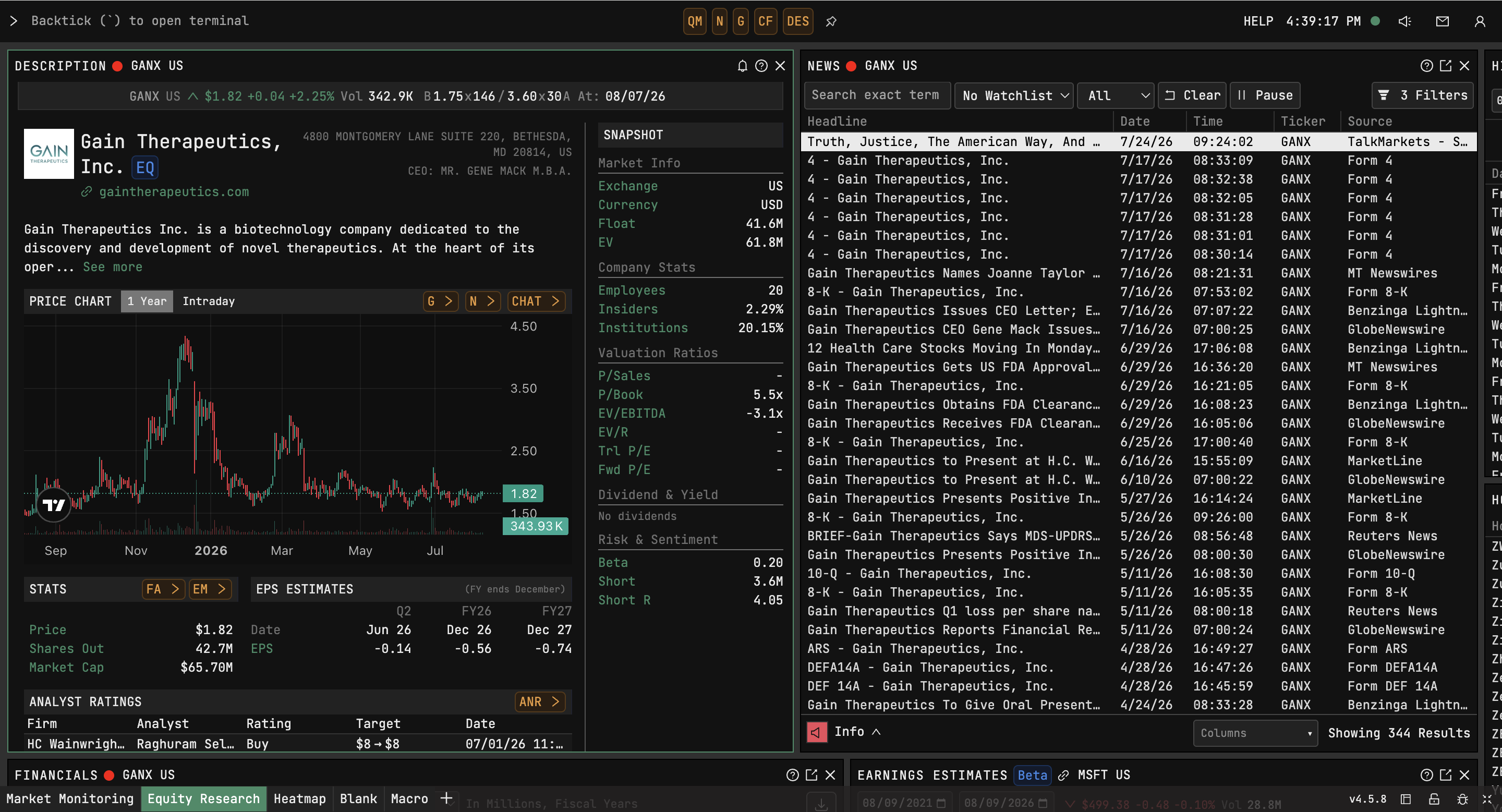
A browser-based research terminal with a Bloomberg-style command interface: DES, FOCUS, TAS, HDS. Real-time quotes, filings, financials, ownership and news, at $996 a year against Bloomberg's roughly $27,000.
I use it for the filing and ownership work behind the deep dives, the part that used to mean six browser tabs and a spreadsheet. It handles research and analysis; order execution and dealer chat are not in it, so it sits alongside a broker rather than replacing one. There is a 14-day trial, so the cheapest way to judge it is to run it against whatever you use now.
Disclosure: this is a referral link and mungbeans.io earns a commission if you subscribe, at no extra cost to you. The discount code is why it is here; the recommendation is because I pay for it myself. The site carries no advertising, and every paid link is listed on one page.
Get the work as it publishes
One list: weekly signal reports when stocks cross the line, and every deep dive as it goes up.
No spam. Unsubscribe anytime.
Not financial advice. This is an educational tool. Past performance does not guarantee future results. Do your own research before making investment decisions.