Alphabet (GOOGL): Berkshire's Bet on the AI Era
The Setup
Alphabet closed the week of May 16 at $396.78 — up 140% from its January 2025 low of $165, 130% above its 200-week moving average of $172, and within 3% of its all-time high of $409.
This is not a “below the line” setup. By every metric in the mungbeans screener, GOOGL is far from signaling a dislocation entry. But Berkshire Hathaway — in its first 13F filing under new CEO Greg Abel — disclosed that it tripled its Alphabet position in Q1 2026, making it a top-ten holding worth over $7 billion. When the most disciplined capital allocator in history buys aggressively, it’s worth running the framework even without a technical signal.
The question isn’t whether Alphabet is a great business. It is. The question is whether $397 is a price where the risk/reward favors entry — or whether Berkshire got a better deal than what’s available today.
Layer 1: Earnings Quality — Is the Company What It Claims to Be?
The Revenue Machine
Alphabet reported $109.9 billion in Q1 2026 revenue, up 22% year-over-year and the 11th consecutive quarter of double-digit revenue growth. For context, this is a $4.8 trillion company growing top-line revenue faster than most mid-caps.
The revenue breakdown tells the story of a multi-engine growth company. Google Search and related services remain the core at roughly $50 billion per quarter. YouTube advertising continues to grow. Google Cloud — the crown jewel of the growth narrative — hit $20 billion in Q1, up 63% year-over-year, with operating margins of 32.9%. Subscriptions, platforms, and devices round out the portfolio.
Four-year revenue progression: $283B (2022) → $307B (2023) → $350B (2024) → $403B (2025), with 2026 tracking to approximately $440B at the Q1 run rate. Analysts project $487B for full-year 2026.
The Profitability Story
Net income has more than doubled: $60B (2022) → $74B (2023) → $100B (2024) → $132B (2025). Profit margin expanded from 21.2% to 37.9% over this period. ROE is 38.9% — elite among mega-caps and among the best in the entire S&P 500.
Gross margin has steadily improved: 55.4% → 56.6% → 58.2% → 59.7%. This is a business with expanding pricing power, not compressing margins.
Where the Cash Flow Diverges
Here’s the problem: free cash flow has flatlined while net income doubled.
| Year | Revenue | Net Income | FCF | FCF Yield | CapEx |
|---|---|---|---|---|---|
| 2022 | $283B | $60B | $60B | 5.1% | ~$31B |
| 2023 | $307B | $74B | $69B | 3.9% | ~$32B |
| 2024 | $350B | $100B | $73B | 3.1% | ~$52B |
| 2025 | $403B | $132B | $73B | 1.8% | ~$91B |
| 2026 (Q1 ann.) | ~$440B | — | ~$40B* | 0.6%* | ~$143B* |
*Q1 2026 annualized: $10.1B quarterly FCF × 4 = ~$40B; $35.7B quarterly capex × 4 = ~$143B. Full-year capex guidance is $180-190B.
The FCF yield compression from 5.1% to 0.6% in four years is extraordinary. This isn’t happening because the business is deteriorating — it’s happening because management is converting an ever-larger share of operating cash flow into AI infrastructure. Q1 2026 FCF margin fell to 9.2% from 21% a year earlier.
Layer 1 Verdict: MIXED. Revenue quality is exceptional — 22% growth at this scale is remarkable. Profitability is elite. But the cash generation that underpins equity valuation is being redirected into capex at an accelerating rate. The earnings are real. The free cash flow compression is also real.
Layer 2: Financial Distress — Can This Company Survive?
This is not a question anyone is seriously asking about a $4.8 trillion company with $95 billion in cash, but the framework demands it.
Debt-to-equity is 20.0% — the lowest among mega-cap tech (AAPL: 79.5%, AMZN: 53.3%, MSFT: 30.3%, META: 35.6%). Total debt rose from $22.6B in 2024 to $59.3B in 2025, reflecting the capex ramp, but remains modest against the revenue base and cash reserves.
Interest coverage is not a concern at any foreseeable capex level. Alphabet could fund $185B in annual capex from operating cash flow plus modest debt issuance without financial stress.
There is no distress risk here. Alphabet could cease all AI investment tomorrow and immediately generate $100B+ in annual FCF from its existing businesses. The spending is entirely discretionary — a strategic choice, not a necessity.
Layer 2 Verdict: PASS. Pristine balance sheet. Lowest leverage among mega-cap tech. No scenario produces financial distress.
Layer 3: The 200-Week Moving Average
GOOGL’s 200WMA sits at $172.36. The current price of $396.78 is 130% above the line. This is as far from a below-the-line signal as a stock can get.
Touch History
Alphabet has crossed below its 200WMA 8 times since its 2004 IPO. What’s remarkable is the consistency of the outcome:
- 12-month return after touching: +30.5% average, 100% positive (8 for 8)
- 24-month return after touching: +63.9% average, 100% positive (8 for 8)
- Average weeks below the line: 9.0
- SPY average return over same 12-month periods: +17.2%
Every single time Alphabet has gone below the line, it’s been a buy. Not most of the time — every time, with an average 13-point premium over SPY over the subsequent year. The stock typically spends only 9 weeks below before recovering above.
This is the track record of a business with a structural competitive moat that the market periodically misprices during macro panics.
What Would It Take to Go Below the Line?
At a 200WMA of $172, GOOGL would need to fall 57% from current levels. That sounds extreme, but it hit $139 in the COVID crash (2020) and $165 in early 2025 during the tariff selloff. Both produced generational entries. The 200WMA will continue rising as the stock stays above it, so the target level is a moving one.
Layer 3 Verdict: NO SIGNAL. No 200WMA entry. No approaching signal. The touch history is extraordinarily bullish — if this stock ever goes below the line again, history says buy it aggressively.
Layer 4: Bean Score — FCF Yield Dislocation
Current Bean Score: -1.85σ (Expensive)
This is the most important number in this analysis. The Bean Score measures how far a stock’s current FCF yield has deviated from its own historical baseline, normalized by volatility. At -1.85σ, Alphabet’s FCF yield is nearly two standard deviations below its own baseline — meaning the stock is significantly more expensive than usual on a cash flow basis.
The Numbers
| Metric | Value |
|---|---|
| Current FCF Yield | 2.79% |
| Baseline FCF Yield (last earnings) | 3.74% |
| Historical Deviation Mean | -0.18 |
| Historical Deviation Std | 0.42 |
| TTM FCF | $64.4B |
| Bean Score | -1.85σ |
Dislocation Price Levels
| Level | σ | Price |
|---|---|---|
| Deep Value | +2.0σ | $120.78 |
| Value | +1.0σ | $133.49 |
| Fair Value | 0.0σ | $149.20 |
| Expensive | -1.0σ | $169.10 |
| Deep Expensive | -2.0σ | $195.12 |
At $397, GOOGL is trading more than 2x its Bean Score “Fair Value” price of $149. Even the “Deep Expensive” level of $195 is half the current price.
Why the Score Looks This Extreme
The Bean Score is calibrated to GOOGL’s own history — specifically, the relationship between its FCF yield and its baseline yield at each earnings report. The score is extreme because the FCF compression from capex is unprecedented for this company. Alphabet has never voluntarily sacrificed this much cash generation before.
This is a critical distinction: the Bean Score correctly identifies that GOOGL is expensive on a cash flow basis. But it doesn’t know whether the capex will generate returns that justify the sacrifice. If Google Cloud revenue keeps growing 50-60% annually and the $462B backlog converts, the future FCF yield could be dramatically higher than today’s — which would retroactively make today’s price a bargain.
The Bean Score measures what IS. The bull case is about what WILL BE.
Important Caveat
The Bean Score has only 2 quarters of baseline data for GOOGL (n_quarters = 2). The system recommends 4+ quarters for reliable σ readings. This score should be treated as directionally correct but not precision-calibrated.
Layer 5: The Capex Question — Growth Investment or Value Destruction?
This is the central investment question for Alphabet in 2026, and it deserves its own section.
The Scale of the Bet
Alphabet’s capital expenditure trajectory:
- 2023: ~$32B
- 2024: ~$52B (63% increase)
- 2025: ~$91B (75% increase)
- 2026 guidance: $180-190B (100% increase)
- 2027: “significantly increase” from 2026
That last point is worth sitting with. Management has guided that 2027 capex will be meaningfully higher than $185B. If it increases even 30%, that’s $240B in a single year — more than the total annual revenue of all but a handful of companies on earth.
What They’re Building
The overwhelming majority of capex goes to technical infrastructure: data centers, TPU (Tensor Processing Unit) chips, and networking equipment. Approximately $87-93B of the 2026 spend is directed specifically at Google Cloud infrastructure. This is the physical layer of the AI computing revolution — the picks and shovels.
Google Cloud’s $462B backlog (nearly doubled year-over-year) and the growing list of enterprise AI customers provide demand visibility. Meta’s commitment to Google-designed TPU clusters validates external demand. Waymo, which surpassed 500,000 fully autonomous rides per week and is pursuing a $100B+ external valuation, represents an additional optionality layer.
The Bull Case
AI compute is the new infrastructure layer of the global economy. Google is one of three companies (with Microsoft/Azure and Amazon/AWS) capable of building at this scale. Cloud revenue growing 63% with 33% operating margins demonstrates that the spending is producing returns. The $462B backlog provides multi-year revenue visibility. As cloud revenue scales and capex eventually normalizes, FCF will reaccelerate from a much larger revenue base.
The unit economics are working: Google Cloud went from unprofitable to 33% operating margins in three years while growing 63% annually.
The Bear Case
Compute commoditizes faster than the contracts pay back. The capex cycle never normalizes because the AI training/inference demand curve is an arms race — every dollar you save in efficiency, you redeploy into larger models. FCF stays compressed for years, and the stock de-rates to reflect a capital-intensive infrastructure business rather than a software-margin cash machine.
The antitrust ruling is also a tail risk. The December 2025 final judgment limits search default agreements to one-year terms (ending the multi-year exclusive deals with Apple and device manufacturers), requires data sharing with competitors, and establishes a six-year remedial framework. Google Search still commands ~90% market share, but the structural moat around default placement is weakening.
The Middle Case
Capex peaks in 2027-2028, Cloud revenue continues growing 40-50% annually, and FCF recovers to $100-120B by 2029. At a $5T market cap, that’s a 2.0-2.4% FCF yield — better than today but not cheap by historical standards. The stock delivers mid-teens annual returns driven by earnings growth but doesn’t offer the asymmetric payoff of a below-the-line entry.
Layer 6: Peer Comparison
Mega-Cap Tech at a Glance
| Metric | GOOGL | AAPL | MSFT | META | NVDA | AMZN |
|---|---|---|---|---|---|---|
| Price | $397 | $300 | $422 | $614 | $225 | $264 |
| Market Cap | $4.8T | $4.4T | $3.1T | $1.6T | $5.5T | $2.8T |
| FCF Yield | 0.6% | 2.3% | 1.2% | 1.6% | 1.1% | 0.3% |
| ROE | 38.9% | 141.5% | 34.0% | 32.9% | 101.5% | 24.3% |
| D/E | 20.0% | 79.5% | 30.3% | 35.6% | 7.3% | 53.3% |
| Bean Score | -1.8σ | -2.2σ | -1.4σ | -0.6σ | -2.4σ | N/A |
| Shares 3Y | -5.9% | -7.3% | -0.4% | -3.2% | -1.4% | +4.8% |
| FCF Trend | Growing | Declining | Volatile | Growing | Growing | Volatile |
What Stands Out
GOOGL’s advantages: Lowest D/E ratio in the group (20% vs. 30-80% for peers). Growing FCF trend (despite the capex compression). Strong buyback program (-5.9% share reduction). Highest revenue growth rate among the mature names. Buffett Quality screen: PASS. Cannibal screen: PASS. Wide Moat screen: PASS.
GOOGL’s weaknesses: Second-lowest FCF yield (0.6%, only AMZN is worse). Bean Score is the third-most-expensive reading after NVDA and AAPL. The capex trajectory is the steepest in the group on a percentage basis.
The relative value question: META at -0.6σ (near fair value on the Bean Score) with 1.6% FCF yield and growing free cash flow is arguably the better risk/reward in mega-cap tech right now. MSFT at -1.4σ is also less extended than GOOGL. GOOGL is being priced for perfection, and among this peer group, it’s not the cheapest.
Layer 7: Berkshire’s Position — What Buffett and Abel See
Greg Abel tripled Berkshire’s Alphabet stake to roughly 58 million shares in Q1 2026, worth approximately $7 billion at quarter-end and over $23 billion at current prices. This was the largest single-stock purchase in the first post-Buffett 13F filing.
What the move tells us: Abel views Alphabet as a durable business with a multi-decade competitive moat (Search dominance, YouTube, Cloud, Waymo). Berkshire’s style is to buy businesses that will be stronger in 10 years, not to trade 13-week signals. At Berkshire’s scale, they need positions worth $20B+ to move the needle — the universe of available targets is small, and Alphabet checks every quality box.
What the move does NOT tell us: that $397 is a good entry for retail investors. Berkshire’s original Q3 2025 position was built at roughly $165-175 per share. Even with the Q1 2026 averaging up (likely in the $190-250 range given the Q1 trading range), Berkshire’s cost basis is dramatically below today’s price. They can afford to be patient on a position that’s already profitable. A retail buyer at $397 does not have that cushion.
The Verdict: Wait for Better Entry
GOOGL is, unambiguously, one of the best businesses in the world. It passes every quality screen in the mungbeans framework: Buffett Quality, Wide Moat, Cannibal, growing FCF trend, elite ROE, conservative balance sheet. The 20-year track record of 21% annualized returns (vs 11% for SPY) speaks for itself. Every 200WMA touch has been a winning entry, 8 for 8.
But the framework says the price is wrong — or at least, the price is paying for a lot of things that haven’t happened yet.
The Bean Score at -1.85σ says GOOGL is expensive on a cash flow basis. Not moderately — significantly. The FCF yield has compressed from 5.1% to 0.6% in four years, driven by a capex cycle that management says will accelerate in 2027.
The 200WMA at $172 provides no technical entry signal. At 130% above the line, this is the opposite of a below-the-line setup.
The Berkshire stamp of approval is real but doesn’t change the math. Abel built this position at prices 50-60% below where the stock trades today.
The Framework’s Answer
The mungbeans approach is built for asymmetric entries — buying great businesses at dislocated prices. GOOGL is a great business at a full price. The framework says: wait.
What would change this to a buy?
- A 200WMA test — historically a once-every-few-years event that has produced 30%+ returns every time. Would require a macro shock or severe market correction.
- Bean Score normalization — either through price decline (stock gets cheaper) or FCF recovery (capex normalizes and cash generation rebounds). A Bean Score above 0σ with a below-the-line signal would be a generational setup.
- A meaningful pullback into the $250-300 range — this wouldn’t produce a formal signal but would bring the FCF yield closer to 3-4% and the Bean Score closer to neutral, improving the risk/reward substantially.
Alphabet will almost certainly be worth more in 10 years than it is today. The business quality is that high. But the mungbeans framework isn’t about buying good businesses at any price — it’s about buying good businesses at great prices. GOOGL at $397 is a good business at a price that demands everything goes right.
Data as of May 16, 2026. The Bean Score is experimental with only 2 quarters of baseline data. Not investment advice — see our disclaimer.
Godel Terminal
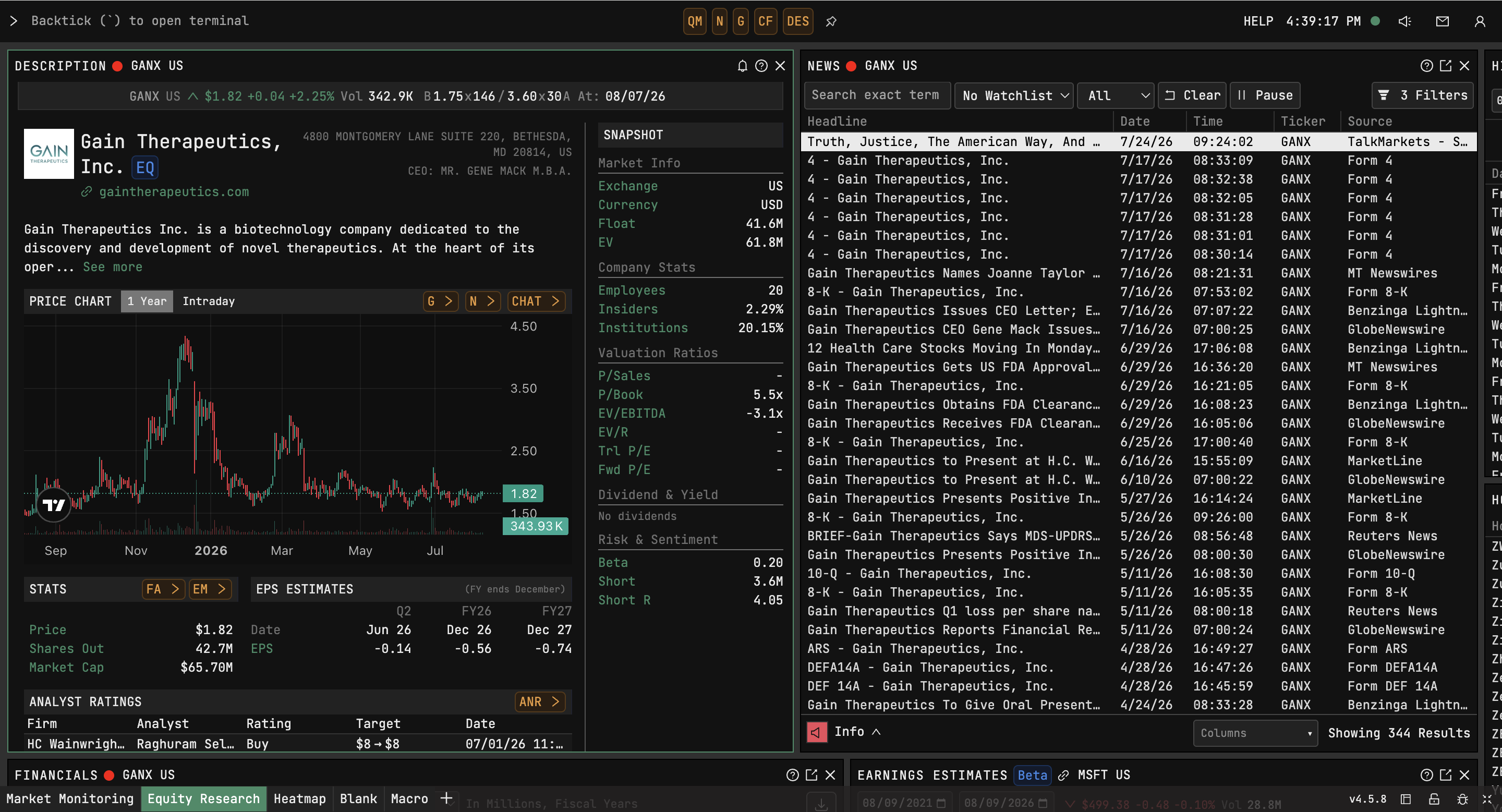
A browser-based research terminal with a Bloomberg-style command interface: DES, FOCUS, TAS, HDS. Real-time quotes, filings, financials, ownership and news, at $996 a year against Bloomberg's roughly $27,000.
I use it for the filing and ownership work behind the deep dives, the part that used to mean six browser tabs and a spreadsheet. It handles research and analysis; order execution and dealer chat are not in it, so it sits alongside a broker rather than replacing one. There is a 14-day trial, so the cheapest way to judge it is to run it against whatever you use now.
Disclosure: this is a referral link and mungbeans.io earns a commission if you subscribe, at no extra cost to you. The discount code is why it is here; the recommendation is because I pay for it myself. The site carries no advertising, and every paid link is listed on one page.
Get the work as it publishes
One list: weekly signal reports when stocks cross the line, and every deep dive as it goes up.
No spam. Unsubscribe anytime.
Not financial advice. This is an educational tool. Past performance does not guarantee future results. Do your own research before making investment decisions.