The Golden Screen: 5 Stocks Where Every Signal Says Buy
What This Is
I ran the full mungbeans screener looking for stocks where every variable points the same direction. Not just below the 200-week moving average. Not just a positive Bean Score. Every filter at once:
- Below the 200WMA
- Positive Bean Score (cheap relative to own FCF history)
- Positive free cash flow
- Cannibal (actively buying back shares)
- Growing or stable FCF trend
- Profitable (positive net margins)
- Positive ROE
- RSI below 70 (not overbought)
- Positive historical return after touching the 200WMA
98 stocks passed the base screen. I then ranked by a composite score that weights Bean Score magnitude, FCF growth, balance sheet quality, insider activity, moat characteristics, and accumulation signals. These are the top 5.
This article is a live test. I’m publishing the picks at today’s prices and tracking returns. If the screener works as a combined signal, these should outperform. If it doesn’t, I want to know that too.
The Five Picks
1. Zoetis (ZTS) — $81.32
Composite Score: 13/16 — the highest in the screen.
Zoetis is the world’s largest animal health company, spun off from Pfizer in 2013. Livestock and companion animal pharmaceuticals, vaccines, diagnostics. The kind of business that doesn’t care about tariffs, AI hype cycles, or consumer sentiment. Animals get sick regardless of the macro environment.
The stock is 48% below its 200WMA with an RSI of 24 — deep oversold territory. What put it there: the Trump administration’s tariff escalation hit animal health supply chains, Zoetis guided cautiously on international exposure, and the market sold it like a cyclical. It’s not. This is a 72% gross margin, 28% net margin business with subscription-like revenue from pet owners who don’t stop buying heartworm medication because the S&P dropped.
| Metric | Value |
|---|---|
| Bean Score | +3.31σ (Deep Value) |
| Below 200WMA | -48.2% |
| RSI | 24.0 |
| FCF Yield | 5.2% (baseline: 4.5%) |
| FCF 3Y CAGR | +19.9% |
| Shares YoY | -5.3% (cannibal) |
| ROE | 67.7% |
| Gross Margin | 71.8% |
| Net Margin | 28.0% |
| Insider Buys | 3 buys, $886K (cluster + conviction) |
| Touch History | 6 touches, +8.7% avg 12m return |
| Flags | High ROE, Wide Moat, Cluster Buy, Conviction Buy |
The Bean Score at +3.31σ means ZTS’s FCF yield is more than three standard deviations above its own baseline — the cheapest it has been since I started tracking. The stock is sitting below its own Deep Value level of $85.17, which is the price at which the Bean Score would read +2.0σ. Fair Value is $110.
The only flag: 286% D/E. But ZTS runs asset-light with a 3.15 current ratio. The debt is a capital allocation choice for buybacks, not a solvency risk. They retired 5.3% of shares outstanding in the last year.
2. Lululemon (LULU) — $127.18
Composite Score: 12/16
Lululemon is 59% below its 200WMA, the deepest discount in the group. The sell-off has been grinding: inventory concerns, slowing North American same-store sales, competition from Alo Yoga and Vuori, and the broader consumer discretionary rotation. The stock peaked near $490 in late 2023. At $127, it’s trading where it was in 2019.
What the numbers say is different from the narrative. FCF has grown at a 41% CAGR over three years. Gross margins are 57%. ROE is 34%. Debt-to-equity is 36% — one of the cleanest balance sheets in retail. The company is buying back stock aggressively (-8.5% over 3 years) and two insiders bought $1.5M worth in the last 12 months.
| Metric | Value |
|---|---|
| Bean Score | +2.33σ (Deep Value) |
| Below 200WMA | -58.8% |
| RSI | 32.4 |
| FCF Yield | 5.4% (baseline: 4.9%) |
| FCF 3Y CAGR | +41.1% |
| Shares YoY | -3.9% (cannibal) |
| ROE | 34.0% |
| Gross Margin | 56.6% |
| Net Margin | 14.2% |
| D/E | 36.2% |
| Insider Buys | 2 buys, $1.49M (conviction buy) |
| Touch History | 12 touches, +18.9% avg 12m return |
| Flags | High ROE, Wide Moat, Buffett Quality, Low Debt, Conviction Buy |
The touch history is strong: 12 prior crossings below the 200WMA with an average 18.9% return over the next 12 months. The Bean Score puts Fair Value at $163.62 and Deep Value at $115.51. At $127, LULU sits between those two levels — solidly in the value zone by its own cash flow history.
LULU is the only stock in this screen that carries the Buffett Quality flag (high ROE + low debt + wide moat). The risk is that the brand is genuinely in secular decline and the FCF growth reverses. The current numbers don’t support that thesis, but the market is pricing it.
3. Nike (NKE) — $44.67
Composite Score: 11/16
Nike needs no introduction. The stock is 47% below its 200WMA, RSI 24, with $9.2M in insider buying across 9 separate purchases in the last 12 months. That’s the heaviest insider activity of any stock in this screen.
The bull case: Nike is a wide-moat brand with global distribution that has been through management turmoil (CEO turnover, DTC strategy reversal, inventory bloat) and come out the other side. The bear case: margins have compressed (operating margin down to 6.9%), FCF has been declining (-9.6% 3Y CAGR), and the competitive landscape is tougher than it’s been in decades.
| Metric | Value |
|---|---|
| Bean Score | +1.77σ (Value) |
| Below 200WMA | -46.7% |
| RSI | 24.2 |
| FCF Yield | 2.0% (baseline: 1.4%) |
| FCF 3Y CAGR | -9.6% |
| Shares YoY | -1.8% (cannibal) |
| ROE | 16.0% |
| Gross Margin | 40.9% |
| Net Margin | 4.8% |
| D/E | 79.3% |
| Insider Buys | 9 buys, $9.19M (cluster + conviction) |
| Touch History | 25 touches, +31.2% avg 12m return |
| Flags | High ROE, Wide Moat, Cluster Buy, Conviction Buy |
The touch history is excellent: 25 prior crossings with a 31.2% average 12-month return. That’s the best bounce rate in this group by a wide margin. Nike tends to overshoot on the downside and snap back hard.
The negative FCF trend is the one red mark. FCF is positive and the company is still buying back shares, but the trajectory isn’t improving. If the turnaround under the new leadership team stabilizes margins, the current price is a gift. If margins keep compressing, the Bean Score will recalibrate lower. The insiders are betting on the former — $9.2M is real money.
4. KBR (KBR) — $33.46
Composite Score: 10/16
KBR is a government services and engineering company that most retail investors haven’t heard of. Defense technology, space, cybersecurity, energy transition engineering. Revenue is ~70% U.S. government, which provides a stable base with long contract durations.
The stock dropped 36% below its 200WMA on a combination of defense budget uncertainty and a general sell-off in government contractors. The fundamentals didn’t break. FCF grew at a 16.6% CAGR over three years. The company bought back 7.4% of shares outstanding over three years. Four insiders bought $945K in stock.
| Metric | Value |
|---|---|
| Bean Score | +2.67σ (Deep Value) |
| Below 200WMA | -36.2% |
| RSI | 34.9 |
| FCF Yield | 5.9% (baseline: 10.9%) |
| FCF 3Y CAGR | +16.6% |
| Shares YoY | -4.5% (cannibal) |
| ROE | 29.1% |
| Gross Margin | 14.5% |
| Net Margin | 5.2% |
| D/E | 176.9% |
| Insider Buys | 4 buys, $945K (cluster buy) |
| Touch History | 13 touches, +29.1% avg 12m return |
| Flags | High ROE, Cluster Buy |
The Bean Score at +2.67σ is the second highest in the group. The touch history shows a 29.1% average return after crossing below the line — KBR tends to bounce. Low gross margins (14.5%) are normal for government contracting; the business model runs on volume and contract renewals, not pricing power.
The D/E of 177% is elevated but manageable for a company with predictable government revenue. The real catalyst here is the defense spending cycle. If the U.S. defense budget holds or grows, KBR’s backlog converts to revenue and the stock re-rates. If there are meaningful cuts, the thesis weakens regardless of what the screener says.
5. Comcast (CMCSA) — $25.20
Composite Score: 10/16
Comcast is the most aggressive cannibal in this group — 14.6% of shares retired over three years. The company is essentially shrinking itself while growing FCF at a 15% CAGR. That math works in shareholders’ favor as long as the revenue base holds.
The bear case is well-known: cord-cutting, broadband competition from fixed wireless (T-Mobile, Verizon), and the Universal theme parks business that’s sensitive to consumer spending. The stock is 22% below its 200WMA, the shallowest discount here, but the Bean Score at +2.23σ says it’s cheap relative to its own history.
| Metric | Value |
|---|---|
| Bean Score | +2.23σ (Deep Value) |
| Below 200WMA | -22.2% |
| RSI | 26.6 |
| FCF Yield | 4.5% (baseline: 18.0%) |
| FCF 3Y CAGR | +15.0% |
| Shares 3Y | -14.6% (cannibal) |
| ROE | 20.9% |
| Gross Margin | 70.1% |
| Net Margin | 15.0% |
| D/E | 106.9% |
| Dividend Yield | ~5.2% |
| Insider Buys | 0 |
| Touch History | 25 touches, +29.1% avg 12m return |
| Flags | High ROE, Wide Moat |
At $25.20, CMCSA is almost exactly at its Deep Value level ($25.08). The 5.2% dividend yield adds a paid-to-wait component that the other picks lack. The 25-touch history with 29.1% average returns suggests Comcast tends to recover from below-the-line visits.
The gap between current FCF yield (4.5%) and baseline (18.0%) is the widest in the group. That baseline was set during a period of unusually high FCF generation, so the Bean Score may be partially reflecting a reversion to a lower-FCF normal rather than a genuine dislocation. Something to watch as the baseline recalibrates with more quarters of data.
No insider buying is the one missing signal. Management is buying back stock aggressively at the corporate level but nobody is reaching into their personal accounts.
Head to Head
| ZTS | LULU | NKE | KBR | CMCSA | |
|---|---|---|---|---|---|
| Price | $81.32 | $127.18 | $44.67 | $33.46 | $25.20 |
| Market Cap | $34.1B | $15.2B | $66.2B | $4.2B | $90.0B |
| Below 200WMA | -48.2% | -58.8% | -46.7% | -36.2% | -22.2% |
| Bean Score | +3.31σ | +2.33σ | +1.77σ | +2.67σ | +2.23σ |
| RSI | 24.0 | 32.4 | 24.2 | 34.9 | 26.6 |
| FCF Yield | 5.2% | 5.4% | 2.0% | 5.9% | 4.5% |
| FCF 3Y CAGR | +19.9% | +41.1% | -9.6% | +16.6% | +15.0% |
| Shares 3Y | -8.4% | -8.5% | -6.0% | -7.4% | -14.6% |
| ROE | 67.7% | 34.0% | 16.0% | 29.1% | 20.9% |
| Gross Margin | 71.8% | 56.6% | 40.9% | 14.5% | 70.1% |
| Net Margin | 28.0% | 14.2% | 4.8% | 5.2% | 15.0% |
| D/E | 286.2% | 36.2% | 79.3% | 176.9% | 106.9% |
| Div Yield | 2.6% | — | 3.7% | 2.0% | 5.2% |
| Insider $ 12m | $886K | $1.49M | $9.19M | $945K | $0 |
| 12m Avg Return | +8.7% | +18.9% | +31.2% | +29.1% | +29.1% |
| Composite | 13 | 12 | 11 | 10 | 10 |
What I’m Watching
This is a diversified basket by design: healthcare (ZTS), consumer discretionary (LULU, NKE), industrials/defense (KBR), and media/telecom (CMCSA). If the screener is working as intended, the combined signal should produce better risk-adjusted returns than any single variable alone.
The performance tracker at the top of this page will update with returns from the publish date. The test isn’t whether each stock goes up — individual names can and will disappoint. The test is whether the basket, selected by requiring every filter to align simultaneously, beats the S&P 500 over 6 and 12 months.
Check back, or don’t. The numbers will speak for themselves.
Data as of May 23, 2026. The Bean Score is experimental with limited baseline history. Not investment advice — see our disclaimer.
Godel Terminal
A browser-based research terminal with a Bloomberg-style command interface: DES, FOCUS, TAS, HDS. Real-time quotes, filings, financials, ownership and news, at $996 a year against Bloomberg's roughly $27,000.
I use it for the filing and ownership work behind the deep dives, the part that used to mean six browser tabs and a spreadsheet. It handles research and analysis; order execution and dealer chat are not in it, so it sits alongside a broker rather than replacing one. There is a 14-day trial, so the cheapest way to judge it is to run it against whatever you use now.
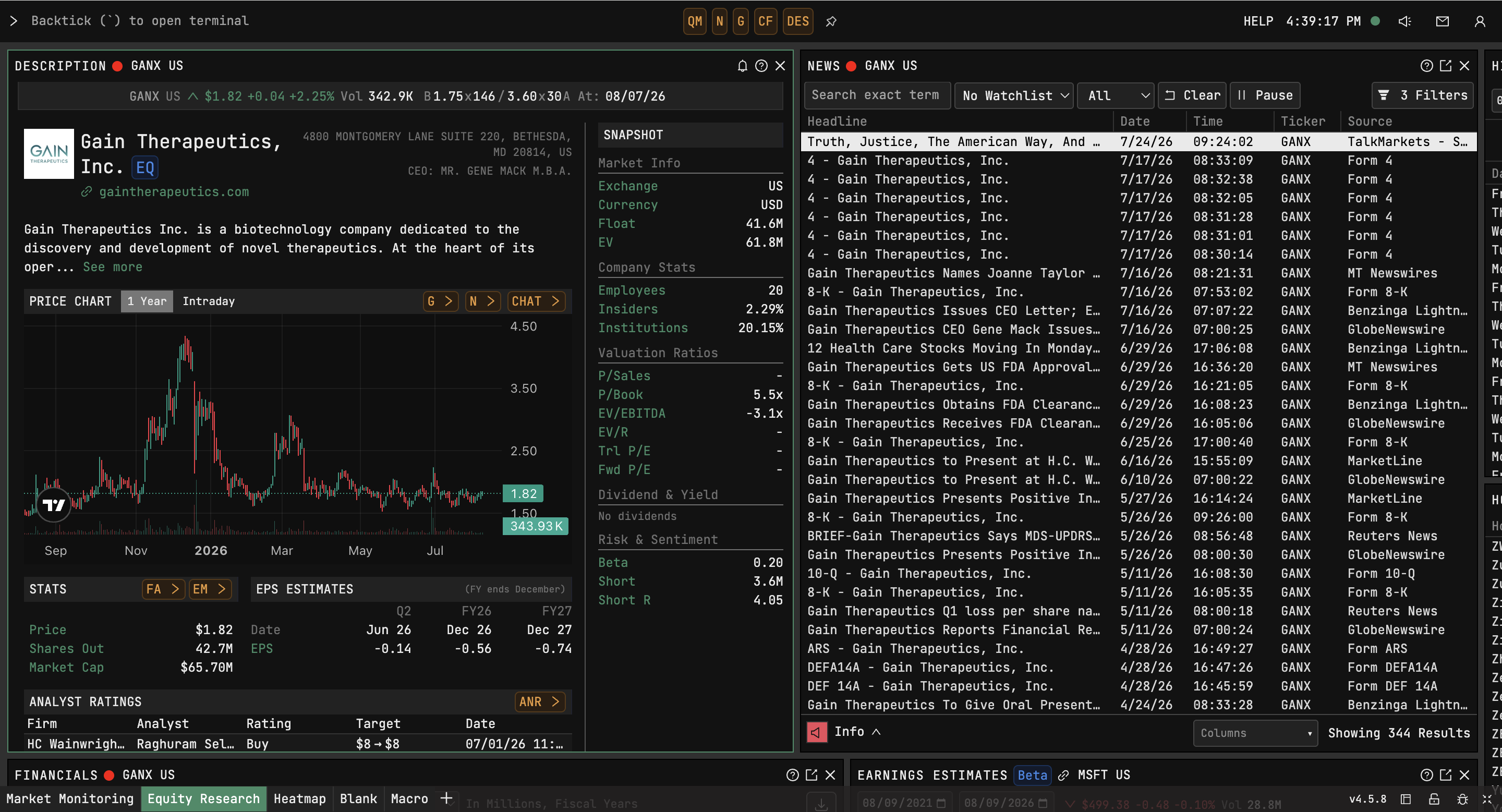
Disclosure: this is a referral link and mungbeans.io earns a commission if you subscribe, at no extra cost to you. The discount code is why it is here; the recommendation is because I pay for it myself. The site carries no advertising, and every paid link is listed on one page.
Get the work as it publishes
One list: weekly signal reports when stocks cross the line, and every deep dive as it goes up.
No spam. Unsubscribe anytime.
Not financial advice. This is an educational tool. Past performance does not guarantee future results. Do your own research before making investment decisions.