Fidelity National Information Services (FIS): Deep Value or Value Trap?
The Setup
FIS closed mid-April at approximately $49.70 — down 26% from its 200-week moving average of $67.37, roughly 25% year-to-date, and about 67% from its 2021 high of $150. The stock is in its sixth crossing below the 200WMA in five years.
The easy narrative is that FIS is a serial underperformer — a company that destroyed $17.7 billion in shareholder value with the Worldpay acquisition, spent three years cleaning up the mess, and now can’t get out of its own way. The stock has been dead money since 2021. Why would this time be different?
The answer is structural. FIS in April 2026 is a fundamentally different business than FIS in 2022. The Worldpay merchant payments division — the thing that blew up the balance sheet and distracted management for four years — is gone. In its place, FIS acquired Global Payments’ Issuer Solutions business (formerly TSYS) for $13.5 billion in January 2026, creating the largest pure-play banking and capital markets technology company in the world.
The question isn’t whether FIS had problems. It did, and they were severe. The question is whether the market is still pricing in a disaster that has already been resolved.
Layer 1: Earnings Quality — Is the Company What It Claims to Be?
The Accruals Check
FIS reported GAAP net income that remains distorted by the Worldpay write-downs, restructuring charges, and acquisition accounting. The trailing PE of 69x is meaningless — it reflects non-cash charges from a business unit FIS no longer owns, not the earning power of the continuing operations.
The relevant metric is free cash flow. FIS reported $1.6 billion in GAAP free cash flow for FY2025 (the fiscal year ending December) and $2.2 billion in adjusted free cash flow, up 18-19% year-over-year. On a trailing-twelve-month basis as of the most recent data, GAAP FCF runs at approximately $1.9 billion — the improvement reflects the Issuer Solutions acquisition closing in January 2026. Operating cash flow of $2.8 billion against adjusted net income of approximately $3.3 billion (based on $5.75 adjusted EPS × ~575M diluted shares) gives a cash conversion ratio of roughly 0.85x — acceptable but not exceptional.
The gap between GAAP and adjusted figures is larger than we’d like to see. FIS defines “adjusted” to exclude acquisition, integration, and transformation costs. Those were real cash expenditures — approximately $200 million in integration costs related to the Issuer Solutions deal alone — that the adjusted figures don’t capture. We prefer to anchor on the TTM GAAP FCF of ~$1.9 billion, noting that the integration costs are temporary and management expects them to roll off by 2028.
Stock-Based Compensation
FIS’s buyback yield is 6.34%, indicating the company is retiring shares aggressively. This is a meaningful positive — management is using the depressed share price to reduce the float rather than issuing equity to fund acquisitions. No specific SBC figure was available, but the net share count has been declining, which means buybacks exceed dilution.
Revenue Quality: Recurring and Mission-Critical
This is where FIS shines. Q4 2025 banking revenue grew 8.3%, with recurring revenue up 8.8%. Capital markets revenue grew 5.6% with recurring revenue up 5.3%. Full-year revenue was $10.7 billion, up 5.8%.
FIS processes transactions for banks. Its software runs core banking systems, payment processing, risk management, and capital markets settlement. Banks don’t switch core technology providers — the switching costs are measured in years and hundreds of millions of dollars. FIS’s revenue is structurally sticky in a way that most technology companies can only dream of.
Layer 1 Verdict: PASS WITH CAVEATS. Cash flow is positive and growing. Revenue is high-quality and recurring. The gap between GAAP and adjusted numbers warrants caution, but the underlying business is generating real cash. The trailing PE is garbage — ignore it and use forward PE (7.3x) or FCF yield (7.2%).
Layer 2: Financial Distress — Can This Company Survive?
FIS carries approximately $13.3 billion in total debt against $599 million in cash — a net debt position of roughly $12.7 billion. Debt-to-equity is 91%. Interest coverage is 5.9x EBIT on an annual basis, though quarterly coverage dipped to 3.7x in mid-2025 during the transition period.
This is not a clean balance sheet. The $13.5 billion Issuer Solutions acquisition was partially debt-financed, and the leverage ratio is higher than we’d want for a long-term hold. FIS needs to execute on its debt paydown plan.
However, context matters. FIS’s debt is investment-grade rated and the company’s recurring revenue base provides highly predictable cash flows to service it. Operating cash flow covered 21% of total debt in the most recent period. Management has stated a target of $3 billion+ in free cash flow by 2028, which would represent roughly 23% of current debt — a reasonable delevering trajectory.
The short-term liquidity picture is tighter: short-term assets of $4.4 billion don’t cover short-term liabilities of $7.4 billion. This is common for financial technology companies that carry settlement-related liabilities, but it’s worth monitoring.
Layer 2 Verdict: CAUTION. FIS is not in distress, but it’s carrying meaningful leverage from the Issuer Solutions acquisition. The debt is serviceable given the recurring revenue profile, but execution on the delevering plan matters. This is not a pristine balance sheet like Adobe’s — it’s a company that has made a big bet and needs time to work through it.
Layer 3: Value Creation — Is This Business Worth Running?
ROIC vs. WACC
FIS’s current ROIC is approximately 4.1-4.5%, which is low. For context, its 3-year median is 2.7%, so the current level represents improvement — but this is still a company that barely earns its cost of capital.
The low ROIC is the echo of the Worldpay disaster. When you acquire a business for $43 billion, write down $17.7 billion of it, and spend four years restructuring, the invested capital base is bloated relative to current earnings. The denominator is enormous because of past mistakes.
What matters going forward is whether the new FIS — banking + capital markets + issuer solutions — can generate returns that justify the current invested capital. Management guides to 30-31% adjusted revenue growth in 2026 (reflecting the full year of Issuer Solutions), adjusted EPS of $6.22-$6.32, and FCF growth to $3 billion by 2028. If they hit those targets, ROIC will improve materially as earnings grow against a stabilizing capital base.
Margin Profile
Gross margin is 36.65%. Operating margin is 22.09%. These are solid for a financial technology infrastructure company — not software-company margins, but FIS runs data centers, processes physical transactions, and employs thousands of compliance and operations staff. The margin structure is appropriate for the business model.
Management guided to 40-45 basis points of margin expansion in 2025 and the Issuer Solutions integration should drive further expansion as duplicate costs are eliminated.
Comparison to Peers
| Company | Forward PE | Revenue Growth | FCF Yield | Signal |
|---|---|---|---|---|
| FIS | 7.3x | 30%* | 7.2% | Deep discount |
| Fiserv (FI) | ~18x | ~8% | ~4% | Premium priced |
| Jack Henry (JKHY) | ~28x | ~7% | ~3% | Significant premium |
| Global Payments (GPN) | 4.2x | ~5% | 9.2% | Also cheap |
| PayPal (PYPL) | 7.8x | ~5% | 7.7% | Comparable |
*FIS 2026 revenue growth includes Issuer Solutions acquisition; organic growth is ~6-8%.
FIS trades at a steep discount to Fiserv and Jack Henry despite similar business models (core banking technology). Part of this discount is earned — FIS’s Worldpay era genuinely destroyed value. But at 7.3x forward earnings, the stock is priced as if the destruction is ongoing. It isn’t.
Layer 3 Verdict: INCOMPLETE — IMPROVING. Current ROIC is mediocre, a hangover from the Worldpay period. But the forward trajectory matters more than the rearview. If management executes on the integration and hits $3 billion FCF by 2028, this becomes a high-quality compounder at a deep discount. If they stumble, the low ROIC persists.
Layer 4: Structural Fragility — What Could Break This?
The Worldpay Hangover: Resolved or Recurring?
FIS’s story from 2019 to 2025 is a cautionary tale about empire-building through acquisition. The company paid $43 billion for Worldpay in 2019, watched the merchant payments business underperform as Stripe, Adyen, and Square ate market share, wrote down $17.7 billion, divested the unit, settled a $210 million investor lawsuit, and spent four years restructuring.
The bull case says this chapter is closed. As of January 2026, FIS has fully exited Worldpay (selling its remaining minority stake to Global Payments) and replaced it with the Issuer Solutions business — credit card issuance technology that complements FIS’s existing banking platform. The company is now a focused banking/capital markets technology provider rather than a sprawling fintech conglomerate.
The bear case says management that made a $43 billion mistake might make another one. The Issuer Solutions acquisition at $13.5 billion is a big bet. If integration goes poorly — if clients churn, synergies don’t materialize, or the credit issuance market softens — FIS will find itself on the wrong side of leverage again.
The AI Opportunity and Risk
FIS is leaning hard into AI. The company launched agentic AI tools for banks (TreasuryGPT, Banker Assist) and recently introduced a commerce product enabling banks to transact with AI agents. Management describes “accelerating 20% growth in recurring ACV” partly driven by AI upselling.
The opportunity is real: banks are technology laggards that desperately need modernization, and FIS sits at the center of their tech stack. If FIS can be the AI bridge for mid-market and regional banks, it’s a genuine growth catalyst.
The risk is execution. FIS is not a cutting-edge AI company — it’s a technology infrastructure provider bolting AI capabilities onto legacy systems. If the AI tools don’t work well enough to justify premium pricing, the narrative collapses.
Revenue Concentration and Customer Risk
FIS serves approximately 80% of the world’s largest financial institutions. This is both a moat and a concentration risk. Winning a contract like the Mizuho deal (announced Q4 2025) can move the needle significantly, but losing a major bank could create a similarly large hole.
The saving grace is switching costs. Banks don’t leave core technology providers easily. But they do renegotiate contracts downward when they have leverage — and in a consolidating banking industry, surviving institutions have more leverage than ever.
Iran-Hormuz Crisis Exposure
FIS processes financial transactions — it doesn’t ship goods through the Strait of Hormuz. The direct impact of the Iran crisis on FIS’s business is negligible. What matters is the second-order effect: if the crisis triggers a broader economic slowdown, bank transaction volumes decline, and FIS’s revenue growth slows.
However, FIS’s banking infrastructure revenue has historically been among the most recession-resistant categories in technology. Banks may cut lending and reduce headcount in a downturn, but they don’t turn off their core banking systems.
Layer 4 Verdict: MODERATE RISK. The Worldpay chapter is genuinely closed, but the Issuer Solutions integration is the new execution risk. AI is a real catalyst if management delivers, but FIS isn’t a natural AI leader. The business is structurally defensive — banking infrastructure doesn’t disappear — but the leverage means less room for error.
Layer 5: Informed Sentiment — What Do Insiders and Shorts Know?
Insider Activity
Director Jeffrey Goldstein — the independent Chairman of the Board — has been buying shares through a 10b5-1 plan. He acquired 1,197 shares at $47.39 in April 2026 and 941 shares at $64.11 in January 2026. These are relatively small purchases ($57K and $60K respectively), but the direction matters: the board chairman is adding to his position as the stock falls, not selling into the decline.
CEO Stephanie Ferris reported a March 2026 disposition of 12,265 shares at $51.05 — but this was a tax-related sale (code F), not an open-market decision to reduce exposure. Total insider transactions in 2026 were 25, totaling $3.6 million, predominantly tax-related dispositions and equity award conversions.
No red flags here. The chairman is buying. The CEO’s only sale was tax-related.
Short Interest
Short interest declined 21.7% from January to February 2026, from 16.0 million shares to 12.5 million shares. Current short interest is 2.4% of the float — a low level that indicates limited bearish conviction among institutional investors.
The declining short interest is a mild positive. Shorts are covering, not pressing.
Analyst Consensus
15 analysts cover FIS with an average rating of “Buy.” The average 12-month price target is $73.71, implying 55% upside from current prices. This is a wide gap between where the stock is and where the street thinks it should be.
Layer 5 Verdict: MILDLY POSITIVE. Board chairman buying, declining short interest, no insider selling beyond tax obligations, and unanimous Buy-side bullishness. The sentiment data doesn’t reveal hidden problems.
Traditional Valuation Metrics
| Metric | Current | Context | Signal |
|---|---|---|---|
| Trailing P/E | 69.1x | Distorted by write-downs | Ignore |
| Forward P/E | 7.3x | vs. peer avg ~18x | Extreme discount |
| FCF Yield (TTM) | 7.2% | On GAAP FCF of $1.9B | Attractive |
| EV/Revenue | ~2.4x | vs. Fiserv ~6x | Significant discount |
| Dividend Yield | 3.3% | Covered by FCF | Stable |
| Buyback Yield | 6.3% | Aggressive repurchase | Shareholder-friendly |
| Debt/Equity | 91% | Post-acquisition elevated | Monitor |
At 7.3x forward earnings, FIS is priced like a declining business in a cyclical industry. It’s actually a recurring-revenue infrastructure company guiding to 30% revenue growth and 27-33% FCF growth. The disconnect is stark.
The comparison that matters: Fiserv (FI), FIS’s closest peer, trades at roughly 18x forward earnings despite similar growth rates in its core banking segment. That’s a 2.5x valuation premium for a nearly identical business model. Even if you argue FIS deserves a discount for its execution history, 60% cheaper seems excessive.
DCF Sanity Check
If FIS hits $3 billion in FCF by 2028 (management’s target) and trades at a conservative 12x FCF — well below Fiserv’s current multiple — the implied equity value is $36 billion, or roughly $67 per share. That’s the 200WMA. At 15x FCF (still a discount to peers), you get $84 per share, or roughly 70% upside.
Even applying a significant haircut for execution risk and discounting the 2028 FCF back to today at a 10% rate, you arrive at a price meaningfully above $50.
Crossing History: What the Line Tells Us
FIS has crossed below its 200WMA six times since 2021. That’s a relatively high frequency for five years, and on its own, it would be a yellow flag in our framework — rare crossers outperform chronic crossers by a wide margin.
But the context for these crossings reveals something important:
Crossings 1 and 2 (September–October 2021): Shallow dips of -0.24% and -2.12%. FIS bounced back in one week each. These were noise — the stock briefly touched the line and recovered immediately. Normal for a stock beginning a downturn; the 200WMA hadn’t caught up yet.
Crossing 3 (October 2021): The big one. FIS crossed at -10% below the line and didn’t recover for 154 weeks — nearly three years. During that time, the stock fell as far as $44.49, a maximum drawdown of -55% from the crossing price. This was the Worldpay implosion: the $17.7 billion write-down, the strategic review, the eventual spin-off. The market was right to sell. The episode returned -15.5% while the S&P 500 gained 31.2% — a 47-point underperformance.
Crossings 4 and 5 (December 2024 – April 2025): Post-Worldpay divestiture. Crossing 4 was a shallow -0.13% dip that resolved in 8 weeks. Crossing 5, in February 2025, was deeper at -15.36% — and this one recovered in 10 weeks with a +15.6% return, beating the S&P 500 by 24.6 points. This episode behaved exactly like a typical deep crossing: a sharp dislocation followed by a strong snap-back.
Crossing 6 (current, entered ~August 2025): FIS is now 26% below the line.
The pattern tells a story. Crossings 1-3 were one event — the Worldpay catastrophe — spread across three separate dips as the situation deteriorated. Crossings 4-5 were the post-restructuring volatility, and the deeper one recovered quickly and strongly. The company’s crossing history is not six independent episodes of a structurally weak stock. It’s one genuine disaster (Worldpay), a brief post-restructuring wobble, and the current dip.
The current crossing is deeper than any of the post-restructuring episodes. At -26%, FIS is back in territory that historically delivers strong recoveries for S&P 500 stocks — our framework data shows a median episode return of +34% for crossings deeper than -20%, with a 76% beat rate against the index.
But the clock is ticking. The episode started approximately 37 weeks ago. Our framework shows that episodes lasting 26+ weeks underperform the S&P 76% of the time. FIS is past that checkpoint, which means the base rate has flipped against it. This is the tension at the core of the trade: the depth says buy, the duration says be careful.
The Bear Case
- Issuer Solutions integration fails. The $13.5 billion acquisition is the bet. If client migration is bumpy, if the revenue synergies don’t materialize, or if the credit card issuing market softens, FIS will have another billion-dollar problem on an already-levered balance sheet.
- The ROIC never recovers. At 4%, FIS is barely earning its cost of capital. If returns on the new combined entity don’t improve, this remains a value trap regardless of the multiple — you’re buying a business that doesn’t generate economic profit.
- Management credibility. The team that overpaid for Worldpay is largely the same team running the company today. CEO Stephanie Ferris was the CFO who oversaw the Worldpay-era financials. Investors may demand a deeper discount as a management risk premium, and they might be right to do so.
- Debt servicing in a downturn. $13.3 billion in debt with $599 million in cash is fine when revenue is growing and interest rates are manageable. It’s less fine if a recession compresses bank transaction volumes and FIS’s revenue growth stalls.
- Duration risk. The stock has been below the 200WMA for 37+ weeks. Our framework data is clear: the longer the episode, the worse the odds. Most stocks that haven’t recovered by now have something genuinely wrong.
The Bull Case
- The Worldpay cancer has been fully excised. This is not a cosmetic change. FIS sold the entire Worldpay position and acquired a complementary business (Issuer Solutions) that fills a gap in the product suite. The thing that destroyed value is gone. The thing that replaced it makes strategic sense.
- 7.3x forward earnings for a recurring-revenue infrastructure company. FIS processes transactions for 80% of the world’s largest financial institutions on mission-critical systems with years-long switching costs. This profile typically commands 15-20x earnings. At 7.3x, the market is pricing in catastrophe.
- FCF is inflecting. $1.6 billion GAAP FCF in 2025, guided to $2.05-$2.15 billion in 2026, targeting $3 billion+ by 2028. If they’re even in the right zip code on the 2028 number, the current valuation is nonsensical.
- The chairman is buying. Not a lot, but at $47.39 in April 2026, the independent board chairman put personal money into the stock. Insiders don’t buy falling stocks to be polite.
- Banks need what FIS sells. Core banking modernization, AI-powered tools, cloud-native clearing, issuer processing — these are not discretionary purchases. Banks must modernize or die, and FIS sits at the center of their technology stack. The Iran crisis, trade uncertainty, and broader macro volatility don’t change this structural need.
- The last deep crossing worked. The February 2025 crossing at -15.36% recovered in 10 weeks with a +15.6% return and beat the S&P by 24.6 points. This current crossing is deeper, which historically means more upside if recovery occurs.
Our Determination
FIS passes our forensic framework, but with more friction than a name like Adobe or Visa. The earnings quality is real but obscured by accounting noise from the Worldpay era. The balance sheet is leveraged but serviceable. The ROIC is low but improving. The structural risks are genuine but manageable.
What tips the balance is the valuation. At 7.3x forward earnings and 7.2% FCF yield, FIS isn’t priced for modest growth — it’s priced for failure. The market is looking at the Worldpay disaster through the rearview mirror and pricing the stock as if it’s still happening. It isn’t. Worldpay is gone. Issuer Solutions is in. Revenue is growing. FCF is inflecting. Shorts are covering. The chairman is buying.
Our call: Deep Value — with a tighter leash than usual.
FIS is the kind of stock our framework was designed to find: a fundamentally sound business that the market has mispriced because of a narrative that’s expired. The 26% depth below the 200WMA, the 7.2% FCF yield, and the 7.3x forward PE are all converging signals that point to a significant valuation dislocation.
But the duration concern is real. At 37+ weeks below the line, FIS is past the 13-week checkpoint and into territory where odds historically flip. The leverage adds risk that a cleaner balance sheet wouldn’t carry. And the ROIC needs to prove itself in the post-Issuer-Solutions configuration.
This is a “trust the new thesis but watch the execution” situation. If Q1 2026 results (expected soon) show continued revenue acceleration, successful Issuer Solutions integration, and progress on the delevering plan, the thesis strengthens. If they miss, the duration clock keeps ticking in the wrong direction.
What We’re Watching
- Q1 2026 earnings. The first full quarter with Issuer Solutions consolidated. Revenue trajectory, integration costs, and margin expansion are the three numbers that matter.
- FCF conversion in 2026. Management guides to $2.05-$2.15 billion. If the actual number trends toward the low end or misses, the delevering timeline extends and the thesis weakens.
- Debt reduction. Net debt of $12.7 billion needs to come down. Any progress here — even $500 million — would be a positive signal.
- Recurring revenue growth. Q4 2025 showed 8.8% recurring revenue growth in banking. This needs to hold or accelerate. A deceleration would indicate integration disruption.
- The Fiserv valuation gap. If FIS executes and the street rerates it toward even a fraction of Fiserv’s multiple, the upside is substantial. The gap should narrow as Worldpay recedes further into history.
Downside Risk & Upside Potential
Where the Stock Sits Relative to Its Moving Averages
FIS is trading 26% below its 200-week moving average of $67.37. The stock’s worst distance below the 200WMA during the Worldpay period was approximately -55% (hitting $44.49 against a 200WMA of ~$99 at the time). If the current episode deteriorated to match that historical worst relative to today’s 200WMA, the implied trough would be roughly $30 — another 40% below today’s price.
That scenario would require something genuinely catastrophic — a failed integration combined with a recession combined with a banking crisis. It’s not impossible, but it’s not the base case.
Valuation-Based Scenarios
| Scenario | Assumed EPS/FCF | Multiple | Implied Price | From Current |
|---|---|---|---|---|
| Bear case (integration stumbles, growth stalls) | $5.50 adj EPS | 8x | $44 | -11% |
| Stress case (recession + integration failure) | $4.50 adj EPS | 6x | $27 | -46% |
| Base case (execution on plan) | $6.25 adj EPS | 12x | $75 | +51% |
| Bull case (re-rating toward Fiserv) | $6.25 adj EPS | 16x | $100 | +101% |
| FCF-based (2028 $3B FCF at 12x) | $3B FCF | 12x | $67* | +35% |
*Per share assumes ~535M diluted shares.
The Range
| Price | % From Current | |
|---|---|---|
| Stress floor (6x distressed EPS) | ~$27 | -46% |
| Bear case (8x reduced EPS) | ~$44 | -11% |
| Current price | $49.70 | — |
| 200-week moving average | $67.37 | +36% |
| Analyst consensus target | ~$73.71 | +48% |
| Base case (12x forward EPS) | ~$75 | +51% |
| Bull case (16x forward EPS) | ~$100 | +101% |
The asymmetry is notable. The bear case (integration stumbles, multiples stay depressed) gives you -11%. The base case (management executes, modest re-rating) gives you +51%. The upside is roughly 5x the downside in the central scenarios.
Even the stress case at -46% requires two things to go wrong simultaneously: execution failure and recession. Meanwhile, simply returning to the 200-week moving average — which doesn’t require any multiple expansion, just normalization — delivers +36%.
This analysis uses data available as of April 17, 2026. This is not financial advice. Always do your own research before making investment decisions. The author may take a position in securities discussed.
View FIS on the mungbeans.io screener →
Analysis methodology: Mungbeans Five-Layer Forensic Screening Framework
Godel Terminal
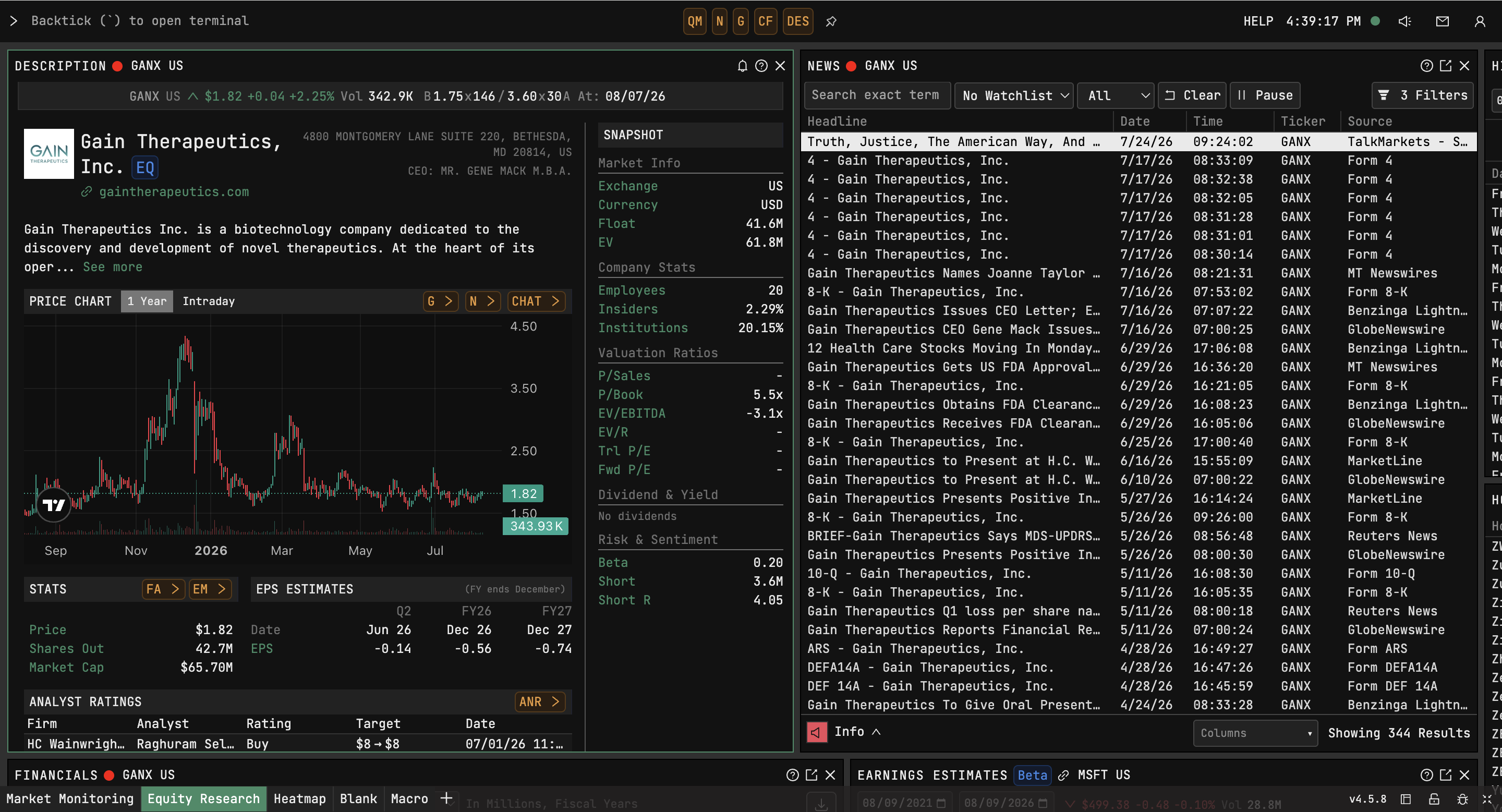
A browser-based research terminal with a Bloomberg-style command interface: DES, FOCUS, TAS, HDS. Real-time quotes, filings, financials, ownership and news, at $996 a year against Bloomberg's roughly $27,000.
I use it for the filing and ownership work behind the deep dives, the part that used to mean six browser tabs and a spreadsheet. It handles research and analysis; order execution and dealer chat are not in it, so it sits alongside a broker rather than replacing one. There is a 14-day trial, so the cheapest way to judge it is to run it against whatever you use now.
Disclosure: this is a referral link and mungbeans.io earns a commission if you subscribe, at no extra cost to you. The discount code is why it is here; the recommendation is because I pay for it myself. The site carries no advertising, and every paid link is listed on one page.
Get the work as it publishes
One list: weekly signal reports when stocks cross the line, and every deep dive as it goes up.
No spam. Unsubscribe anytime.
Not financial advice. This is an educational tool. Past performance does not guarantee future results. Do your own research before making investment decisions.