Celsius Holdings (CELH): Deep Value or Value Trap?
The Setup
Celsius Holdings closed the first week of May at approximately $32 — down 65% from its early 2024 peak of roughly $92, down 52% from its October 2025 high of $67, and sitting 28% below its 200-week moving average of $45.
This is a stock that went from $4 to $92 in four years, making it one of the great growth stories of the post-COVID era, and then gave back two-thirds of the move while the underlying business continued to grow. Q1 2026 revenue was $783 million, up 138% year-over-year. Full-year 2025 revenue was $2.5 billion, up 86% from the prior year. Celsius now commands approximately 21% of the U.S. energy drink category by dollar share — third behind Monster and Red Bull.
So why is the stock near its 52-week low?
Three things happened in sequence. First, PepsiCo — Celsius’s exclusive U.S. distribution partner — overstocked inventory in 2023, then aggressively destocked through 2024, creating a $100-120 million revenue air pocket that sent quarterly growth negative for the first time since 2018. Second, Celsius acquired Alani Nu for approximately $1.8 billion in April 2025, using significant debt and diluting shareholders. Third, the market re-rated the entire high-growth consumer sector downward as the Iran-Hormuz crisis dented consumer confidence.
The result: a company growing revenue 86% annually, trading at a forward PE of roughly 16x. For context, Monster Beverage (MNST) trades at ~28x forward earnings with mid-single-digit growth. The question is whether 16x correctly prices execution risk on the Alani Nu integration and the macro headwinds, or whether the market has overcorrected.
Layer 1: Earnings Quality — Is the Company What It Claims to Be?
The Accruals Check
Celsius generated $359 million in operating cash flow against $108 million in net income for FY2025 — a cash conversion ratio of 3.33x. This is exceptionally high and requires explanation.
The gap between OCF and net income is driven primarily by non-cash charges: $331 million in depreciation and amortization (largely from the Alani Nu acquisition, which added $2.3 billion in goodwill and intangibles to the balance sheet), $28 million in stock-based compensation, and working capital changes. The underlying cash generation is real — operating cash of $359 million and free cash flow of $323 million on $36 million in capex. This is a capital-light consumer goods business.
The net margin of 4.3% looks thin, but that’s almost entirely a function of acquisition-related amortization and one-time integration costs. The operating margin of 18.6% is more indicative of the business’s earning power, and management guides to gross margins returning to the “low 50% range” as integration is completed.
Stock-Based Compensation
SBC was $28 million in FY2025 — modest against $323 million in FCF (8.7%). Buybacks were minimal at $46 million. Capital allocation is currently focused on delevering after the Alani Nu acquisition, which is appropriate.
Revenue Quality
This is where Celsius shines. Q1 2026 revenue of $783 million, up 138% YoY, demolished estimates of $761 million. Alani Nu contributed $368 million (record sales, roughly doubling since acquisition), while the core Celsius brand continues to grow organically. Same-store velocity — the ultimate consumer demand metric for a beverage company — is positive across both brands.
The PepsiCo distribution partnership, which caused so much pain through the 2024 destocking, is now a structural advantage. Celsius moved Alani Nu into PepsiCo’s distribution system, capturing approximately $50 million in distribution synergies. The three-brand portfolio — Celsius (performance), Alani Nu (female-focused wellness), and Rockstar (core energy) — gives PepsiCo a complete energy category offering, making the relationship stickier and more strategically important.
Layer 1 Verdict: PASS. Cash conversion is excellent. FCF is real and growing. Revenue quality is strong with positive velocity trends. The thin net margin is an acquisition artifact, not a profitability problem.
Layer 2: Financial Distress — Can This Company Survive?
Celsius carries $670 million in total debt against $399 million in cash — a net debt position of $271 million. Debt-to-equity is 22.2%. Goodwill and intangibles of $2.3 billion represent 45% of total assets, reflecting the Alani Nu purchase price.
The balance sheet is manageable but not pristine. Before the Alani Nu acquisition, Celsius was essentially debt-free with $800+ million in cash (much of it from PepsiCo’s $550 million strategic investment in 2022). The $1.8 billion acquisition consumed the cash reserves and added debt.
Interest coverage is not a concern. Operating income of $469 million easily services the debt, and FCF of $323 million provides more than enough liquidity to deleverage over time.
The goodwill overhang is worth watching. At $2.3 billion, it represents the premium Celsius paid for Alani Nu. If the brand underperforms — if consumer preferences shift away from “better-for-you” energy drinks, or if competition from private-label entrants intensifies — an impairment writedown would crush reported earnings (though not cash flow).
Layer 2 Verdict: PASS. Moderate, manageable debt. Strong cash flow coverage. The goodwill overhang is the primary balance sheet risk, but the business generates enough cash to deleverage naturally.
Layer 3: Value Creation — Is This Business Worth Running?
Unit Economics
Celsius’s gross margin of 50.4% is exceptional for a beverage company and significantly higher than Monster (53%) and Red Bull (estimated 50-55%). This reflects the “better-for-you” positioning — consumers pay a premium for functional ingredients (green tea extract, ginger root, vitamins) and accept a higher price point ($2.50-$3.00 per can vs. $1.50-$2.00 for traditional energy drinks).
The capital-light model is the real story. Celsius doesn’t manufacture its own beverages — it contracts with co-packers and relies on PepsiCo for distribution. Capex was $36 million in FY2025 on $2.5 billion in revenue — a 1.4% capex-to-revenue ratio. For comparison, Coca-Cola’s capex ratio is approximately 5%, and PepsiCo’s is 5.5%. Celsius converts an extraordinary proportion of its revenue to free cash flow because it doesn’t own factories, trucks, or warehouses.
ROE is 8.1%, suppressed by the inflated equity base from the Alani Nu acquisition and the PepsiCo investment. On a pre-acquisition basis, Celsius’s capital returns were significantly higher.
Growth Trajectory
| Year | Revenue | Growth | Gross Margin |
|---|---|---|---|
| FY2022 | $654M | 108% | 41.4% |
| FY2023 | $1.32B | 102% | 48.0% |
| FY2024 | $1.36B | 2.9% | 50.2% |
| FY2025 | $2.52B | 85.5% | 50.4% |
| Q1 2026 (annualized) | ~$3.1B | 138% QoQ | TBD |
FY2024’s near-flat growth was entirely the PepsiCo destocking — underlying consumer demand never wavered. Strip out the inventory distortion and Celsius’s organic growth has been remarkably consistent. The Alani Nu acquisition, now integrated into PepsiCo distribution, adds a second growth vector.
Comparison to Peers
| Company | Forward PE | Revenue Growth | Gross Margin | FCF Yield |
|---|---|---|---|---|
| Celsius (CELH) | 16x | 138% | 50.4% | 3.9% |
| Monster (MNST) | ~28x | ~5% | 53% | ~3% |
| Coca-Cola (KO) | ~22x | ~3% | 61% | ~4% |
| Red Bull (private) | N/A | ~8% | ~50-55% | N/A |
Celsius is growing revenue 138% and trading at 16x forward earnings. Monster is growing 5% and trading at 28x. Even accounting for Celsius’s acquisition-driven growth versus Monster’s organic growth, the valuation gap is stark. If Celsius delivers even high-single-digit organic growth on top of the Alani Nu contribution, 16x is a significant discount to the peer group.
Layer 3 Verdict: PASS. Exceptional unit economics (50%+ gross margins, 1.4% capex ratio), a capital-light franchise model, and a growth rate that dwarfs the peer set. The acquisition has temporarily suppressed returns on capital, but the underlying business is a high-quality compounder.
Layer 4: Structural Fragility — What Could Break This?
PepsiCo Dependency
Celsius’s distribution is entirely through PepsiCo in the U.S. This is both the company’s greatest advantage (access to the second-largest beverage distribution network in the world) and its greatest risk (single-partner dependency). If PepsiCo decided to prioritize its own energy brands or terminate the partnership, Celsius would face a distribution crisis.
The mitigating factor: PepsiCo invested $550 million for a stake in Celsius and designated it as its “energy category captain.” That’s not a casual relationship. PepsiCo doesn’t have a credible in-house alternative — Rockstar, which PepsiCo acquired for $3.85 billion, has been losing share steadily. Celsius and Alani Nu are the growth engines in PepsiCo’s energy portfolio. The partnership is strategically aligned, not arm’s-length.
The Alani Nu Integration Bet
This is the execution risk. Celsius paid $1.8 billion for Alani Nu — roughly 5x Alani Nu’s trailing revenue and a meaningful premium for a brand that was still proving itself. The integration into PepsiCo distribution is “substantially complete” and generated $50 million in synergies, which is ahead of schedule. Alani Nu sales doubled post-acquisition.
But consumer brands are fragile. Alani Nu’s appeal is built on social media presence, influencer marketing, and a specific aesthetic that resonates with women aged 18-44. If that brand equity fades — if the next “it” wellness brand emerges — the $2.3 billion in goodwill becomes a writedown candidate.
Category Saturation
The energy drink category is crowded. Ghost, Bucked Up, Ryse, ZOA, Prime, and dozens of other entrants are competing for the “better-for-you” positioning that Celsius pioneered. Category share growth eventually plateaus. Celsius at 21% share is past the easy gains — future share expansion requires taking shelf space from Monster and Red Bull, which is harder than displacing legacy brands from new consumers.
The Lawsuit
Celsius is defending against an investor class action alleging the company oversold inventory to PepsiCo in 2023, artificially inflating revenue. The lawsuit claims the destocking wasn’t a surprise but a correction of prior channel stuffing. If this has merit, it could result in a settlement and reduced credibility. We have no evidence the claims are valid, but the overhang exists.
Layer 4 Verdict: MODERATE RISK. PepsiCo dependency is real but strategically mitigated. The Alani Nu integration is working so far. Category saturation is a medium-term concern. The lawsuit is an overhang but unlikely to impair the business.
Layer 5: Informed Sentiment — What Do Insiders and Shorts Know?
Insider Activity
Insiders have been net sellers, with approximately 45,000 shares sold ($2.83M) in the last 30 days and no reported purchases. This is a soft negative — you’d like to see buying at a 65% drawdown — but Celsius insiders have historically been sellers, and the company’s early investors and executives are sitting on enormous gains from the $4-to-$92 run. Some selling is natural portfolio management.
Short Interest
Short interest is approximately 17.4 million shares, or 8.2% of the float. This is elevated — meaningfully higher than Monster (2.6%) or most consumer staples names. The shorts are betting that the valuation re-rating has further to go, or that the Alani Nu acquisition won’t deliver.
The short interest has declined from 18.8 million shares in the prior period, suggesting some covering. But at 8.2%, there remains substantial bearish conviction.
Analyst Consensus
18 Buy ratings, 1 Hold, 0 Sells. Average 12-month price target: $63.32 — roughly 96% above the current price. Even the lowest analyst target is well above today’s $32. The street is unanimously bullish.
Layer 5 Verdict: MIXED. Insider selling and elevated short interest are negatives. Unanimous analyst Buy consensus and a $63 average price target are positives. The market is clearly divided on Celsius — institutions and analysts are bullish, while shorts and insiders (for different reasons) are positioned against.
Traditional Valuation Metrics
| Metric | Current | vs. Monster | Signal |
|---|---|---|---|
| Trailing PE | 75x* | 33x | Premium (misleading) |
| Forward PE | 16x | 28x | Steep discount |
| PEG Ratio | 0.33 | 2.1 | Extremely undervalued on growth |
| EV/EBITDA | 14.8x | 22x | Significant discount |
| P/S | 2.8x | 8.5x | Deep discount |
| FCF Yield | 3.9% | 3.0% | Higher yield at lower multiple |
*Trailing PE is inflated by acquisition-related charges that suppress net income below operating earnings power.
The valuation anomaly is striking. A PEG ratio of 0.33 means you’re paying for roughly one-third of the growth rate. Even if you haircut the 138% Q1 revenue growth to a “normalized” 20% (assuming Alani Nu anniversaries and organic growth moderates), 16x forward PE on a 20% grower with 50%+ gross margins is cheap.
The comparison to Monster is instructive. Monster is a $52 billion company growing mid-single digits at 28x forward earnings. Celsius is a $8 billion company growing triple digits at 16x. The market is pricing Celsius as though the growth is going to stall completely and the integration is going to fail. If either assumption proves wrong, the re-rating is substantial.
Crossing History: What the Line Tells Us
Celsius has no crossing episodes in our S&P 500 dataset because the stock wasn’t in the index during the period our episode data covers. CELH was added to the S&P 500 in October 2023 — a relatively recent entrant.
However, the stock is currently 28% below its 200WMA of $45. Our framework data across all S&P 500 stocks shows that crossings deeper than 20% have historically delivered a median episode return of +34% with a 76% beat rate against the index. The depth signal is loud.
What we can’t assess is crossing frequency — how often Celsius visits below the line — because we don’t have enough history. For a high-growth consumer brand that went from $4 to $92, there simply aren’t prior 200WMA crossings to reference. This stock hasn’t existed at scale long enough to have a pattern.
The lack of crossing history cuts both ways. We can’t run the rare-crosser analysis that makes the case for HD or Visa so compelling. But we can observe that Celsius’s first-ever crossing below the 200WMA is happening during a period of record revenue, positive velocity, and successful integration — not during a business deterioration. That’s the profile of a dislocation, not a structural decline.
The Bear Case
- The growth is acquisition-fueled, not organic. Strip out Alani Nu and Celsius’s organic growth moderates to high-single-digits or low-teens. At 16x forward earnings, that growth rate doesn’t justify a re-rating — it justifies the current multiple.
- PepsiCo can change the math overnight. If PepsiCo renegotiates distribution terms, shifts shelf space priorities, or decides to build its own “better-for-you” energy brand, Celsius’s unit economics deteriorate immediately. This is a single-distributor business.
- $2.3 billion in goodwill on a $8 billion market cap. If Alani Nu stumbles — if the brand loses relevance, if influencer marketing becomes less effective, if a competitor captures the female wellness energy segment — the writedown would be devastating. Goodwill impairment doesn’t affect cash flow, but it crushes reported earnings and shakes institutional confidence.
- Category maturation. Energy drinks have been the fastest-growing beverage category for a decade. Growth rates will eventually normalize. The question is whether Celsius’s 21% share holds or erodes as the category matures and private-label entrants gain traction.
- The class action lawsuit. If the court finds that Celsius engaged in channel stuffing with PepsiCo, the settlement could be significant and management credibility would be permanently damaged.
The Bull Case
- 16x forward PE on a triple-digit grower. Even if you assume growth decelerates to 15-20% (which is conservative given the Q1 2026 blowout), a PEG of 0.8-1.0x is still cheap for a consumer brand with 50%+ gross margins and a capital-light model.
- The PepsiCo relationship is deepening, not fraying. Celsius is PepsiCo’s energy category captain. Alani Nu’s integration into PepsiCo distribution doubled its sales. PepsiCo now has three complementary brands (Celsius, Alani Nu, Rockstar) covering the entire energy drink spectrum. Walking away from this portfolio would leave PepsiCo without a competitive energy strategy.
- The destocking is over. The $100-120 million inventory air pocket that crushed 2024 results is fully lapped. Q1 2026’s 138% growth proves the sell-through is real — consumers are buying the product, not just distributors stocking shelves.
- $323 million in FCF on almost zero capex. Celsius doesn’t own factories. It contracts manufacturing and outsources distribution. The business model converts nearly all operating cash flow to free cash flow. At $32 per share, you’re buying this cash flow stream at roughly 25x — expensive for a utility, cheap for a brand growing this fast.
- International expansion is untapped. Celsius has meaningful distribution in Australia, the UK, and Scandinavia, but international is less than 10% of revenue. The global energy drink market is $86 billion and growing 8%+ annually. PepsiCo’s global distribution network could accelerate international rollout in ways that are impossible for an independent brand.
- Analyst consensus: $63 target. 18 of 19 analysts rate it Buy with a target nearly double the current price. The street sees a stock that the market has temporarily mispriced.
Our Determination
Celsius passes all five forensic layers with the kind of profile our framework was built to identify: a high-quality business experiencing a temporary narrative discount that has driven the stock well below its fundamental value.
The earnings quality is excellent — 3.3x cash conversion, capital-light model, growing revenue. The balance sheet is manageable and improving. The unit economics are best-in-class for the beverage sector. The structural risks are real (PepsiCo dependency, acquisition goodwill) but mitigated by the strategic alignment and the integration performance to date. Informed sentiment is divided, which is typical at inflection points.
Our call: Deep Value.
At 16x forward earnings with 50%+ gross margins, near-zero capex requirements, and a Q1 2026 revenue number that annualizes to $3.1 billion, Celsius is trading like a mature, low-growth consumer staple. It’s not. It’s a 21% category share brand that just posted 138% revenue growth, with an untapped international opportunity and the second-largest beverage distribution network in the world behind it.
The stock is 28% below its 200WMA. The PEG ratio is 0.33. The analyst consensus target is nearly double the current price. Something has to give — either the business deteriorates to justify the valuation, or the stock re-rates upward. Based on the Q1 2026 results, the business is accelerating, not deteriorating.
The risk is real: if growth decelerates sharply (sub-10% organic), the multiple doesn’t expand. If PepsiCo changes terms, the model breaks. If the Alani Nu brand fades, the goodwill impairs. You need to believe that at least one of the growth vectors — organic Celsius growth, Alani Nu post-integration, or international expansion — continues to deliver. Given the Q1 2026 evidence, that seems like the higher-probability outcome.
What We’re Watching
- Q2 2026 earnings. Alani Nu will begin to lap the acquisition anniversary (April 2025), creating a tougher comp. Organic Celsius growth rates and Alani Nu velocity trends are the key metrics.
- Gross margin trajectory. Management guides to “low 50s.” If gross margins hold or expand, integration is working. If they compress, volume growth may be coming at the expense of pricing power.
- International expansion. Any announcements about expanded PepsiCo distribution partnerships outside the U.S. would be a significant catalyst.
- Short interest trend. At 8.2%, shorts are positioned against the stock. If covering accelerates, the short squeeze potential amplifies the upside.
- The class action. A dismissal would remove the overhang. A settlement or adverse ruling would create a near-term headwind.
Downside Risk & Upside Potential
Where the Stock Sits Relative to Its Moving Averages
Celsius is trading 28% below its 200-week moving average of $45. The stock is near its 52-week low of $31.80 and 65% below its 2024 peak of ~$92.
Because CELH is a relatively recent S&P 500 addition with extreme historical volatility (the stock went from $4 to $92 in four years), the 200WMA is heavily influenced by the parabolic run-up. The $45 200WMA will continue to decline as the lower recent prices roll into the average.
Valuation-Based Scenarios
| Scenario | Assumed EPS | Multiple | Implied Price | From Current |
|---|---|---|---|---|
| Bear case (growth stalls, goodwill impairs) | $1.50 | 12x | $18 | -44% |
| Stress case (PepsiCo renegotiates, category saturates) | $1.20 | 10x | $12 | -63% |
| Base case (growth moderates to 15-20%, integration works) | $2.50 | 22x | $55 | +70% |
| Bull case (international expansion, share gains continue) | $3.00 | 28x | $84 | +160% |
The Range
| Price | % From Current | |
|---|---|---|
| Stress floor (PepsiCo disruption) | ~$12 | -63% |
| Bear case (growth stalls) | ~$18 | -44% |
| 52-week low | $31.80 | -2% |
| Current price | $32.29 | — |
| 200-week moving average | $45 | +39% |
| Analyst consensus target | $63.32 | +96% |
| Bull case (28x bull EPS) | ~$84 | +160% |
The asymmetry is significant. The bear case at $18 requires growth to stall and the multiple to compress further — possible but inconsistent with Q1 2026 results. The base case at $55 requires nothing heroic — just continued execution on the integration and moderate organic growth at a multiple that’s still below Monster’s. The upside-to-downside ratio in the central scenarios is roughly 3:1.
The stress case at $12 is the nightmare scenario: PepsiCo walks away, Alani Nu fails, and Celsius becomes a $1.3 billion brand trading at a distressed multiple. We give this low probability but non-zero — it’s the reason the stock isn’t a table-pounding buy for everyone.
We’re adding this one to the portfolio.
This analysis uses data available as of May 8, 2026. This is not financial advice. Always do your own research before making investment decisions. The author may take a position in securities discussed.
View Celsius on the mungbeans.io screener →
Analysis methodology: Mungbeans Five-Layer Forensic Screening Framework
Godel Terminal
A browser-based research terminal with a Bloomberg-style command interface: DES, FOCUS, TAS, HDS. Real-time quotes, filings, financials, ownership and news, at $996 a year against Bloomberg's roughly $27,000.
I use it for the filing and ownership work behind the deep dives, the part that used to mean six browser tabs and a spreadsheet. It handles research and analysis; order execution and dealer chat are not in it, so it sits alongside a broker rather than replacing one. There is a 14-day trial, so the cheapest way to judge it is to run it against whatever you use now.
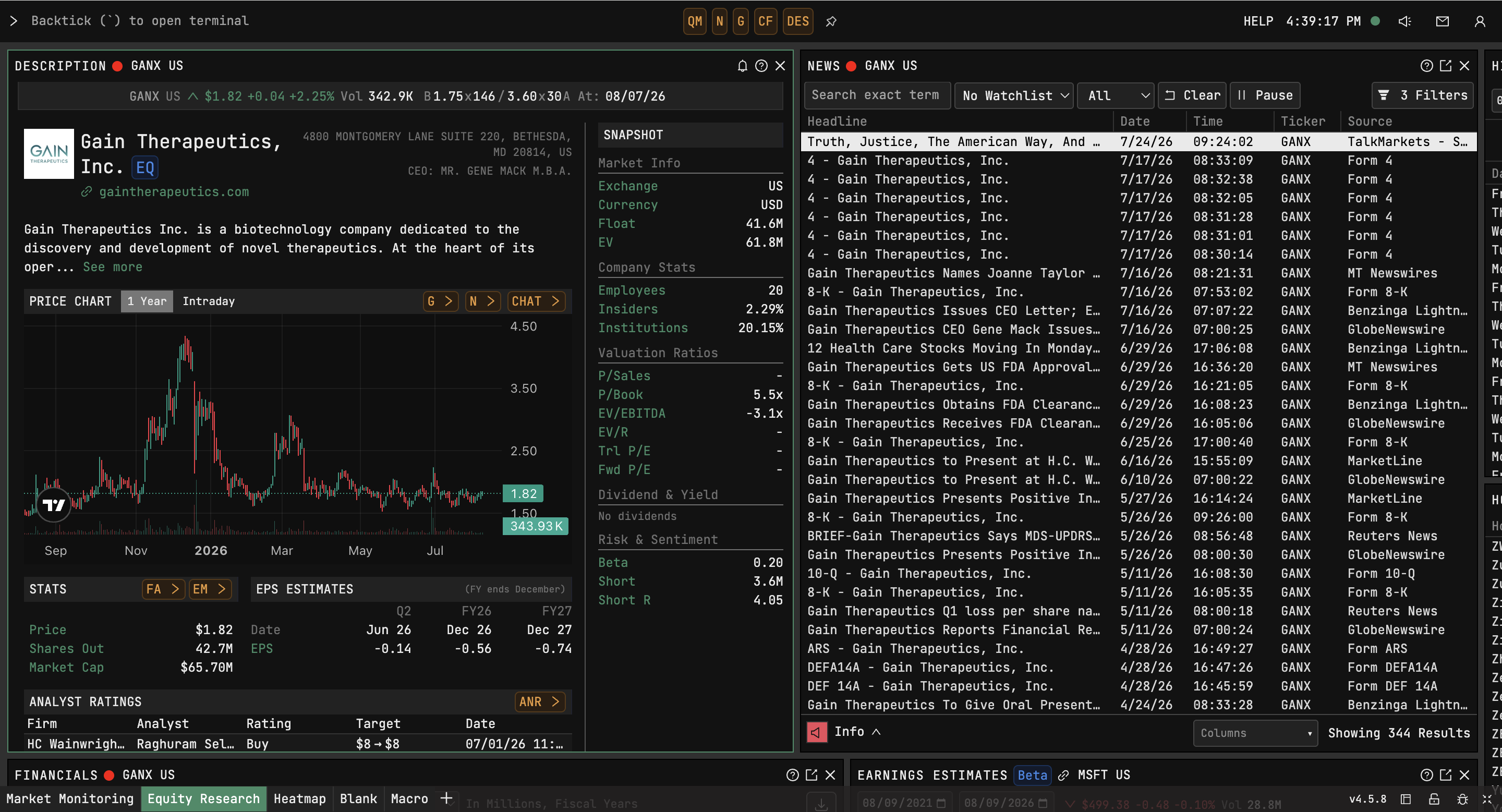
Disclosure: this is a referral link and mungbeans.io earns a commission if you subscribe, at no extra cost to you. The discount code is why it is here; the recommendation is because I pay for it myself. The site carries no advertising, and every paid link is listed on one page.
Get the work as it publishes
One list: weekly signal reports when stocks cross the line, and every deep dive as it goes up.
No spam. Unsubscribe anytime.
Not financial advice. This is an educational tool. Past performance does not guarantee future results. Do your own research before making investment decisions.