Berkshire's Hidden Menu: LILA vs. LAMR vs. DPZ
The Premise
Berkshire Hathaway’s portfolio gets analyzed to death — but the coverage is concentrated on Apple, Coca-Cola, Bank of America, and the other top-10 holdings that together represent over 80% of the equity portfolio. The tail end gets ignored.
That’s a mistake. Buffett (and now his successors) size positions based on conviction and opportunity cost. A small position can mean “we like it but it’s too small to matter at our scale,” or it can mean “this is early and we’re building.” Three holdings in the back half of the portfolio caught our attention for very different reasons:
Liberty Latin America (LILA) — $27 million position (0.01% of portfolio). A Caribbean and Latin American cable/telecom operator. Berkshire has held this since the 2015 Liberty Media restructuring and is sitting on a -77% loss. This is either a forgotten legacy position or a deliberate hold.
Lamar Advertising (LAMR) — $152 million position (<0.1% of portfolio). The largest outdoor advertising company in North America. Berkshire has been quietly adding shares. A REIT yielding 4.6% with the kind of toll-road economics Buffett loves.
Domino’s Pizza (DPZ) — $1.4 billion position (0.5% of portfolio, 20th largest). Berkshire’s fastest-growing recent conviction bet. They took a new position in Q3 2024, added 12%+ in Q4 2025, and now own nearly 10% of all outstanding shares. The stock has since fallen 34% from its highs.
Three very different businesses. Three very different risk profiles. Which one should you actually buy?
Round 1: What Do You Own?
LILA — Caribbean Telecom Infrastructure
Liberty Latin America provides cable television, broadband, and mobile services across 20+ countries in the Caribbean and Latin America. Its key markets are Panama (where it’s the dominant provider), Jamaica, Puerto Rico, Costa Rica, and Chile. Revenue: $4.4 billion. Market cap: $1.6 billion.
That market cap-to-revenue ratio — 0.36x — tells you the market has essentially no confidence in this business. LILA trades at a significant discount to its asset base, which is either a deep value opportunity or an accurate reflection of a business that can’t convert revenue into shareholder value.
LAMR — Outdoor Advertising Monopoly
Lamar Advertising owns and operates approximately 363,000 billboard displays across the United States, Canada, and Puerto Rico. It’s structured as a REIT. Revenue: $2.3 billion. Market cap: $14.2 billion.
This is the simplest business of the three. Lamar owns physical advertising space — billboards on highways, digital displays in cities, airport advertising — and rents it out. The product doesn’t change. The infrastructure depreciates slowly. The leases are long-term. And outdoor advertising is one of the few ad channels that hasn’t been disrupted by digital media — you can’t install an ad blocker on a highway.
DPZ — Global Pizza Franchise Machine
Domino’s Pizza operates the world’s largest pizza delivery company with 21,000+ stores across 90+ markets. Revenue: $5.0 billion. Market cap: $11.0 billion.
But here’s what makes Domino’s interesting: it’s not really a pizza company. It’s a technology-enabled franchise platform. Domino’s corporate owns very few stores — it collects royalties (5.5%+ of sales) and supply chain fees from franchisees. The capital-light model generates enormous returns on capital — return on assets north of 30% — while requiring almost no physical infrastructure. Total assets: $1.7 billion. For context, LILA has $12.2 billion in assets and generates less free cash flow.
Round 1 Summary:
| LILA | LAMR | DPZ | |
|---|---|---|---|
| What it is | Caribbean cable/telecom | U.S. billboard REIT | Global pizza franchise |
| Revenue | $4.4B | $2.3B | $5.0B |
| Market Cap | $1.6B | $14.2B | $11.0B |
| Price/Sales | 0.36x | 6.2x | 2.2x |
| Business model | Capital-intensive infrastructure | Toll-road ad space | Capital-light royalty platform |
Round 2: Can It Make Money?
Earnings Quality
| Metric | LILA | LAMR | DPZ |
|---|---|---|---|
| Operating Income | $720M | $698M | $950M |
| Net Income | -$611M | $587M | $602M |
| Operating CF | $806M | $864M | $792M |
| Free Cash Flow | $306M | $683M | $672M |
| FCF Yield | 13.0%* | 3.8% | 4.8% |
| OCF/Net Income | N/A (loss) | 1.47x | 1.32x |
| CapEx as % Revenue | 11.3% | 8.0% | 2.4% |
*LILA’s FCF yield looks deceptively attractive because the market cap is tiny relative to the cash flow. The problem is that the cash flow goes to servicing $8.4 billion in debt, not to shareholders.
LILA generates $806 million in operating cash flow — impressive in isolation — but then spends $500 million on capex (telecom infrastructure in hurricane-prone Caribbean markets isn’t optional maintenance) and $656 million on interest. After paying to keep the lights on and service the debt, there’s almost nothing left. Net income is negative $611 million. This company makes money operationally but drowns in its capital structure.
LAMR is a cash flow machine. $864 million in OCF on $2.3 billion in revenue — a 38% operating cash flow margin. CapEx is modest at $181 million (maintaining billboards isn’t expensive). The 1.47x cash conversion ratio means the company generates significantly more cash than GAAP earnings suggest. This is clean, predictable, and recurring.
DPZ generates $792 million in OCF with only $121 million in capex — a capital-light franchise model that converts nearly all of its operating cash to free cash. The 1.32x cash conversion is strong. Revenue grew 5% in FY2025 and 3.5% in the most recent quarter, with net store growth of 180 globally in Q1 2026. The franchise model means Domino’s doesn’t need to spend capital to grow — franchisees fund the store expansion.
Round 2 Winner: LAMR for raw cash generation quality, with DPZ close behind on capital efficiency. LILA is eliminated — it generates operating cash but can’t convert it to shareholder value.
Round 3: How Strong Is the Balance Sheet?
| Metric | LILA | LAMR | DPZ |
|---|---|---|---|
| Total Debt | $8.4B | $4.9B | $5.0B |
| Cash | $784M | $65M | $233M |
| Net Debt | $7.6B | $4.9B | $4.8B |
| Equity | $556M | $1.0B | -$3.9B |
| Debt/EBITDA | 9.3x | 4.5x | 4.8x |
| Interest Coverage (EBIT) | 1.1x | 4.4x | 4.8x |
| Interest Expense | $656M | $160M | $196M |
LILA is in financial distress. Debt-to-EBITDA of 9.3x is critical-level leverage. Interest coverage of 1.1x means the company earns barely enough operating income to cover its interest payments. The Puerto Rico subsidiary (LPR) has net leverage of nearly 8x and covenant leverage of 14x — the creditors haven’t responded to management’s liability restructuring proposal. 75% of the consolidated debt matures in 2031 or later, which buys time, but the interest burden alone ($656M/year) consumes 81% of operating cash flow. This is a balance sheet in crisis.
LAMR carries manageable leverage at 3x net debt-to-EBITDA — management describes this as “one of the lowest leverage levels in its history” and estimates $1 billion+ in investment capacity within its targets. The debt supports a REIT that distributes most of its cash flow to shareholders. This is structural leverage, not crisis leverage.
DPZ has negative equity (-$3.9 billion) because it has deliberately leveraged its balance sheet through buybacks, returning far more cash to shareholders than the business has ever earned in cumulative profits. This sounds alarming but is actually a feature of the franchise model: Domino’s doesn’t need equity because it doesn’t need assets. The business generates cash from royalties and supply chain fees, not from owning physical infrastructure. At 4.8x Debt/EBITDA and 4.8x interest coverage, the leverage is elevated but well-serviced by the cash flows.
Round 3 Winner: LAMR. Conservative leverage with capacity for growth. DPZ’s negative equity is a deliberate capital structure choice, not distress — it’s fine for investors who understand the model. LILA’s balance sheet is genuinely dangerous.
Round 4: What’s the Moat?
LILA — Incumbent Telecom in Small Markets
LILA’s competitive advantage is being the dominant (often only) broadband provider in small Caribbean and Central American markets. In Panama, Jamaica, and several island nations, LILA’s infrastructure is the internet backbone. You can’t easily build a competing fiber or cable network on a Caribbean island — the market is too small to support two providers.
The problem is that this moat protects a business that earns terrible returns. Regulatory pressure keeps pricing low. Currency volatility (virtually all revenue is in local currencies, debt is in USD) creates constant FX headwinds. Hurricane exposure is structural — Hurricane Melissa in 2025 caused $100 million in costs, and this is a recurring risk, not a one-time event.
LILA’s moat is real but narrow. It’s the kind of moat that prevents the business from dying, not the kind that generates excess returns.
LAMR — Physical Space You Can’t Replicate
Lamar owns permit rights and physical billboard structures in 155+ U.S. markets, many of which were grandfathered under zoning laws that now prohibit new billboard construction. You literally cannot build competing inventory in most of Lamar’s key locations — the permits don’t exist anymore.
This is one of the most durable moats in American business. The Highway Beautification Act of 1965 and subsequent state regulations created a regulatory barrier that grows stronger every year as more jurisdictions restrict new outdoor advertising. Lamar’s existing assets become more valuable over time simply because the supply of billboard locations is permanently constrained.
Digital conversion is the growth lever: Lamar operates 5,400+ digital billboard faces, which generate approximately 3x the revenue of static boards on the same structure. Digital boards now represent 31% of total billboard revenue and are growing 5% year-over-year. Each static-to-digital conversion is a one-time capex investment that permanently increases the revenue capacity of a fixed, irreplaceable asset.
DPZ — Franchise Network Effects + Technology Platform
Domino’s moat has multiple layers. The franchise network itself is a moat — 21,000+ locations with a “fortressing” strategy that increases delivery density and reduces delivery times. The technology platform (ordering app, logistics optimization, delivery tracking) is a moat — Domino’s spends more on tech than most pizza companies spend on ingredients. The supply chain (vertically integrated dough manufacturing and distribution) is a moat — franchisees buy from Domino’s because it’s cheaper and more consistent than alternatives.
The franchise ROIC for Domino’s operators is attractive enough that new franchisees continue entering the system globally. Net store growth of 800-1,000 per year (pre-2026 slowdown) demonstrates that the unit economics work. When your franchisees make money, they open more stores.
Round 4 Winner: Tie between LAMR and DPZ. Both have exceptional, multi-layered moats. LAMR’s is more static (it just exists — supply is permanently constrained). DPZ’s is more dynamic (it grows through network effects and technology investment). LILA’s moat exists but doesn’t generate attractive returns.
Round 5: Valuation — What Are You Paying?
| Metric | LILA | LAMR | DPZ |
|---|---|---|---|
| Trailing PE | N/A (loss) | 24.3x | 19.5x |
| Forward PE | 11.0x | 22.9x | 15.7x |
| EV/EBITDA | 9.0x | 18.5x | 15.6x |
| FCF Yield | 13.0%* | 3.8% | 4.8% |
| Dividend Yield | 0% | 4.6% | 2.4% |
| Price/Book | 2.8x | 14.0x | N/A (neg equity) |
| vs. 200WMA | +2.6% | +35.9% | -16.6% |
*LILA’s FCF yield is to equity holders who sit behind $8.4B in debt — the enterprise-level picture is far less attractive.
LILA at 11x forward PE looks cheap, but the forward PE assumes the company turns profitable — which requires the Puerto Rico restructuring to succeed, the hurricane costs to normalize, and FX headwinds to abate. If any of those fail, the “E” in the PE ratio doesn’t materialize.
LAMR at 23x forward PE is not cheap by any traditional measure. But LAMR is a REIT — the relevant metric is FFO (funds from operations), not earnings. At ~16x forward FFO, LAMR is reasonably valued for a monopoly-like REIT with 8% FFO growth. The 4.6% dividend yield is the highest among the three and is well-covered. The stock is 36% above its 200WMA — this is not a distressed opportunity.
DPZ at 15.7x forward PE is the cheapest it’s been since before the pandemic. The stock is 16.6% below its 200WMA — the only one of the three currently below the line. DPZ traded at 25-35x forward PE from 2019-2024. The compression to 16x reflects the Q1 2026 earnings miss ($4.13 vs. $4.31 consensus), the lowered comp guidance (from mid-single-digit to low-single-digit), and broader macro anxiety about consumer spending.
At 16x forward earnings, the market is pricing Domino’s as a low-growth, ex-growth business. But Domino’s is still opening 700+ new stores per year globally, still growing revenue, and still generating 30%+ returns on assets. This is a temporary narrative discount on a structurally advantaged business.
Round 5 Winner: DPZ. Not because it’s the “cheapest” (LILA is, on paper), but because it offers the best price relative to business quality. A franchise platform generating 30%+ ROA at 16x forward earnings is a rare setup. LAMR is fairly valued — a fine hold, but you’re not getting a discount. LILA is cheap for a reason.
Round 6: What Does Berkshire’s Sizing Tell You?
Position sizing is information. Berkshire’s allocation across these three stocks tells a story:
LILA ($27M, 0.01% of portfolio): This is a legacy position from the Liberty Media restructuring, not an active bet. Berkshire is down 77% on the position. At $27 million, it’s not even worth the administrative effort of selling for a portfolio measured in hundreds of billions. The position tells you nothing about current conviction — it’s a historical artifact.
LAMR ($152M, <0.1%): Small but growing. Berkshire has been adding incrementally. At this size, it’s likely a Todd Combs or Ted Weschler pick rather than a Buffett conviction bet. The adds are directionally positive — someone at Berkshire likes the business enough to keep buying — but the position size says “interested, not convicted.”
DPZ ($1.4B, 0.5%, 20th largest): This is an active, growing conviction bet. Berkshire took a new position in Q3 2024, added substantially, and now owns 9.91% of all outstanding shares. At $1.4 billion, this is meaningful even by Berkshire standards. The continued buying through Q4 2025 — at prices well above where the stock sits today — tells you Berkshire sees value at higher prices than the current $330.
The sizing is unambiguous. Berkshire is most convicted in DPZ, mildly interested in LAMR, and simply hasn’t gotten around to cleaning up LILA.
Round 7: The Risk You’re Taking
LILA’s Risks
The list is long: $8.4 billion in debt with 1.1x interest coverage, a Puerto Rico subsidiary that may need to restructure (creditors aren’t responding to management’s proposal), recurring hurricane exposure ($100M+ per event), currency risk (USD debt, local currency revenue), a -$611M annual net loss, and no dividend. The stock has lost 77% of Berkshire’s investment. The risk here isn’t a temporary drawdown — it’s permanent capital impairment in a business that can’t earn its way out of its capital structure.
LAMR’s Risks
Modest: a recession could reduce ad spending 10-15% (outdoor advertising held up better than digital in 2008-2009 but still declined), rising interest rates increase the cost of REIT financing, and there’s always the long-tail risk that autonomous vehicles or changes in commuting patterns reduce billboard impressions. The stock is also 36% above its 200WMA — you’re buying near a high, not a dislocation. The 10.4% short interest as a percentage of float is elevated for a REIT, suggesting some informed bearish activity.
DPZ’s Risks
The near-term risk is real: management just lowered same-store-sales guidance to “positive low single digits,” citing macro and geopolitical pressure. Q1 earnings missed by $0.18. International same-store sales declined 0.4%. If consumer spending weakens further, comps could go negative and the stock could fall another 10-15% before stabilizing.
The longer-term risk is more existential: food delivery aggregators (DoorDash, Uber Eats) have reduced Domino’s historic delivery advantage, and the “aggregator tax” (15-30% commission on orders placed through third-party apps) threatens margins for franchisees who participate. Domino’s has largely avoided aggregator platforms, which protects margins but limits discoverability.
The balance sheet — negative $3.9 billion in equity, $5 billion in debt — means DPZ has no balance sheet cushion if cash flows deteriorate significantly. But this is by design, and the franchise model’s stability makes it defensible. Domino’s has increased its dividend 15% and continued buybacks through the downturn, signaling management confidence.
The Verdict
This isn’t close.
LILA is a pass. The business generates operating cash flow but can’t convert it to shareholder value because the capital structure consumes everything. Interest coverage of 1.1x is a single bad quarter away from covenant violations. The Puerto Rico subsidiary is in a de facto restructuring. Berkshire’s position is a $27 million legacy stub, not a vote of confidence. There is a world where LILA’s debt gets restructured, the currency headwinds abate, and the stock triples — but the risk of permanent capital loss is too high for us to call it undervalued with any conviction. Cheap stocks with 830% debt-to-equity ratios are cheap for a reason.
LAMR is a hold. It’s a wonderful business — one of the best moats in the real estate sector, growing FFO, 4.6% dividend yield, conservative leverage, and a secular tailwind from digital billboard conversion. If you own it, keep it. But at 36% above the 200WMA and 23x forward PE, you’re paying full price for quality. Our framework is built for identifying dislocations, and LAMR isn’t dislocated — it’s valued correctly. Wait for a pullback.
DPZ is the buy. A franchise platform generating 30%+ returns on assets, growing store count by 700+ per year, trading at 15.7x forward earnings — its cheapest multiple in five years — and 16.6% below its 200-week moving average. Berkshire owns 10% of the company and was adding shares at significantly higher prices. Management just raised the dividend 15%.
The near-term setup is uncomfortable: missed earnings, lowered guidance, macro uncertainty. That’s why the stock is down 34% from its high and available at 16x. The question is whether “positive low single-digit” comp growth is the new normal or a temporary trough. We think it’s a trough. Domino’s has navigated worse — COVID, the 2022 inflation spike, the “pizza turnaround” of 2009 — and emerged stronger each time because the franchise model is self-correcting: when demand softens, weak franchisees close, strong franchisees absorb the volume, and unit economics improve.
The 200WMA signal adds weight. DPZ has no crossing history in our S&P 500 dataset (it was added to the index relatively recently), so we can’t run the full rare-crosser analysis. But a stock falling 16.6% below its 200WMA with a 30%+ ROA and a 4.8% FCF yield is exactly the kind of dislocation our framework is designed to identify.
Our pick: DPZ. Buy the pizza. Wait for the delivery.
What We’re Watching
DPZ: Q2 2026 comps (due July). If same-store sales return to mid-single-digit growth, the stock rerates quickly. If they go negative, the correction deepens but the thesis doesn’t break — it just gets cheaper.
LAMR: Any pullback toward the 200WMA ($103) would change our verdict from “hold” to “buy.” At a 4.6% yield with 8% FFO growth, LAMR at 15-18x forward FFO would be compelling.
LILA: The Puerto Rico restructuring outcome. If creditors agree to a liability management deal, the equity could double. If they don’t, LPR may need to raise dilutive capital or file. This is a binary bet we’re not willing to make.
This analysis uses data available as of May 2, 2026. This is not financial advice. Always do your own research before making investment decisions. The author may take a position in securities discussed.
View these stocks on the mungbeans.io screener: DPZ · LAMR · LILA
Godel Terminal
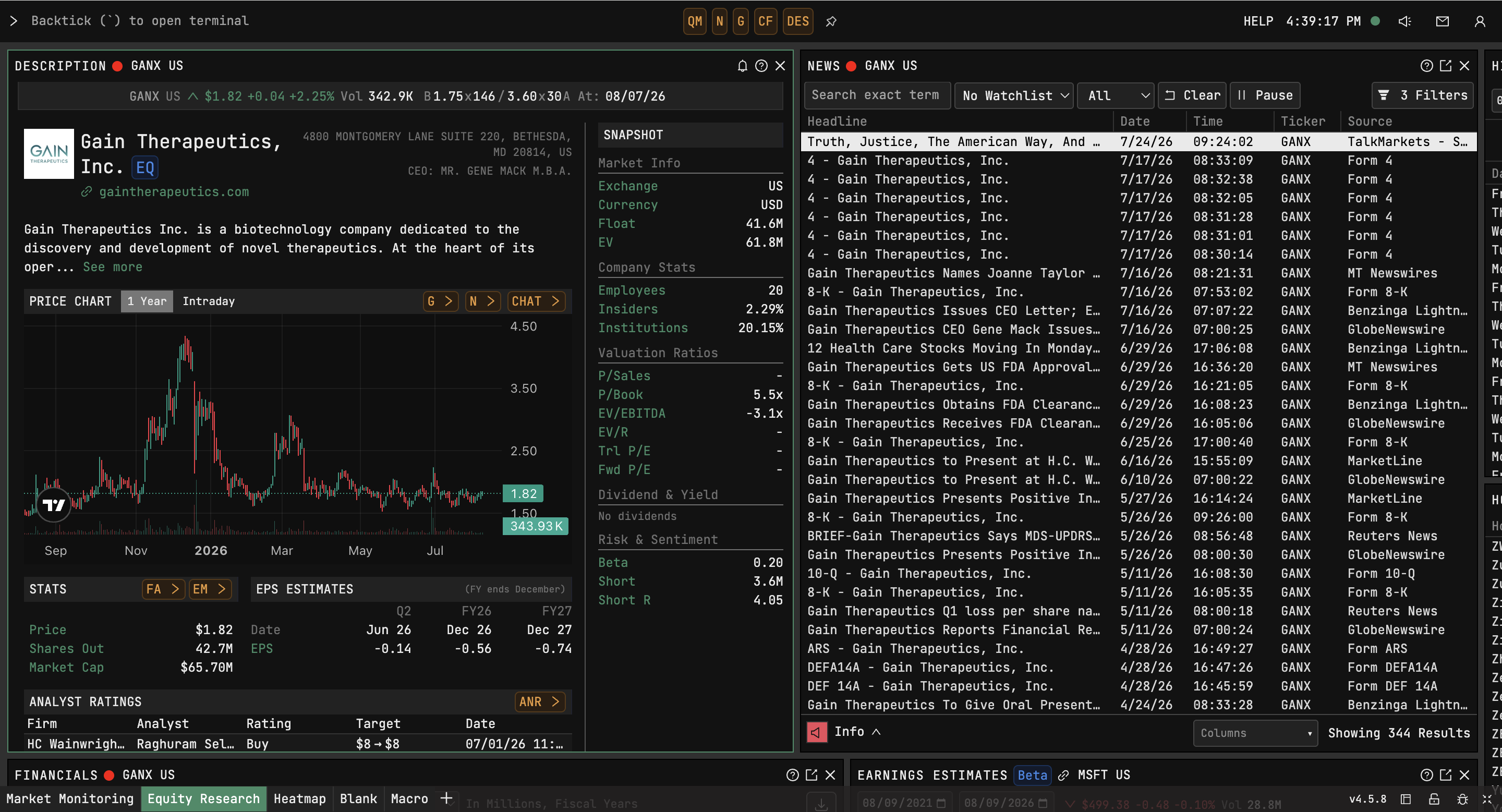
A browser-based research terminal with a Bloomberg-style command interface: DES, FOCUS, TAS, HDS. Real-time quotes, filings, financials, ownership and news, at $996 a year against Bloomberg's roughly $27,000.
I use it for the filing and ownership work behind the deep dives, the part that used to mean six browser tabs and a spreadsheet. It handles research and analysis; order execution and dealer chat are not in it, so it sits alongside a broker rather than replacing one. There is a 14-day trial, so the cheapest way to judge it is to run it against whatever you use now.
Disclosure: this is a referral link and mungbeans.io earns a commission if you subscribe, at no extra cost to you. The discount code is why it is here; the recommendation is because I pay for it myself. The site carries no advertising, and every paid link is listed on one page.
Get the work as it publishes
One list: weekly signal reports when stocks cross the line, and every deep dive as it goes up.
No spam. Unsubscribe anytime.
Not financial advice. This is an educational tool. Past performance does not guarantee future results. Do your own research before making investment decisions.