Deep Dives
Forensic analysis of stocks flagged by our 200-week moving average screener. Each deep dive runs the five-layer value trap screening framework to determine whether a stock is genuinely undervalued or cheap for a reason.
Get the work as it publishes
One list: weekly signal reports when stocks cross the line, and every deep dive as it goes up.
No spam. Unsubscribe anytime.
Godel Terminal
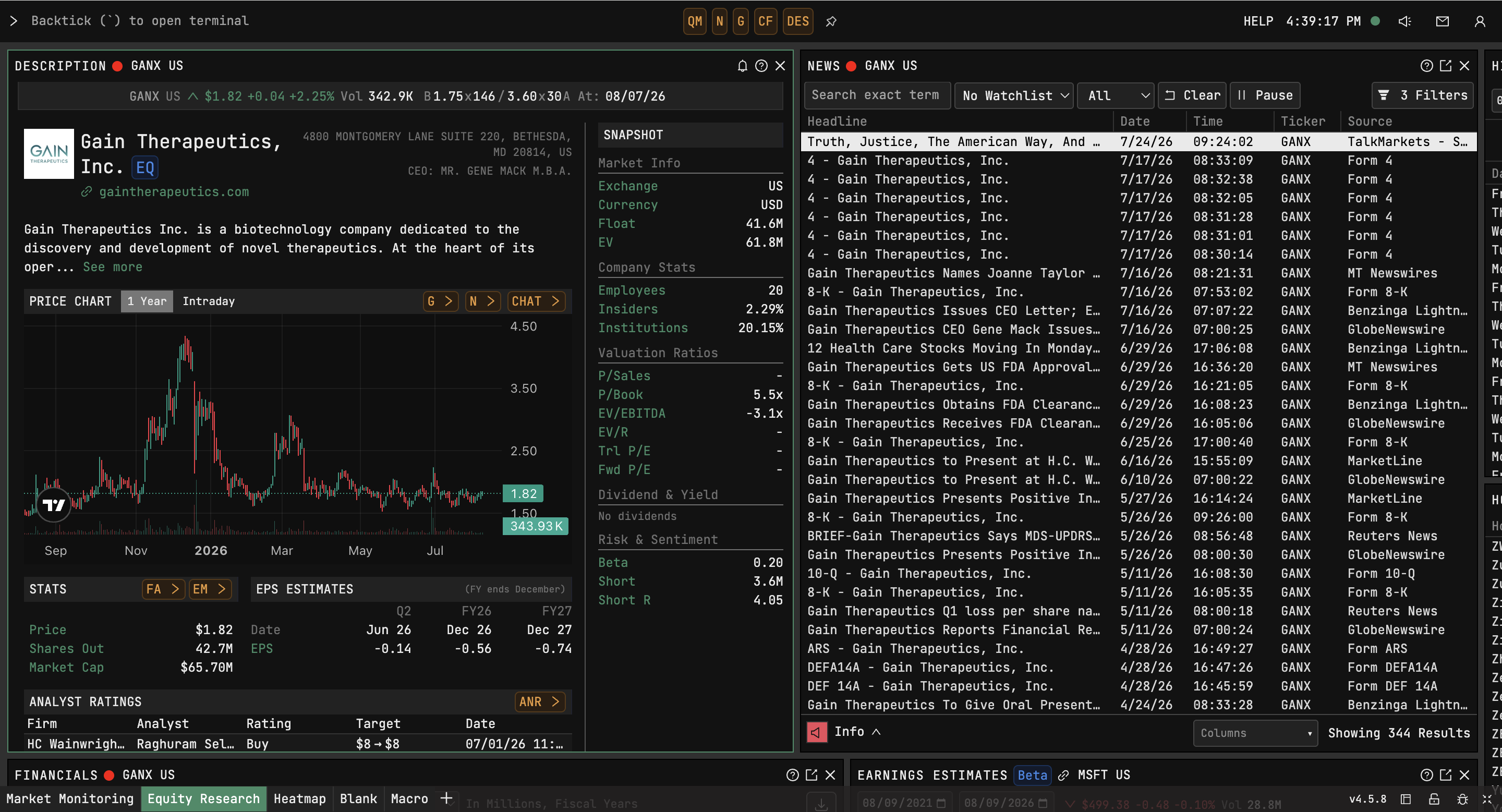
A browser-based research terminal with a Bloomberg-style command interface: DES, FOCUS, TAS, HDS. Real-time quotes, filings, financials, ownership and news, at $996 a year against Bloomberg's roughly $27,000.
I use it for the filing and ownership work behind the deep dives, the part that used to mean six browser tabs and a spreadsheet. It handles research and analysis; order execution and dealer chat are not in it, so it sits alongside a broker rather than replacing one. There is a 14-day trial, so the cheapest way to judge it is to run it against whatever you use now.
Disclosure: this is a referral link and mungbeans.io earns a commission if you subscribe, at no extra cost to you. The discount code is why it is here; the recommendation is because I pay for it myself. The site carries no advertising, and every paid link is listed on one page.
GENI Q2 Review: What the Screener Found, and What the Business Proved
Eight of nine calls from the June thesis landed inside six weeks. Q2 beat on revenue and margin, Legend backs out to ~$274M annualized, and both Polymarket and Kalshi signed before the print. The 200-week line found the question; the business answered it. Revised target $15.41 on 311M fully diluted shares, with GAAP positivity as the gate.
Genius Sports (GENI): The Operating System of Modern Sport
GENI has assembled the only platform that owns sports data at the camera, owns the fan at the destination, and sits between both and the advertiser. Revenue is compounding at 30%+. Margins are expanding 500bps in a single transaction. The market has it down 45% in 2026. I go line by line through the business to understand why.
The Golden Screen: 5 Stocks Where Every Signal Says Buy
I ran every variable in the mungbeans screener at once — below the 200WMA, positive Bean Score, growing FCF, cannibal buybacks, profitability, insider buying — and found 5 stocks where nothing is flashing red. This is a live test of whether the screener works as a combined signal.
The Anthropic Revaluation: Who's Sitting on Hidden Value at $1 Trillion?
Anthropic hit $1 trillion on secondary markets after a 233% revenue surge. I look at which public companies hold Anthropic stakes and whether the market has priced in what those positions are now worth. SK Telecom, Zoom, Salesforce, Alphabet, and Amazon all have exposure. The math is most interesting where you'd least expect it.
Everspin (MRAM) vs NVE Corp (NVEC): The Spintronics Thesis
MRAM sits at the intersection of AI data center demand, NOR Flash displacement, and edge AI inference. I dig into the physics, the three MRAM generations (Toggle → STT → SOT), five market vectors, and why this niche memory technology could become infrastructure. Everspin is the pure-play manufacturer with a $40M defense contract, IBM hyperscaler pipeline, and 128/256Mb density ramp. NVE is Buffett Quality with 79% gross margins but 3% growth. Both are overbought. When does the growth narrative become a value stock?
BlackBerry (BB) vs Semtech (SMTC): Two IoT Growth Plays, Two Very Different Profiles
BlackBerry is finally profitable with QNX embedded in 275M vehicles and $100M cash flow guidance. Semtech's LoRa connects 178M devices while AI data center revenue grew 58%. Both are above the line and expensive on the Bean Score. I run the growth framework on two IoT infrastructure plays.
Alphabet (GOOGL): Berkshire's Bet on the AI Era
Berkshire tripled its Alphabet stake in Q1 2026. Revenue is growing 22%, Cloud is up 63%, and the company is a Buffett Quality cannibal. But the Bean Score says expensive at -1.85σ, FCF yield has collapsed from 5.1% to 0.6%, and $185B in annual capex is consuming the cash machine. We run the full framework on Google.
Introducing the Micro Cap Screener — and Why Compugen (CGEN) Is Our First Deep Dive
The 200-week moving average works for large caps. Micro caps are a different animal entirely. We built a new screener from scratch, and Compugen is the first stock that made us stop and look twice.
UiPath (PATH): Deep Value or Value Trap?
UiPath has fallen 87% from its IPO-year highs while reaching GAAP profitability for the first time. The RPA pioneer is pivoting to agentic AI orchestration, and the stock trades at 14x forward earnings with zero debt and $1.7 billion in cash. We run the framework.
Celsius Holdings (CELH): Deep Value or Value Trap?
Celsius has fallen 65% from its peak while growing revenue 86%. The Pepsi destocking is over, Alani Nu is integrated, and the stock trades at 16x forward earnings. We run the framework on the most polarizing name in energy drinks.
Berkshire's Hidden Menu: LILA vs. LAMR vs. DPZ
Three Berkshire holdings most people couldn't name. A Caribbean telecom drowning in debt, a billboard company printing cash, and Buffett's favorite pizza chain at a 34% discount. We run all three through the framework and pick a winner.
Fidelity National Information Services (FIS): Deep Value or Value Trap?
FIS is 26% below its 200-week moving average and trading at 7x forward earnings — the cheapest it's been since the Worldpay meltdown. But this is a different company than it was in 2022.
Below the Line: What 3,370 Crossings Tell Us About Free Cash Flow and the 200-Week Moving Average
We backtested every S&P 500 stock that crossed below its 200-week moving average over 15 years and asked: does positive free cash flow predict better outcomes? The answer is more complicated — and more useful — than we expected.
The Uranium Supercycle: Who Wins, Who Gets Squeezed, and Where the Framework Finds an Edge
Uranium is in a structural supply deficit with no quick fix. Every miner is 90%+ above the 200WMA. Utilities burn through fuel contracts they can't afford to replace. We model what happens to utility earnings at $200, $300, and $500/lb uranium, and identify the only nuclear names where the framework has a signal.
Sesame Seed Trades: The Butterfly Effects of the Strait of Hormuz
The Strait of Hormuz closure doesn't just affect oil. It cascades into helium, fertilizer, nuclear energy, maritime insurance, petrochemicals, and shipping routes. We map the second and third-order effects and identify where the mungbeans framework finds actual value in the chaos.
What to Do With Your Cash When the World Is on Fire
The Strait of Hormuz is closed. Oil just broke $100. Japan and Korea are in freefall. Inflation is re-accelerating. What does the mungbeans.io 200-week framework say about investing during geopolitical crises — and what should you actually be doing with your cash right now?
Stock Faceoff: S&P Global (SPGI) vs. Nasdaq (NDAQ)
Two dominant financial data companies. One just crossed below its 200-week moving average, the other sits 28% above it. Which is the better investment right now?
Stock Faceoff: Lululemon (LULU) vs. Abercrombie & Fitch (ANF)
Two premium apparel retailers at dramatically different positions relative to their 200-week moving averages. Lululemon has cratered 50% below the line. Abercrombie is sitting right on it. Which is the better buy?
Stock Faceoff: Iridium (IRDM) vs. EchoStar (SATS)
Two satellite companies, two completely different stories. Iridium sits 29% below its 200-week moving average with strong free cash flow. EchoStar is 260% above it, running on spectrum sales and restructuring momentum. Which is the better investment?
Stock Faceoff: Disney (DIS) vs. AppFolio (APPF)
Two completely different businesses just crossed below their 200-week moving averages. One is a $176 billion entertainment empire, the other a $6 billion property management software company. Which new crosser is the better buy?
StealthGas (GASS): Deep Value or Value Trap?
A forensic value analysis of StealthGas, the world's largest owner of small pressurized LPG carriers, trading at 44% of book value with zero debt. We apply our five-layer screening framework to a shipping company that looks almost too cheap to be real.
The Trade Desk (TTD): Deep Value or Value Trap?
A forensic value analysis of The Trade Desk after a 78% collapse from its highs. We apply our five-layer screening framework to determine whether the leading independent demand-side platform is a broken stock or a broken business.
Nike (NKE): Deep Value or Value Trap?
A forensic value analysis of Nike after four consecutive years of stock declines. Tariffs, China weakness, and rising competition from Hoka and On have crushed the stock — but insiders are buying heavily. We apply our five-layer screening framework.
Sirius XM (SIRI): Deep Value or Value Trap?
Berkshire Hathaway owns 37% and keeps buying. A forensic analysis of Sirius XM at $21.68 — 39% below its 200-week moving average.
PayPal (PYPL): Deep Value or Value Trap?
A forensic value analysis of PayPal at its lowest valuation in history. We run it through our five-layer screening framework to determine if this is a generational buying opportunity or a melting ice cube.